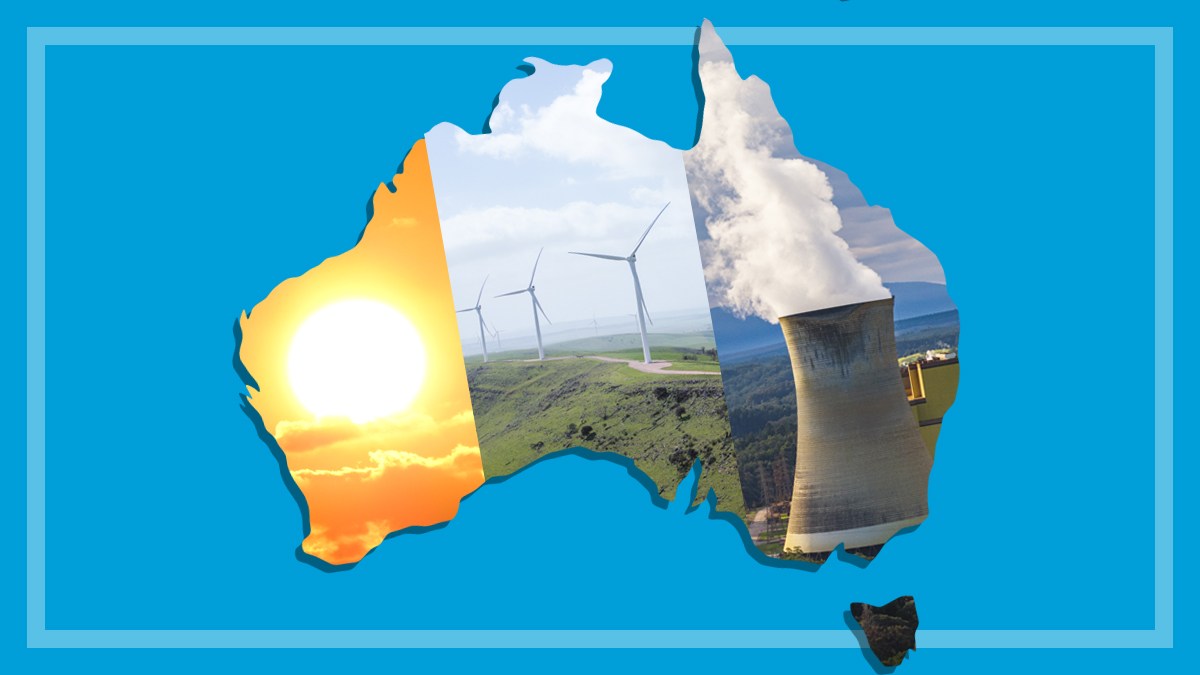
While the federal government drives national energy policy, states and territories play a key role in offering the energy-saving incentives that can really help households
The ACT, Victoria, NSW and SA are leading the way in enabling our national quest for net-zero emissions, while the rest of the country lags behind
We offer a state-by-state breakdown of some household energy-saving progams you may not know about
It stands to reason that the federal government would be taking a leading role in setting energy policy as Australia steers a course toward achieving net zero emissions by 2035.
The Commonwealth’s Cheaper Home Battery Program, for instance, has proven hugely popular and is poised to deliver a major boost to the country’s ongoing shift to renewable energy. (Net zero means that we, as a nation, take as much carbon out of the atmosphere as we put into it.)
But it’s actually the states and territories that have their hands on the smaller, more localised levers that can most affect individual households. These jurisdictions can set policies geared toward their constituents that help reduce energy bills, improve energy efficiency and accelerate the transition to full electrification.
The states and territories that have their hands on the smaller, more localised levers that can most affect individual households
They play a pivotal role, but a new national scorecard from the Energy Efficiency Council (ECC) reveals that some states and territories are doing a significantly better job than others. (The ECC is a not-for-profit membership organisation made up of corporations, energy companies, governments and other businesses.)
“The EEC has run the ruler over the policies that Australia’s states and territories have in place to help households cut their energy bills,” says ECC CEO Luke Menzel.
The research was funded through a grant program managed by Energy Consumers Australia (ECA). ECA manager for consumer advocacy Justin Whelan says the scorecard “shows where governments across Australia can supercharge electrification and energy efficiency policies to deliver financial, health and environmental benefits for all households and small businesses”.
The scorecard reveals a mixed picture. Progress has been made toward Australia taking its place as a world leader in emissions reduction and energy efficiency, but big gaps remain. Somewhere around 70% of Australia’s 11 million homes, for instance, were built before minimum energy standards were introduced.
The EEC has run the ruler over the policies that Australia’s states and territories have in place to help households cut their energy bills
ECC CEO Luke Menzel
Meanwhile, going from a three-star to a five-star efficiency rating can cut cooling and heating needs by around 40%. And switching to electrical appliances and vehicles along with upgrading household energy efficiency can mean savings of up to $2025 a year per household, according to ECA research.
(A recent report from ECA delivers good news in this area. In a survey of 500 landlords in NSW, three-quarters either supported or didn’t oppose minimum standards. As it stands, 70% of renters across Australia avoid using heating or cooling because of the cost.)
The EEC scorecard is based on three key areas of energy performance: electrification, energy efficiency and demand flexibility (where households are given control over how much electricity they use and when they use it, in effort to reduce pressure on the energy grid and lower usage and costs).
The ACT comes in first place for having the best overall energy policy settings, which include a range of incentives for households to improve energy efficiency along with supporting regulations. The nation’s capital is followed by Victoria and NSW, which have the second and third best overall energy policies, respectively.
Victoria is leading the way in measures to phase out gas appliances and increase electrification, while NSW and South Australia have the best policies to support demand flexibility.
South Australia, Western Australia and NSW offer incentives to join Virtual Power Plants, which present an opportunity to access discounts and generate household income under several different scenarios.
Text-only accessible version
State or territory
Overall Rank (from best to worst)
Energy efficiency rating (higher number = better rating)
Electrification rating
Demand flexibility rating
ACT
1
7
7
3
Victoria
2
7
8
5
NSW
3
6
5
6
South Australia
4
4
3
6
Western Australia
5
3
3
5
Tasmania
6
6
2
3
Queensland
7
2
1
3
Northern Territory
8
1
1
3
Which jurisdictions are falling behind?
Tasmania, Queensland and the Northern Territory lack both financial incentives and regulatory measures to support household energy efficiency and are trailing far behind in the collective effort to achieve net zero.
“No jurisdiction is perfect – there is room for improvement across the board. But these findings show there is an urgent need for some states to step up their efforts in supporting households to respond to the cost-of-living crisis,” says Menzel.
The failings underscore what needs to be done to get these states and territories on track.
Tasmania has no rebate program to incentivise owners to insulate their properties, and it lacks a mandatory home-energy rating and disclosure scheme. It also lacks substantive minimum rental energy-efficiency standards.
These findings show there is an urgent need for some states to step up their efforts in supporting households to respond to the cost-of-living crisis
ECC CEO Luke Menzel
Queensland has no financial incentive program to encourage homes and businesses to phase out gas and embrace full electrification, and it has no electrification standards for renters. It also lacks incentives for consumers to join VPPs or adopt technologies that support demand flexibility.
The Northern Territory similarly lacks an energy-efficiency incentive program, and the government provides no substantial information to consumers about the financial and environmental benefits of going electric. Any government-led phase out of gas appliances has yet to begin. The state also lacks a flexible-demand strategy or measurable targets for the uptake of flexible demand technologies such as solar energy systems.
“We developed a robust methodology, gathered the evidence, and rated each and every jurisdiction for their energy efficiency, electrification and energy flexibility policies and programs,” Menzel says.
“The ACT, Victoria and NSW have topped the league table, South Australia is somewhere in the middle, and WA, Queensland and Tasmania right down the bottom.”
Andy Kollmorgen is the Investigations Editor at CHOICE. He reports on a wide range of issues in the consumer marketplace, with a focus on financial harm to vulnerable people at the hands of corporations and businesses. Prior to CHOICE, Andy worked at the Australian Securities and Investments Commission (ASIC) and at the Australian Financial Review along with a number of other news organisations. Andy is a former member of the NSW Fair Trading Advisory Council. He has a Bachelor of Arts in English from New York University. LinkedIn
Andy Kollmorgen is the Investigations Editor at CHOICE. He reports on a wide range of issues in the consumer marketplace, with a focus on financial harm to vulnerable people at the hands of corporations and businesses. Prior to CHOICE, Andy worked at the Australian Securities and Investments Commission (ASIC) and at the Australian Financial Review along with a number of other news organisations. Andy is a former member of the NSW Fair Trading Advisory Council. He has a Bachelor of Arts in English from New York University. LinkedIn
For more than 60 years, CHOICE has been fighting the good fight for Australian consumers.
In the past year alone we've uncovered systemic issues with sunscreens, investigated shonky supermarket pricing, fought for stronger scam protections and helped make complex energy pricing fairer and clearer.
CHOICE is here to provide unbiased advice and independent testing in our world-class labs. We buy the products we test, just like you do, and our expert reviews are influence free. We’re here to help you choose smarter. Hopefully you’ll also save some money along the way.
Thanks to CHOICE, you’ll never be alone when a business treats you unfairly. You can support our work by joining or donating to our cause.