
The Shonky Award for gaming a broken system.
Australians shopping for a washing machine, dryer or washer-dryer combo are encouraged to rely on the familiar Energy Rating Labels for information about the appliance’s energy use.
It’s supposed to be simple – more stars mean a more-efficient appliance that’s cheaper to run, right?
Well, only if you use the exact program the rating was based on. And you may not have time for that.
When a washer-dryer takes 13.5 hours to run the drying program that led to its impressive 8-star energy rating, we think it’s time to ask: are the Energy Rating Labels on laundry appliances still useful to consumers?
How appliances get their rating
Many people may not be aware that the Energy Rating Label is based on a specific wash or dry program nominated by the manufacturer for the efficiency test.
This program isn’t necessarily one that households would commonly use, but rather one that produces the best energy-efficiency outcome for the manufacturer.
The Energy Rating Label is based on a specific wash or dry program nominated by the manufacturer … This program isn’t necessarily one that households would commonly use
Australia’s Greenhouse and Energy Minimum Standards (GEMS) framework requires washing machines, dryers and other whitegoods to be tested according to the Australian/New Zealand standards. However, the program used for that test is not prescribed; it’s nominated by the manufacturer.
That leaves the way open to use the gentlest and most economical settings a machine offers to minimise electricity and water consumption during testing, generally at the expense of shorter – or even just reasonable – cycle times.
The washer-dryer that’ll leave you waiting… and waiting
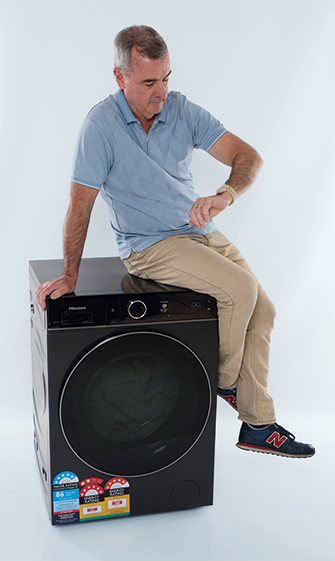
A perfect example of this is the Hisense Series 8i Heat Pump Washer Dryer Combo, tested in the CHOICE labs this year.
Marketed as being “super energy-efficient” with an 8-star energy rating for drying, this machine at a glance would be impressive to anyone looking for an energy-efficient product for a large household.
But what they may not realise is that Hisense only achieves this 8-star rating on the machine’s Eco drying setting. And that setting takes 811 minutes, or 13.5 hours, to dry a full 8kg load.
While this machine is technically energy-efficient when run on its Eco setting, who is going to wait so long for a load of laundry to dry?
And we don’t think you’ll save time by drying a smaller load, either. We used the Eco setting on a 3.5kg load and it took around the same time as the full 8kg load of laundry!
While this machine is technically energy-efficient when run on its Eco setting, who is going to wait so long for a load of laundry to dry?
So then we tried drying the larger 8kg load using the machine’s default program. That took 8 hours and 45 minutes – still a very long time – and, what’s more, the laundry was still very damp at the end.
The only test that gave us a time and drying result we think people would be happy with was a 3.5kg load using the regular drying program, which took about 3 hours.
Run both Energy Rating Label programs back-to-back and you’re looking at over 25 hours of laundry
It’s not just the drying that’s a problem. The same machine’s 5-star energy rating as a washing machine was earned on a 728-minute-long program – that’s more than 12 hours. Run both Energy Rating Label programs back-to-back and you’re looking at over 25 hours of laundry.
In short, if you’re buying this large-capacity washer-dryer because you’re hoping to turn over full loads of laundry in a reasonable time while minimising energy use, you’re barking up the wrong appliance.
Stars, they’re not like us
While this is the furthest our testers have seen a manufacturer take it, other brands also nominate programs that are impractical in the real world in order to achieve desirable star ratings.
“To be fair to Hisense, there is real engineering here,” says CHOICE whitegoods expert Denis Gallagher.
“Fitting a heat pump dryer into a standard-size machine is a genuine achievement, and the machine’s water use is excellent – under a litre to dry a load on the setting that earned the label.
“Hisense has also broken no rules. The program it nominated is one the system allows.”
We believe this practice doesn’t reflect real-life use, and may not meet consumers’ expectations
However, we believe this practice doesn’t reflect real-life use, and may not meet consumers’ expectations.
“If a consumer regularly uses a different program than the one nominated for the Energy Rating Label, their actual energy consumption and in turn household savings could differ greatly from what they had expected when buying based on the energy rating,” says Gallagher.
More improvement needed
Some steps have been taken to improve transparency.
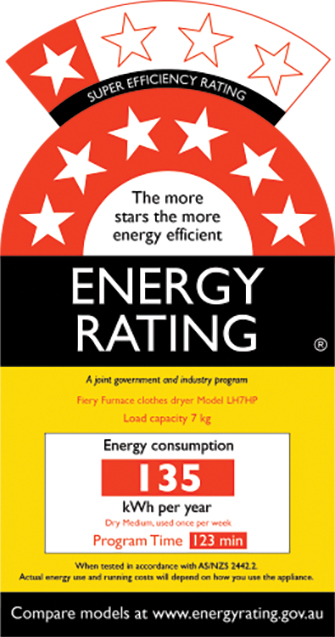
Since October last year, Energy Rating Labels on clothes dryers have been required to show the program cycle time in minutes, so consumers can see how long the program actually takes to achieve the energy rating.
Previously, manufacturers only had to display the name of the program used.
However, the program duration appears in small type below the stars, and is easily overshadowed on the busy label.
And many dryers and washer-dryers will be exempt from displaying this additional information for some time – even up to several years – during a phase-in period.
The changes don’t go nearly far enough to stop manufacturers like Hisense from gaming the Energy Rating System. The system allows this shonky behaviour, and manufacturers take advantage of it.
The system allows this shonky behaviour, and manufacturers take advantage of it
CHOICE wants program times to be displayed more prominently on the Energy Rating Labels, and consumers shouldn’t need to wait so long to see these changes across all models.
Even better, we’d like manufacturers to be required to nominate a drying setting that better reflects how people use their appliances in real life.
More 2026 Shonky Award winners




Sony Interactive Entertainment

Together, we’re more powerful
It’s not fair when companies let us down with dodgy products and bad business practices. But when we work together, companies listen and governments change laws.
We’re up for that fight, and we need your help.
Donate today and support our quest for a better, fairer, safer Australia.
