
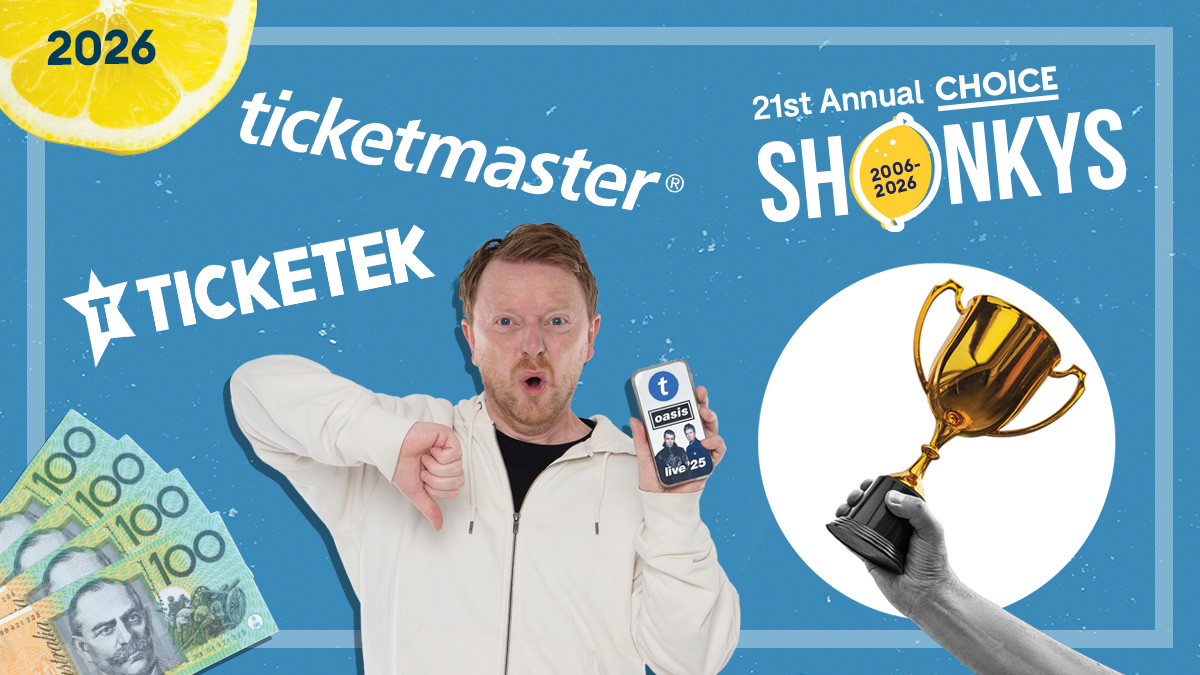
The Shonky Award for fleecing fans.
In 1988, around the peak of John Farnham’s career, a ticket to the Aussie rocker’s Age of Reason Tour set you back $36.30.
In June this year, when ‘Farnsy’ fans logged onto the Ticketek website to buy tickets to a tribute concert featuring Jimmy Barnes, Tina Arena and others, it seemed all reason had left the stadium. When they finally reached the front of the virtual queue, outraged fans faced ticket prices of up to $1650.
When they finally reached the front of the virtual queue, outraged Farnsy fans faced ticket prices of up to $1650
“The price of a ticket for this event may increase or decrease at any time,” Ticketek told customers on the purchase page.
Watching live music or sport is a beloved tradition for many Australians, but it’s one that’s becoming increasingly costly, thanks to the big ticketing companies wielding their massive market power to fleece fans.
This year, CHOICE is giving a Shonky to both Ticketek and Ticketmaster for profiteering at the punter’s expense, using dynamic pricing and other sneaky tactics to shake down fans and empty their wallets.
Dynamic pricing does fans dirty
Dynamic pricing is already commonplace when buying airline tickets or using rideshare apps, but it’s crept its way into live events. And not just at concerts, but at footy games too.
Earlier this year, NRL fans buying tickets through Ticketmaster’s website encountered “In Demand Tickets”, where “prices are adjusted according to supply and demand”. (Ticketmaster has since removed this description from its website, but In Demand Tickets appear to remain dynamically priced.)
While a regular seat at an NRL game was priced at $125, a seat labelled “In Demand”, just one row and one bay apart, was priced at $175.
A regular seat at an NRL game was priced at $125. A seat labelled “In Demand”, just one row and one bay apart, was priced at $175
According to Ticketek, “dynamic pricing is the most effective way of reducing scalping via unauthorised secondary markets”. Ticketmaster says “In Demand” tickets allow event organisers to set prices closer to their market value.
A spokesperson for the Australian Competition and Consumer Commission says dynamic or surge pricing is not prohibited under Australian Consumer Law; however, companies must not mislead customers about prices.
Concerted pressure
In the UK last year, Ticketmaster agreed to change its sales tactics after an investigation by the Competition and Markets Authority into misleading ticket prices at Oasis concerts. Fans were shocked when the cost was far higher than expected and were given minutes to decide whether to pay the inflated prices.
Despite promising to clean up its act in the UK, Ticketmaster has since tried its sneaky tactics in Australia.
Earlier this year, local BTS fans were livid when Ticketmaster said prices for the band’s upcoming Australian shows would not be revealed until customers were in the virtual waiting room on the day of sale.
Local BTS fans were livid when Ticketmaster said prices for the band’s upcoming Australian shows would not be revealed until customers were in the virtual waiting room on the day of sale
Fans sent an open letter to Ticketmaster, saying that withholding prices created an “unnecessary and completely avoidable position of difficulty and stress” during a cost-of-living crisis. Ticketmaster caved, releasing prices one day ahead of presale and three ahead of general admission, but for many it was too little too late.
Chandi Gupta, deputy CEO at Consumer Policy Research Centre, says ticketing companies use the fear of missing out, virtual queues and limited purchasing time to pressure fans into buying tickets at unfair prices.
“It’s deeply unfair that they are exploiting the consumer’s decision-making process,” says Gupta.
Ticketmaster also changes the window of time for purchasing based on demand, so it might “differ depending on time of day or for different events”, as explained on its website.
It’s deeply unfair that they are exploiting the consumer’s decision-making process
Chandi Gupta, Consumer Policy Research Centre
An ACCC spokesperson says that creating an environment that places unreasonable pressure on the consumer to make a decision may break new unfair trading laws that commence in July 2027, though all circumstances would need to be assessed.
Ticketmaster denies its practices are designed to manipulate customers or distort their decision-making. It says that these features are designed to manage demand fairly.
“In the case of BTS, fans were able to access the price range map well before the queue opened and tickets went on sale,” a spokesperson told CHOICE.
Massive market power
Both Ticketek and Ticketmaster say it is up to promoters and event organisers to agree on how prices are set. But Dr Sam Whiting, senior research fellow at the School of Media and Communications at RMIT, says the ticketing giants’ market share and exclusive arrangements with, and even ownership of, venues give them a lot of power in setting the norms.
“We wouldn’t have dynamic pricing if it wasn’t for the level of consolidation that these ticketing companies have,” Whiting says.
A report released in March 2026 by the US Senate found Ticketmaster and its parent company Live Nation pushed artists to “aggressively” expand the use of dynamic pricing, with the number of dynamically-priced tickets sold in North America increasing by 700% between 2019 and 2022.
We wouldn’t have dynamic pricing if it wasn’t for the level of consolidation that these ticketing companies have
Dr Sam Whiting, School of Media and Communications, RMIT
“Outside of the US, we’re in the first inning, so we’re just rolling [dynamic pricing] out around the world,” Live Nation CEO Michael Rapino said on a 2023 earnings call to investors.
Last April, a US federal court found Live Nation had a monopoly over big concert venues, suppressing competition and driving up prices. Internal texts exposed during the trial revealed the company leaderships’ attitudes about charging customers high prices.
“I almost feel bad taking advantage of them,” an executive wrote. “Robbing them blind baby. That’s how we do.”
Dr Meg Elkins, a cultural and behavioural economist at RMIT, says ticketing companies are aware people tend to go out less since the pandemic, and they’re asking fans to fork out more for the few events they choose to attend.
Does cultural participation then only exist for those that are able to afford excessive prices?
Dr Meg Elkins, cultural and behavioural economist, RMIT
“Does cultural participation then only exist for those that are able to afford excessive prices? And I would call these prices excessive right now,” says Elkins.
CHOICE Editorial Director Mark Serrels says although competition laws prevent businesses from setting prices artificially low, companies dominating the market are free to set prices excessively high.
“A ban on price gouging could prevent the biggest companies in Australia from using their power to pile up bigger and bigger profits at the expense of ordinary people,” he says.
More 2026 Shonky Award winners


Sony Interactive Entertainment

Together, we’re more powerful
It’s not fair when companies let us down with dodgy products and bad business practices. But when we work together, companies listen and governments change laws.
We’re up for that fight, and we need your help.
Donate today and support our quest for a better, fairer, safer Australia.