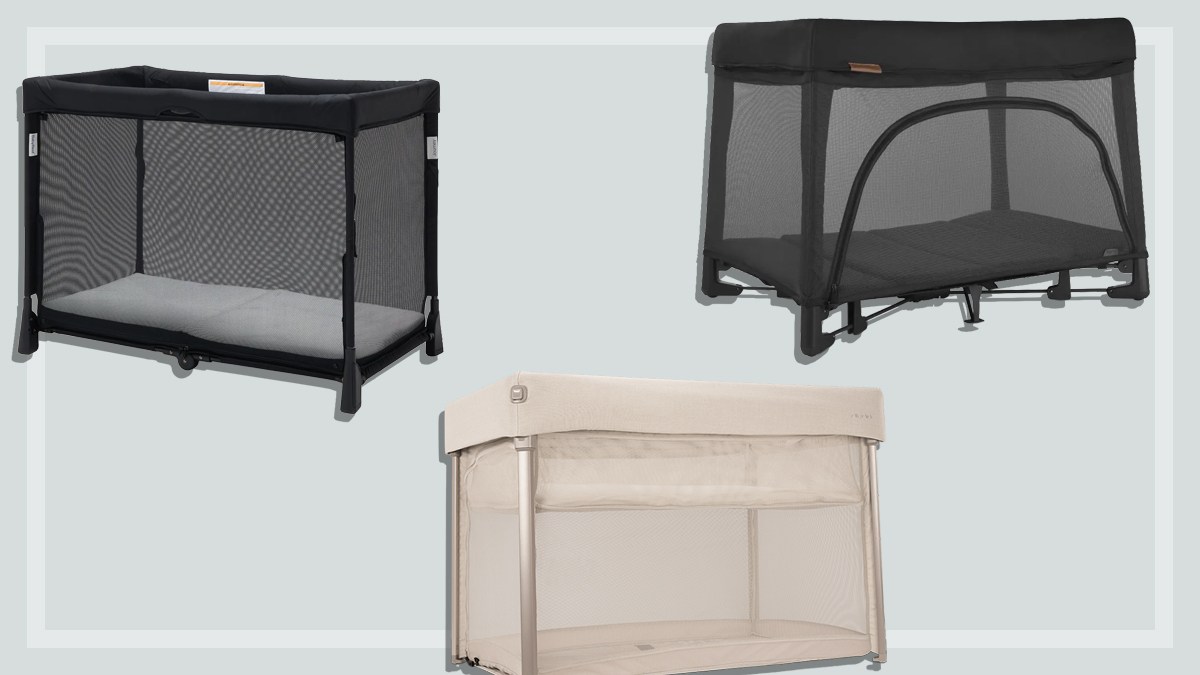
Your baby will spend hours asleep on their cot mattress and when it comes to baby sleep, safety is always the priority.
A cot mattress with a sleeping surface that’s too soft increases the risk of fatal sleeping accidents. If a baby rolls over face-first, their nose could push against any cushioning or undulating surfaces in the mattress and their breathing could become obstructed.
Suppliers must now ensure that products such as cot mattresses are sufficiently firm and safe, and compliant with the specified design, construction and performance standards. They must also ensure that the product has sufficient warnings and usage instructions.
The CHOICE labs have been testing cot mattress firmness since 2016 and have seen improvements in that time. However, we still run into unsafe mattresses out there that fail our tests.
Follow our guide for choosing the safest mattress for your little one.
Parents are advised by safety experts to always choose a “firm” mattress to minimise the risk of sudden unexpected death in infancy (SUDI). But until very recently there was no agreed definition of firmness.
The good news is that there’s a standard test method for firmness, AS/NZS 8811.1:2013 Method 1: Sleep Surfaces – Test for firmness. New mattresses must comply with this standard, but if you’re wanting to check an older mattress, you can make sure it complies with this standard (or other international equivalents) by checking the packaging or manufacturer’s website.
When we test cot mattresses in the CHOICE labs, we test them to the Australian standard test method, so our cot mattress reviews can tell you which ones passed or failed our safety tests.
Older cot mattresses may not have the compliance information included, so if you’re wondering whether your current cot mattress is firm enough, we’ve got some tips for testing that at home.
How to test cot mattress firmness at home
Dr Ron Somers, one of the researchers behind the standard firmness test, has devised a DIY method for parents and carers which mimics the lab-based standard test for firmness (for more on the official method, see How We Test Cot Mattresses).
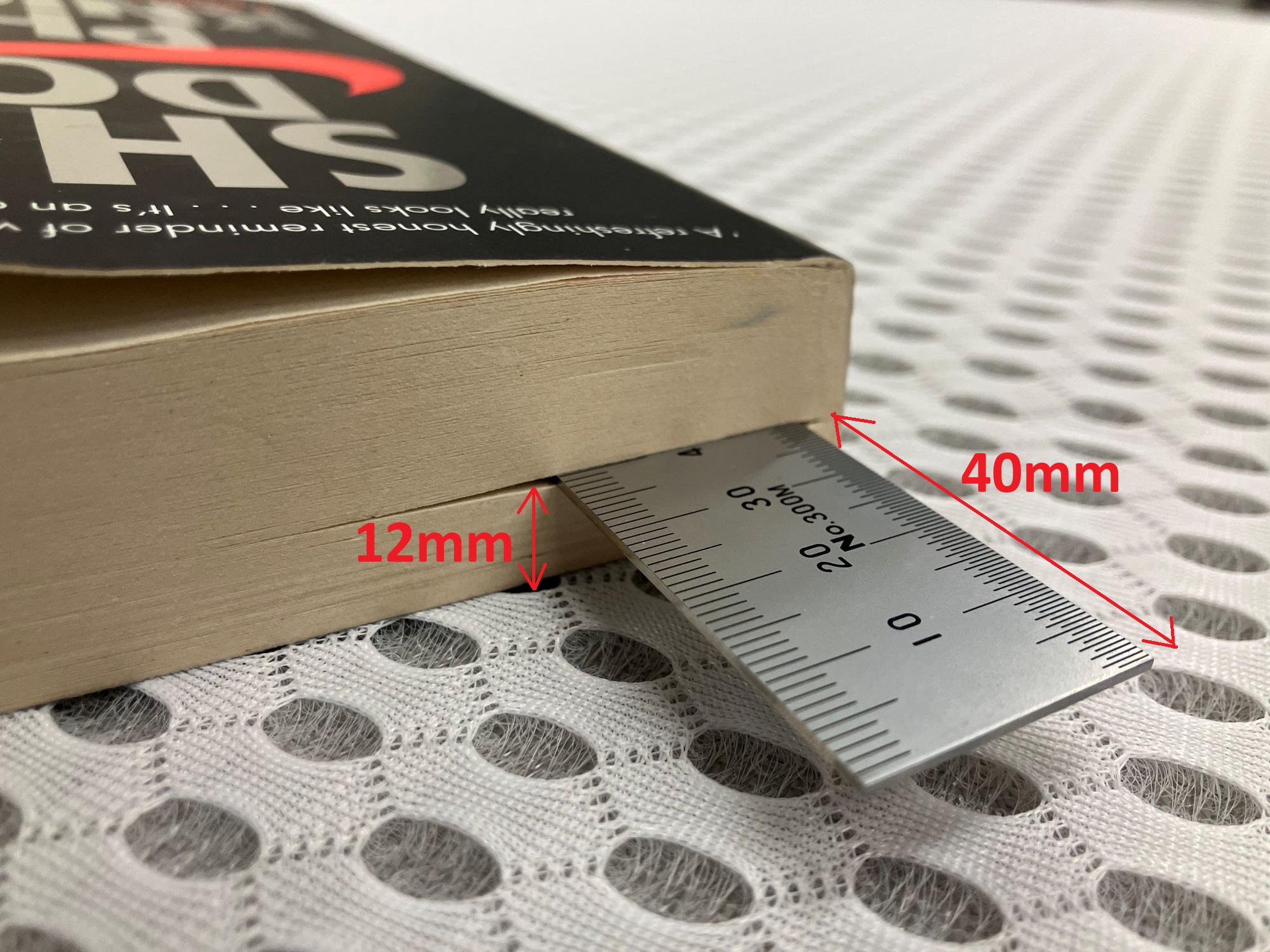
Place the ruler inside the book 12mm from the back, with 40mm protruding from it.
This informal test method is for home use only and is not a replacement for the standard test for firmness (which uses a calibrated apparatus and conditioned lab environment). Only use this method as a guide for the older mattresses that may not display a label claiming compliance with firmness requirements. If buying new, check our expert reviews first.
If your mattress fails this test then it is definitely not safe.
You’ll need:
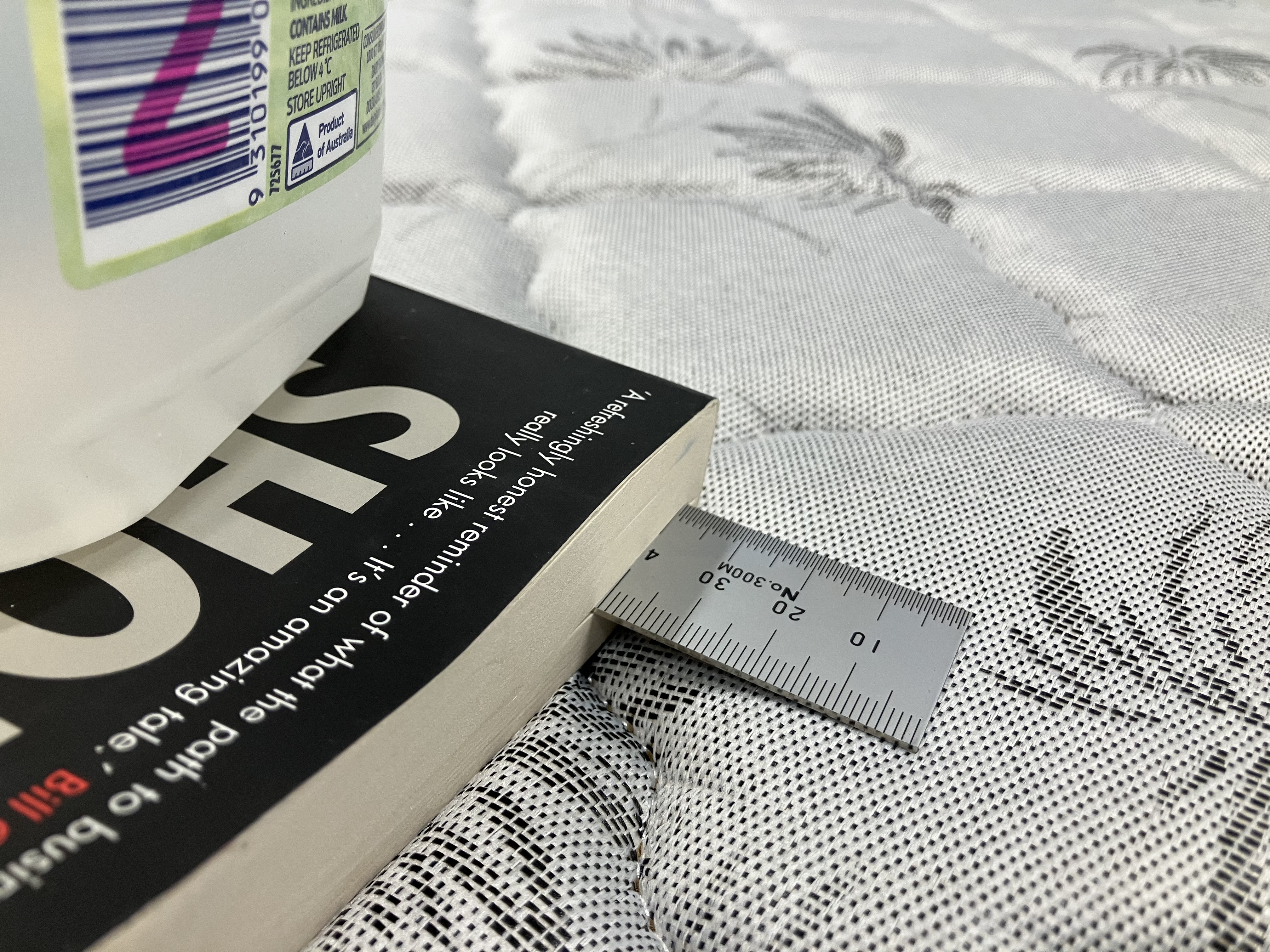
This mattress is too soft because the 2L of liquid causes the ruler to come into contact with the mattress surface.
a B-format paperback book (approximately 128mm x 200mm). It needs to be at least 12mm thick.
a ruler
2L of liquid in a container or containers (such as a plastic milk carton or two 1L Tetra Paks).
Method:
Lay the book down unopened, and find a page in the book that measures 12mm from the back cover. At this point, insert your ruler (like a bookmark) tightly against the crease with 40mm protruding from the top of the pages (see diagram).
Close the book and place it on the softest part of the mattress.
Place the container or containers of liquid on the book in such a way that the paperback remains horizontal.
If the protruding ruler does not contact the mattress, then it is firm enough. If the ruler does contact the mattress (see image) then it is too soft to be safe. Repeat on different parts of the mattress just to be sure, especially anywhere a child’s head might rest.
Testing for mattress firmness at home
The importance of a good fit
It’s essential to cot safety that the mattress fits snugly in the cot, and that it meets the cot manufacturer’s recommended dimensions.
There must never be more than a 4cm gap between the edge of the mattress and the adjacent cot side when the mattress is pushed to the opposite side. Gaps at the sides are a suffocation risk, just as insufficient firmness is.
There must never be more than a 4cm gap between the edge of the mattress and the adjacent cot side when the mattress is pushed to the opposite side
But if a mattress fits too tightly, sections of it could deform and bunch up along the cot edge, making it easier for a child to climb out of the cot. It could also cause the dropside to not move freely, if there is one.
That’s why it’s important for manufacturers to at least put the length and width of the mattress on their label, and preferably the thickness, too.
The thickness of the cot mattress can also be the difference between a cot passing or failing the mandatory standard for cot depth. The distance from the top of the mattress to the top of the lowest side when the dropside is closed should be at least 50cm when the base is in the lowest position, and at least 30cm in the upper position.
As for mattress construction, you’ll find a huge variety including foam, latex and inner-spring. All of these sorts of mattresses are capable of passing the firmness test, so we can’t recommend one type over another, but an inexpensive and very basic mattress is just as likely to be as good as any other.
You’ll often find cot mattresses promising “comfort” or “support” for your baby. A baby is not built like an adult, and a firm mattress, not a cushioned one, is safest for your baby. Our tests show that cot mattresses that are flat and don’t have undulating or quilted features are less likely to fail our firmness test. Never use a mattress topper.
Warning about vacuum-packed cot mattresses
Many cot mattresses, regardless of their construction, are shipped in boxes where they’ve been vacuum-packed and rolled up. This makes transporting them more efficient. However, to ensure they’re at their firmest, they must be left on a flat surface for several days (at least) to fully expand.
Generally cot mattresses-in-a-box are no more or less firm than traditional types once they’ve expanded, but we have seen ones that retain their bent shape after a number of weeks prior to use. If this happens, contact the manufacturer for a replacement.
Note that once a cot mattress has expanded, it can no longer be vacuum-packed again.
New cot mattresses are best. However, if you’re getting one second-hand, it’s important to know that any previously-used mattress should be firm enough, clean and show no signs of dampness or mould. It’s also vital that it fits well in the cot.
Kim Gilmour is a Senior project officer. She manages a range of product tests such as coffee machines, stick vacuums, bassinets, high chairs and ovens, which are all tested in our in-house labs.
Kim’s work gives people access to robust, independent advice and helps consumers make informed decisions about their purchases. Her work also helps to keep manufacturers in check, by regularly exposing product flaws which can result in better and safer products.
Prior to CHOICE, Kim spent 16 years working as a technology journalist in Sydney and London. With several years as a senior researcher/writer at our UK sister organisation, Which?
Kim has authored how-to technology books such as Spotify for Dummies and Digital Photography for the Older and Wiser.
Kim has a Bachelor of Arts in Communication (Journalism) from Charles Sturt University. LinkedIn
For more than 60 years, CHOICE has been fighting the good fight for Australian consumers.
In the past year alone we've uncovered systemic issues with sunscreens, investigated shonky supermarket pricing, fought for stronger scam protections and helped make complex energy pricing fairer and clearer.
CHOICE is here to provide unbiased advice and independent testing in our world-class labs. We buy the products we test, just like you do, and our expert reviews are influence free. We’re here to help you choose smarter. Hopefully you’ll also save some money along the way.
Thanks to CHOICE, you’ll never be alone when a business treats you unfairly. You can support our work by joining or donating to our cause.