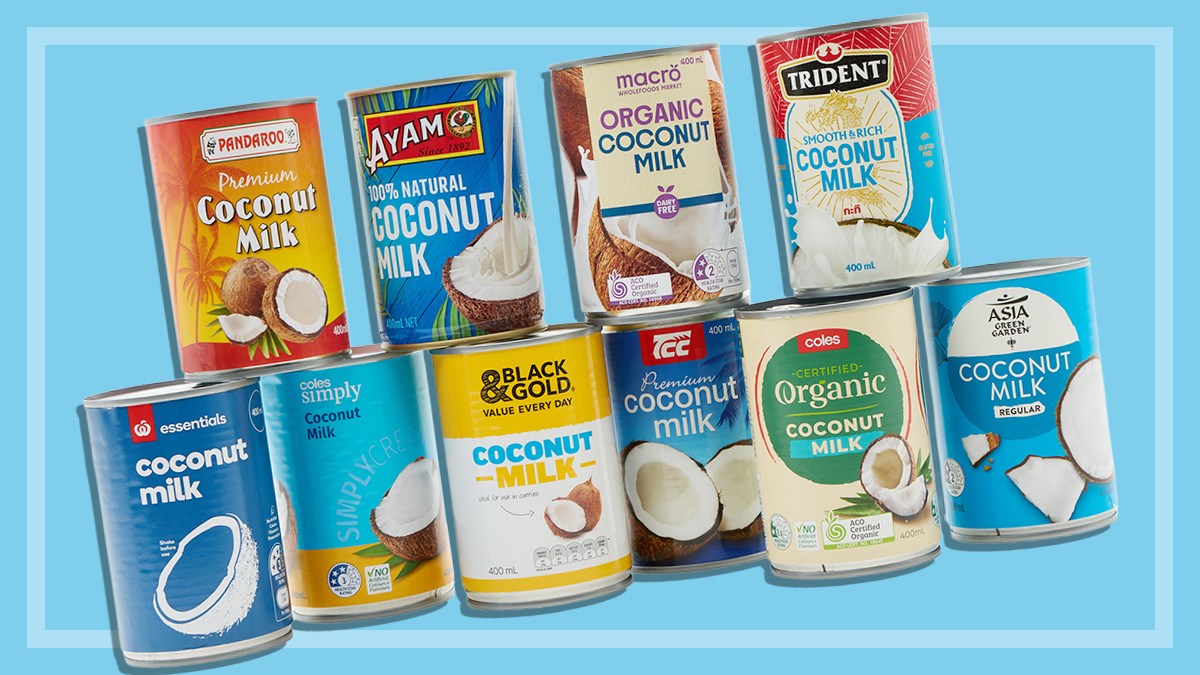
The amount of coconut in coconut milk varies widely, from as little as 45% to as much as 89%
The cheapest coconut milk was also the best value when we calculated the cost per 100ml of coconut
In our in-house taste test, the best value coconut milk also came out on top for taste
Coconut milk is a staple ingredient in many favourite recipes. It’s used by cuisines from all over Asia and other parts of the tropics to add richness and depth to both sweet and savoury dishes. In Australia, it’s estimated that the retail and food service sectors will spend $340 million on coconut milk for cooking in 2026.
There’s certainly a wide variety of coconut milk options to be found in our supermarkets. Name-brand and home-brand varieties are plentiful, and you’ll also find some organic products.
Then there are light coconut milks, coconut creams and light coconut creams. With so much to choose from, you’d be forgiven for being a little perplexed about which one to choose.
So what’s the difference between products, and which one offers the best value for money?
What’s the difference?
If you’ve ever wondered about the difference between all of the different coconut milks and creams on offer, the short answer is fat content: coconut milk has higher water content and coconut cream has more fat.
Both are made from coconut extract made by processing coconut flesh. Different brands of the coconut milk we found in supermarkets contained between 45% and 89% coconut, the other content being mostly water, with some also including additives such as stabilisers, emulsifiers and thickeners.
If you extend the comparison to include coconut creams and light versions, things become even more confusing. Light coconut milks contain even more water than the regular versions, and the products we looked at contained anywhere from 19% to 63% coconut.
Some brands of light coconut milk contain more coconut than other products sold as coconut cream
The most premium coconut creams contain up to 100% coconut, while other brands can contain as little as 45%. The light creams might have as little as 32% coconut and as much as 74%.
In other words, some brands of light coconut milk contain more coconut than other products sold as coconut cream.
We asked FSANZ (Food Safety Australia and New Zealand) about how these products are classified. While the relevant Food Standards code specifies that characterising information (in this case, the amount of coconut) must be declared as a percentage, it does not specify the amount of coconut that must be present in coconut milk.
For consumers, that means you need to pay attention to the label to figure out exactly how much coconut you’re getting.
How much coconut is in your coconut milk?
Ayam 100% Natural Coconut Milk 89% coconut No additiives $5/400ml Product of Malaysia
Aldia Asia Green Garden Coconut Milk 75% coconut Best value $1.69/400ml Product of Vietnam
Coles Organic Coconut Milk 74% coconut Cheapest organic $2.10/400ml Product of Thailand
Trident Premium Coconut Milk 60% coconut $3.43/400ml Product of Thailand
Black&Gold Coconut Milk 54% coconut $1.75/400ml Product of Thailand
TCC Premium Coconut Milk 53% coconut No additives $3.20/400ml Product of Thailand
Coles Simply Coconut Milk 50% coconut $1.70/400ml Product of Thailand
Woolworths Essentials Coconut Milk 50% coconut $1.70/400ml Product of Thailand
Pandaroo Premium Coconut Milk 45% coconut Least coconut $2.26/400ml Product of Thailand
What we found…
Coconut content ranges between 45% and 89%
Prices range from $1.69/can (Aldi Asia Green Garden) to $5/can (Ayam 100% Natural Coconut Milk)
Most are made in Thailand. Asia Green Garden is a product of Vietnam and Ayam is made in Malaysia.
All but two products (Ayam and TCC) contain additives such as stabilisers, thickeners or emulsifiers.
What’s in your coconut milk?
For this article, we’re focusing on standard coconut milks. We looked at the ingredients in 10 varieties from Coles, Woolworths, Aldi and IGA, comparing the cost and percentage of coconut in each tin to figure out how much coconut you’re actually getting.
The different terms used to describe the ingredients in the coconut milks can be confusing, with the main ingredient sometimes described as coconut extract, coconut kernel extract or coconut milk.
These are all essentially the same thing: the flesh of the coconut is grated, soaked and/or blended with water and then pressed to extract a liquid. To produce coconut milk, this extract is then mixed with water and sometimes additives, such as guar gum, that help stop the water and coconut liquid from separating.
The main ingredient is sometimes described as coconut extract, coconut kernel extract or coconut milk
Of the products we looked at, Ayam 100% Natural Coconut Milk had the most coconut, with 89%. The only other ingredient was water.
Next was the Aldi Asia Green Garden coconut milk. It contains 75% coconut, with the remaining ingredients being water and the stabiliser 412 (guar gum).
The products containing the third-highest amount of coconut in our analysis were the two organic products in our sample – Coles Organic Coconut Milk and Woolworths Macro Wholefoods Organic Coconut Milk. Both contained 74% coconut extract, and both also contain guar gum.
The quality of the coconut milk you’re using can have a huge effect on the flavour of the dishes you cook – this flavour can be impacted by not only the amount of the coconut in the product, but the additives (or lack of additives) it might contain.
Other aspects such as fat content, processing and formulation, as well as how old the product is or how it has been stored, can also have an impact on flavour.
CHOICE home economist and expert taster, Fiona Mair, sampled the 10 varieties of coconut milk we compared in a blind tasting. She assessed each sample for texture, taste and aroma, and appearance.
CHOICE home economist Fiona Mair.
Fiona’s pick was Aldi’s Asia Green Garden Coconut Milk, which she described as having “lovely thickness and good flavour”, adding that it had a good aroma and a good amount of solid cream.
This product is 75% coconut kernel extract and costs just $1.69 for a 400ml tin, making it the cheapest of the products we compared. This also makes it the best value product, in terms of the cost per 100ml of coconut.
Not so pleasant was the Pandaroo Premium Coconut Milk. This product has the least amount of coconut extract of any of the products we tested: just 45%. Fiona described it as having a “chemical, metallic taste, an unpleasant flavour and oily mouthfeel”.
Fiona also wasn’t a fan of the Ayam coconut milk. She described it as having an “unpleasant aftertaste and aroma”. This product has the most coconut of any of the products we compared – 89%. It was also one of only two that didn’t include any additives, the other being TCC brand.
Overall, there was quite a lot of variation between the brands. “Some were quite solid… some were quite watery,” Fiona says. “A few had quite a metallic taste, and a couple were quite sweet”.
To read Fiona’s assessment of each of the products, check out the taste test results below.
So if you’re choosing coconut milk for your next curry, be sure to read the ingredients and remember, price is not always an indicator of quality: the cheapest product in our comparison (Aldi Asia Green Garden) contained the second-highest amount of coconut and was rated the tastiest, while the second-most expensive (Trident) was only 60% coconut.
Expert taste test results
Aldi Asia Green Garden Coconut Milk
“Lovely thickness, good flavour, good amount of solid cream”
Coles Organic Coconut Milk
“Good thickness. Smooth, subtle coconut flavour”
Black & Gold Coconut Milk
“Limited flavour, too watery, which would make a curry very watery. OK for soups.”
Coles Simply Coconut Milk
“Limited flavour and aroma. OK for soups.”
Woolworths Essentials Coconut Milk
“Limited flavour and oily mouthfeel.”
Woolworths Macro Wholefoods
“Good consistency, though only a subtle coconut flavour.”
Pandaroo Premium Coconut Milk
“Unpleasant flavour and metallic taste. Oily mouthfeel.”
Ayam 100% Natural Coconut Milk
“Unpleasant aftertaste and aroma, greyish appearance. Weird taste.”
Trident Premium Coconut Milk
“Pleasant Flavour, good thickness, smooth texture.”
TCC Premium Coconut Milk
“Watery texture and flavour is OK, though the aftertaste is not pleasant.”
Know the products to avoid before you shop. Get our free guide and buy smarter.
Margaret Rafferty joined CHOICE in 2018 as a Content editor and since then has filled the roles of Commissioning editor, Managing editor and now Editorial consultant.
Margaret has written on a wide variety of topics and enjoys making complex subjects easy to understand. With over 20 years of media experience, Margaret brings a strong storytelling background to CHOICE. She works closely with people across the organisation to help tell stories that make a positive difference to people and is passionate about uncovering bad practices and helping Australians to avoid falling victim to shonky products and services. LinkedIn
For more than 60 years, CHOICE has been fighting the good fight for Australian consumers.
In the past year alone we've uncovered systemic issues with sunscreens, investigated shonky supermarket pricing, fought for stronger scam protections and helped make complex energy pricing fairer and clearer.
CHOICE is here to provide unbiased advice and independent testing in our world-class labs. We buy the products we test, just like you do, and our expert reviews are influence free. We’re here to help you choose smarter. Hopefully you’ll also save some money along the way.
Thanks to CHOICE, you’ll never be alone when a business treats you unfairly. You can support our work by joining or donating to our cause.