

Friends, we’ve got some good news and some bad news.
First the bad news: the Shonkys are back.
The good news? The Shonkys are back!
This is the duality of the Shonky Awards. On the one hand, we love this annual event. It’s a time for CHOICE to have fun, call out some dodgy products and services, and enjoy hearing your thoughts on the selection.
But wouldn’t it be great if we didn’t need them? If we lived in a land of milk and honey, where children basked in an endless summer and swam gleefully in butterscotch rivers with gumdrop smiles?
The thing is, we live in the real world. So the Shonkys continue in earnest, and with no shortage of contenders. This year we’ve selected six of the absolute shonkiest products and services for your perusal.
Welcome to the 2026 Shonky Awards.
This year, we call out:
- Ticketmaster and Ticketek for fleecing music and sports fans
- Virgin Australia for forcing customers to book under pressure
- Sony Interactive Entertainment for asking us to pay to play, but not own
- Hisense for gaming a broken system
- Quest Protein Chips for confusing getting ripped with ripped-off
- Petcover for a policy that’s all bark, no benefit
Ticketmaster and Ticketek
In 2026, buying a ticket for any in-demand show – be it a concert or a sporting event – is a one-way trip into the bowels of digital hell.
CHOICE is giving a Shonky to both Ticketek and Ticketmaster for profiteering at the punter’s expense, using manipulative tactics to shake down fans and leave them with a headache and an empty wallet.
Dynamic pricing is already commonplace when buying airline tickets or on rideshare apps, but it’s now crept its way into live events, and we don’t like this. Particularly when it’s exploiting fans of musicians or sporting teams.
In 2026, buying a ticket for any in-demand show is a one-way trip into the bowels of digital hell
Earlier this year, NRL fans buying tickets for some matches through Ticketmaster’s site encountered “In Demand Tickets”, where “prices are adjusted according to supply and demand”. While a regular seat at an NRL game was priced at $125, another seat labelled “In Demand”, just one row and one bay apart, was priced at $175.
It’s a great example of how weird it is to buy a ticket for anything these days.
Watching live music or sport is a beloved tradition for many Australians, but it’s one that’s becoming increasingly costly and even stressful, thanks to the big ticketing companies wielding their massive market power to fleece fans.
A well-deserved Shonky.
Read more: 2026 Shonky Award for Ticketek and Ticketmaster
Virgin Australia
It’s a practice that pushes the boundaries of consumer law and of common decency. You’ve paid for something and didn’t receive it, but the business is holding on to your money.
Refunds are not on the table.
Thus begins the troubling story of Virgin Australia’s unused flight credits. They’re made up of customer payments for flights cancelled between 21 April 2020 and 31 July 2022 during the COVID-19 pandemic.
In its annual report released in late August this year, Virgin said it counted $75 million in expired COVID-19 credits as part of its 2026 net profits.
Some customers redeemed their credits, but many others never saw their money again.
That… doesn’t seem right.
Virgin said it counted $75 million in expired COVID-19 credits as part of its 2026 net profits
Long story short, Virgin initially told customers they had to book flights by 30 June 2026 or lose their credits. But, after pressure, Virgin extended the deadline for taking flights to 27 May 2027.
But we believe you should never lose money you spent on flights that were cancelled. Why aren’t refunds possible?
“Expiring credits should be automatically converted to refunds and consumers shouldn’t have to chase them. Virgin’s unfair credit policy means countless people will never see their hard-earned money again,” says CHOICE senior policy and campaigns adviser Bea Sherwood.
“If we can’t rely on airlines to provide this basic entitlement, the government needs to step in and make it a requirement under the Aviation Consumer Protections Charter.”
Very shonky indeed.
Read more: 2026 Shonky Award for Virgin Australia
Sony Interactive Entertainment
It doesn’t get much more convenient than downloading a movie or video game to your collection and enjoying it immediately. But will you be enjoying them for years to come? That’s less certain.
Because, according to Sony Interactive Entertainment, you don’t own the movies and games you buy as a digital download instead of a disc. You’re buying a licence to access the content – a licence that can be removed at any time without recourse.
In June 2026, Sony announced its licensing agreement with distributor Studio Canal was coming to an end in the UK and Europe. 500 Studio Canal movies would no longer be available to buy, rent and watch. That included previously purchased movies stored in customers’ digital libraries. Content that people thought they had bought and would own forever was set to be removed.
Then, a few days after that announcement, Sony brought the hammer down on gamers.
You don’t own the movies and games you buy as a digital download from Sony… You’re buying a licence to access the content – a licence that can be removed at any time
Come January 2028, all new games will be digital-only on PlayStation. No more discs. “This is a natural direction for Sony Interactive Entertainment to adapt to consumer trends as the general preference for digital media significantly outpaces physical discs,” says Sony.
Connecting the dots on this – how secure are these digital purchases going to be?
What happens if licensing agreements expire?
What happens if the PlayStation Network goes down and you can’t download the games you paid for?
What happens if your account gets compromised and permanently suspended by hackers that breach code of conduct in your name?
These are genuine questions in the all-digital age Sony is about to force gamers into. And we reckon it’s pretty shonky that we don’t have a choice in the matter.
Read more: 2026 Shonky Award for Sony Interactive Entertainment
Hisense
Ah, the old familiar energy star ratings. They’re helpful right? More stars is better, less stars is worse.
But were you aware that star ratings – particularly on washing machines and dryers – are based on one specific program on the machine and, more often than not, isn’t necessarily the program you’ll use in the real world?
Case in point: when a Hisense washer-dryer takes 13.5 hours to run the drying program that led to its impressive 8-star energy rating, maybe it’s time to ask, are the Energy Rating Labels on laundry appliances still useful to consumers?
And isn’t the whole thing a bit… shonky?
The Hisense 8i Washer Dryer Combo is marketed as being “super energy-efficient” with an 8-star energy rating for drying.
The Hisense 8i Washer Dryer Combo only achieves its 8-star rating on the machine’s Eco drying setting – which takes 13.5 hours to dry a full load
However, it only achieves this 8-star rating on the machine’s Eco drying setting. A setting that takes a ludicrous 13.5 hours to dry a full-capacity 8kg load. Who on earth is going to wait this long for a load of laundry to dry?
Most people, we suspect, will switch to a quicker program, meaning that the energy savings they expect from an 8-star machine will likely be very different.
“If a consumer regularly uses a different program, their actual energy consumption and in turn household savings could differ greatly to what they had originally expected when purchasing based on the Energy Rating Label,” says Denis Gallagher, our laundry expert.
The system is being gamed and CHOICE would like to see it changed.
CHOICE wants program times to be displayed more prominently on the Energy Rating Labels. Even better, we’d like manufacturers to be required to nominate a drying setting that better reflects how people use their appliances in real life.
Read more: 2026 Shonky Award for Hisense
Quest Protein Chips
Protein is big business. Its presence in everything – from breakfast cereals and ice cream to instant coffee and, bizarrely, ham – is being loudly promoted on packaging, muscling out the regular foods on our supermarket shelves that don’t boast such credentials.
We recently investigated the price difference between the standard versions and the protein versions of a range of different food products. We found you’ll be paying on average around 50% more per 100g for those items promoting protein on the label.
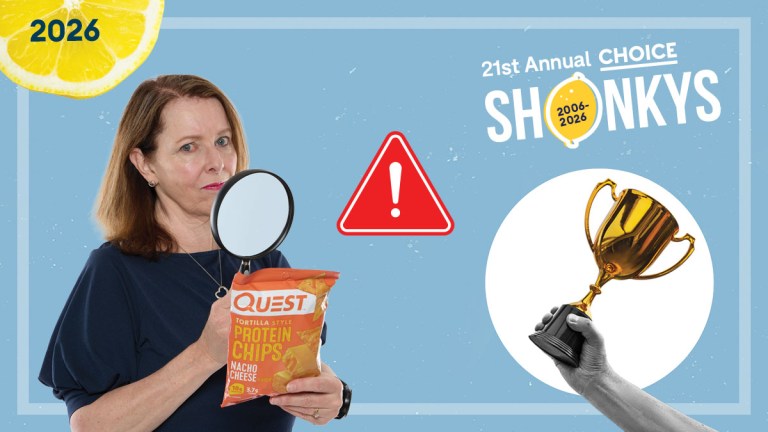
The worst offender in the products we selected for our comparison? Quest Protein Chips. A single 32g packet of this “protein-forward” snack will set you back $6.50.
“Far from being as cheap as chips, this snack food costs more than $20 per 100g. That’s comparable to prices you might pay for Wagyu beef or specialty seafood,” says CHOICE journalist Marg Rafferty.
You’ll be paying 886% more for the Quest Protein Chips than for the similar-flavour Doritos
Compare the Quest Nacho Cheese Tortilla Style Protein Chips to a bag of Nacho Cheese Flavour Doritos. When we first began looking at these products back in July, the Doritos cost $5 for a 170g bag, making the Quest chips 591% more expensive. Since then, the Doritos have dropped in price to just $3.50 for 170g, a unit price of just $2.06 per 100g.
In other words, you’ll be paying 886% more for the protein chips than for the similar-flavour Doritos. That’s a pretty hefty protein tax.
Perhaps the final word should go to the blurb on the packs of Quest Protein Chips. While the marketing text boasts that the product “isn’t just for athletes to enjoy – they’re for everyone!”, it also carries a prominent warning that these chips are “not suitable for children under 15 years of age or pregnant women”, and that this food “should only be used under medical or dietetic supervision”.
Pretty shonky indeed.
Read more: 2026 Shonky Award for Quest Protein Chips
Petcover
Pet insurance has historically been fairly shonky. We gave the entire industry an award back in 2019. Things have improved significantly since then, but every now and then a policy appears that makes us think, “time to go back to the old me…”
So sorry Petcover… it’s Shonky time.
Petcover’s Economy policy is a humdinger. Customers with Petcover’s Economy cover are sold a new policy instead of a renewal at 12 months, and any conditions their pet suffered in the previous year are classified as pre-existing and therefore excluded from cover.
Worse still, Petcover’s policy’s definition of “pre-existing conditions” is one of the broadest we’ve seen. It includes any condition with the same “clinical signs” as another illness or injury. If your cat had pancreatitis, for example, and the clinical signs are vomiting and food refusal, you risk not being covered for a myriad of other conditions where the clinical signs are also vomiting and food refusal.
Petcover’s policy’s definition of ‘pre-existing conditions’ is one of the broadest we’ve seen. It includes any condition with the same “clinical signs” as another illness or injury
As our pet insurance expert Daniel Graham puts it, “you can forget about pre-existing conditions, this barely covers new conditions”.
This applies to chronic conditions too. You only get 12 months of cover for any single condition. So if your pet sustains a complex injury or develops an illness that requires ongoing treatment, Petcover will pay for the first year, but after that, you’re on your own.
“Basically, you’re covered until you have something that needs cover,” says Graham.
Read more: 2026 Shonky Award for Petcover
More about each winner
Sony Interactive Entertainment
Together, we’re more powerful
It’s not fair when companies let us down with dodgy products and bad business practices. But when we work together, companies listen and governments change laws.
We’re up for that fight, and we need your help.
Donate today and support our quest for a better, fairer, safer Australia.