
The Shonky Award for asking us to pay to play, but not own.
In this age of instant gratification, it doesn’t get much more convenient than being able to easily download a movie or video game to your collection to start enjoying immediately.
But will you be enjoying them for years to come? That’s less certain.
Because, according to Sony Interactive Entertainment, you don’t actually own the movies and games that you buy as a digital download instead of a disc. Instead, you’re buying a licence to access the content via Sony’s various digital storefronts, such as the PlayStation Store.
Sony can end these licences at any time with no obligation to issue refunds. And your digital media library will be just… gone
Sony still owns your digital media, leaving you with what is essentially a long-term rental. As the end-user license agreement, or EULA, puts it: “The software is licensed to you, not sold”.
And Sony can end these licences at any time with no obligation to issue refunds. And your digital media library will be just… gone.
The case of the disappearing movie library
Sony isn’t the only company that does this sort of thing. But a recent double-whammy reminder of its right to remove has placed Sony squarely under the Shonky spotlight.
In June 2026, Sony announced its licensing agreement with film producer/distributor Studio Canal was coming to an end in the UK and Europe.
Customers were told that 500 Studio Canal movies would no longer be available to buy, rent and watch.
Content that people thought they had bought and would own forever was set to be removed
That included any previously purchased movies stored in customers’ digital libraries. Content that people thought they had bought and would own forever was set to be removed.
Then, a few days after that announcement and fresh off the back of many customers discovering that the whole “purchase versus license” situation was very real, Sony brought the hammer down on gamers.
Sony says it’s game over for physical media
Come January 2028, all new games will be digital-only on PlayStation. No more discs.
“This is a natural direction for Sony Interactive Entertainment to adapt to consumer trends as the general preference for digital media significantly outpaces physical discs,” says Sony.
Existing titles, and those scheduled for release before that date, will still be available on disc (unless otherwise stated).
This wouldn’t be as much of an issue if customers actually owned their digital content. But the EULA rules remain unchanged as Sony forces its customers down an avenue without ownership by removing the physical media altogether.
Sony is forcing its customers down an avenue without ownership by removing the physical media altogether
The impact on digital games is set to kick in next year. By July 2027, Sony will close the older PlayStation 3 (PS3) and PS Vita digital stores. Existing purchases will still be available to download as often as you need for the “foreseeable future”.
It all sounds pretty vague and potentially implies an end date of some kind. You just have to hope that your devices keep working indefinitely, because once we pass the “foreseeable future”, you won’t be able to re-download your games anymore.
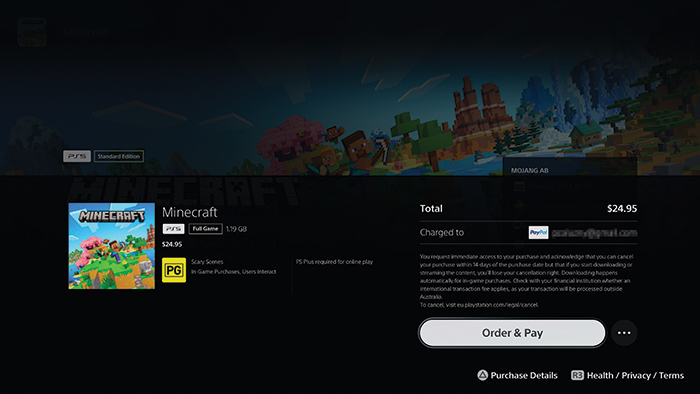
‘Order’, ‘pay’ and ‘purchase’… but it’s not yours to keep
While the EULA lays out the licensing rules, the PlayStation Store’s payment process does not. The checkout process so frequently and consistently uses the term “purchase” that customers could reasonably interpret it as ownership, rather than licensing.
CHOICE games expert Peter Zaluzny describes the process: “After you browse the PlayStation Store and add a digital game to your card, the last step says “Order & Pay”, with no clear indication that you’re essentially just renting the software,” he says. “That is, unless you open an optional menu and read pages upon pages of legal documentation.”
The checkout process so frequently and consistently uses the term ‘purchase’ that customers could reasonably interpret it as ownership, rather than licensing
That’s exactly what you want to do while buying a new game, right?
Which begs the question, says Zaluzny, “Why do these digital licences for games cost as much as a disc-based version for the same title? You know, those physical products that you actually own and will work whenever you pop them into your PlayStation?”
No second life for digital purchases
Fortunately, Sony hasn’t quite gone down the monopoly route. Digital codes will be sold at traditional and online retailers, and there’s no indication that codes will be locked into the same pricing structure as the PlayStation Store.
But there are still flow-on effects. For example, digital-only will eventually kill the more affordable second-hand market for PlayStation games. There is no option to trade-in games or buy them second-hand in the PlayStation Store.
Digital-only will eventually kill the more affordable second-hand market for PlayStation games
In fact, it’s specifically prohibited by the EULA, which states: “You are granted a limited, non-exclusive, non-transferable, and personal licence to play or use the Software for your private, non-commercial use.”
Kind of ironic, given how much shade Sony threw around back in 2013 when Microsoft tried to implement an always-online requirement that restricted game sharing. Back then, Sony made a video mocking an Xbox policy that limited game swapping (look up “Official PlayStation Used Game Instructional Video”).
A Shonky endgame
Then there’s the myriad of issues that come with putting the customers’ eggs in one basket.
What happens when the PlayStation Network goes down and you can’t download the games you paid for?
What do you do if your account gets compromised and permanently suspended by hackers that breach code of conduct in your name?
You can’t protect your licensed media based on the current EULA, and there won’t be any alternatives once the discs go away
Granted, Sony has recovery options, but you just have to pray that the entity at the other end believes your claim. Why? Because there aren’t any bricks and mortar PlayStation shops staffed by actual humans where you can go to seek help, at least not in Australia.
You can’t protect your licensed media based on the current EULA, and there won’t be any alternatives once the discs go away. You’ll own nothing.
More 2026 Shonky Award winners
Together, we’re more powerful
It’s not fair when companies let us down with dodgy products and bad business practices. But when we work together, companies listen and governments change laws.
We’re up for that fight, and we need your help.
Donate today and support our quest for a better, fairer, safer Australia.