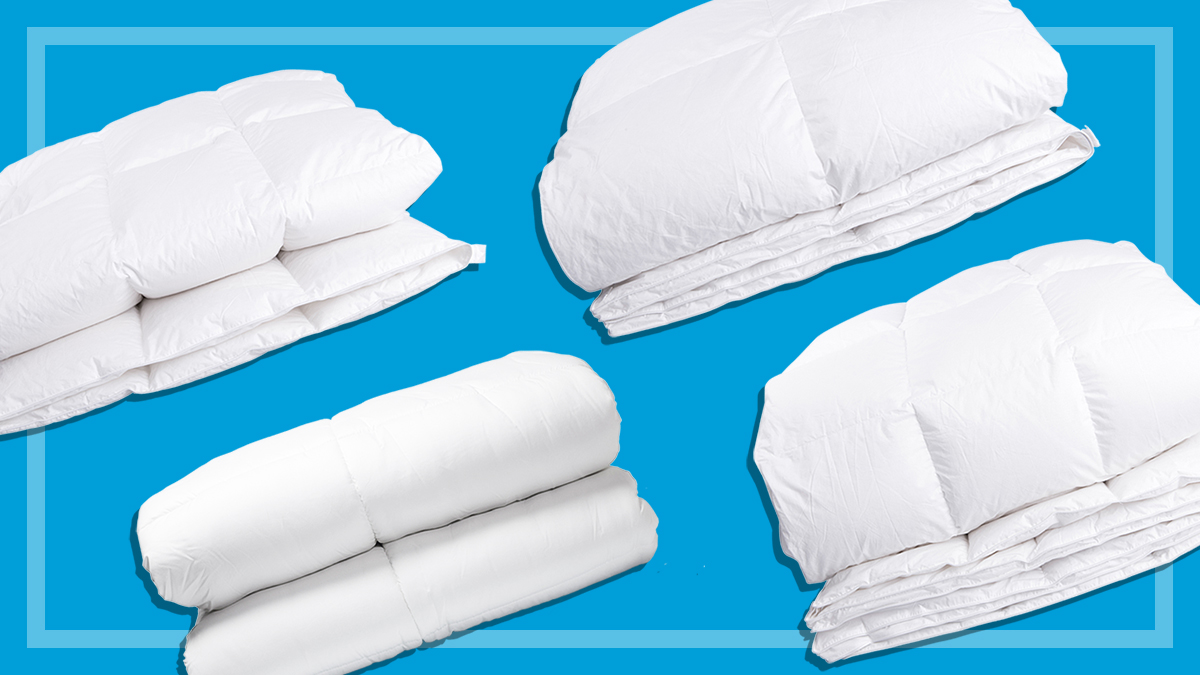
Is there anything more comforting than snuggling down under a warm, fluffy doona? If you’re in the market for a new one, you might be baffled by your options. Should you get wool, microfibre or feather? What’s the difference between feather and down? And is a doona the same as a quilt or duvet?
We answer those questions and more, so you can spend less time shopping and more time snoozing.
Quilt, doona or duvet?
In Australia, quilt, doona and duvet mean the same thing – a thick piece of insulating padding in a plain fabric casing designed to be put inside a cover. You could also call this item a continental quilt, eiderdown or comforter, although in Australia comforters are usually sold as quilts sewn into a decorative cover.
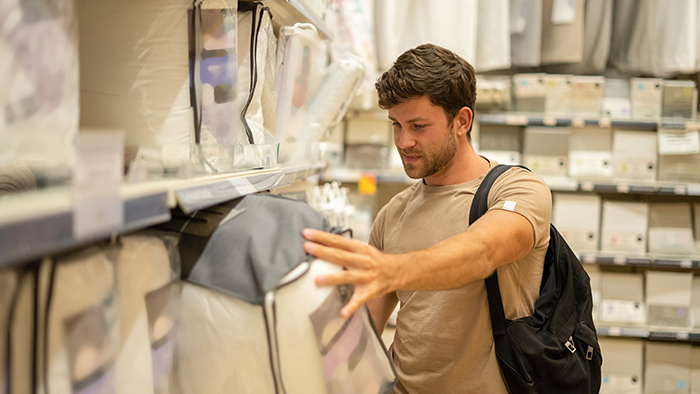
Unless a doona has a major failure, they’re unlikely to be accepted for a return, so it’s worth taking some time to think about what you need before you start shopping for a specific type.
Let’s take a closer look at the following factors:
A queen size bed means a queen size quilt, right? Sadly it’s not so simple.
Firstly, Australian quilt and mattress sizes differ from those of other countries, so it pays to measure your mattress. Also be careful when buying products from international stores like Ikea, as their bedding doesn’t match Australian sizes.
Secondly, even though the majority of Australian bedding suppliers conform to the sizes listed below, some differ, so always check the measurements on the packaging.
Australian quilt sizes
Single: 140cm x 210cm
Double: 180cm x 210cm
Queen: 210cm x 210cm
King: 245cm x 210cm
Super King: 270cm x 240cm
Thirdly, think about going bigger. You might want to go one size larger than your mattress for a number of reasons.
Warmth: The more your doona drapes over you, the fewer draughts that get in. Your doona is also less likely to end up on the floor if you toss and turn. And you might just have a partner who tends to gather the quilt around themselves as the night goes on.
Looks: If you want your quilt to drape over the edges of the bed.
Upsizing: You won’t need to buy a new quilt if you decide to move up a bed size.
In Australia, quilts are often categorised by season and usually include a simple description such as ‘cool’, ‘warm’ or ‘super warm’.
How warm should your doona be?
How warm do you like to be at night? Do you need something to help regulate your temperature? Are you looking for a quilt to use all year round or for a specific season?
Like size, warmth is more complicated than you might think because it’s connected to the fill material, the quality of that material, and, depending on the material, the weight of the quilt.
Another potential problem is a partner who may sleep at a vastly different temperature from you. In this case, you might consider a ‘dual warmth’ doona, which has different warmth ratings on each side.
In Australia, quilts are often categorised by season and usually include a simple description such as ‘cool’, ‘warm’ or ‘super warm’. Some products are also measured in TOG (thermal overall grade). A 1–4 TOG is most suitable for summer, while a 13.5–15 TOG is best for very cold conditions.
Do you like a light or heavy doona?
Which do you prefer: that snug, secure, safe sensation you get from a heavy blanket that wraps around you like a hug?
Or a light, free, unencumbered feeling, like when you’re sleeping under airy cotton sheets?
The good news is your preference for a light or heavy doona need not be outweighed by your requirement for a cooler or warmer quilt.
Some fills, such as high-quality down, are both light and incredibly warm.
The weight of your duvet is influenced by several things.
Fill material: Wool, for example, is heavier than microfibre.
Density: Measured in GSM, or grams per square metre, this tells you about weight, but not necessarily about warmth. However, when comparing GSM in one particular type and grade of filling, the higher rating means the heavier and warmer it will be.
Loft: This is about how high your quilt sits, and is often more about looks than about practical considerations. For most materials, a higher loft equals a higher GSM, but not when it involves filling like down.
How will you wash your doona?
Most microfibre quilts and some made of natural materials are machine washable, but is your washing machine big enough? If you like to wash your doona regularly, particularly to minimise allergies, frequent trips to a laundromat to use a bigger machine can be costly in terms of time and money.
Most feather and down quilts and some made of other materials are dry-clean only too, which makes for an additional cost.
If you suffer from allergies, look for ‘hypoallergenic’ or ‘anti-allergy’ fillings, and quilts which can be machine washed at 60°C and above.
Hypoallergenic materials, such as cotton, bamboo and silk, don’t contain known allergens.
However, dust mites and other allergens can still occur in hypoallergenic fabrics.
Anti-allergy materials, on the other hand, have been chemically treated to prevent mites and other allergens from becoming established.
Most feather and down quilts are dry-clean only, which makes for an additional cost.
Types of doonas: Pros and cons
Doonas come in three main types of filling: feather and down, wool, and polyester, but you’ll come across others such as silk, cotton, and bamboo.
Feather and down quilts
If asked to imagine the softest, fluffiest, most luxurious bedding money could buy, most people would probably picture a huge quilt of feather and down.
The down component is key. Feathers and down come from either ducks or geese, but their qualities are very different. Down provides softness, lightness and warmth. Feathers simply help to add bulk.
The ratio of down to feathers is usually marked on the packaging. The quality of feather and down is described in fill power, which measures the amount of space that one ounce of down can fill. One ounce of high quality down (650 and above) will fill a much larger area than one ounce of lower quality down, resulting in a lighter, but loftier and warmer filling.
Unfortunately, you often have to go hunting for this information on bedding websites and packaging, but it’s worth searching for to determine insulation level.
How much do queen size feather and down quilts cost?
Price is mostly dependent on the down to feather ratio, but is also influenced by the type of down, so feather and down quilts can easily range from $300 up to $1000.
Pros
Highly insulating.
Breathable.
Lightweight.
Durable.
Wicking (encourages moisture to evaporate).
Temperature regulating (helps keep you cool in summer and warm in winter).
Cons
Generally more expensive than other quilt types.
Usually has to be dry-cleaned.
Causes allergies in some people.
Requires regular shaking to fluff back up.
Not always humanely sourced.
Wool quilts
Wool duvets are a popular choice for their warmth and durability. Wool has the unique ability to respond to temperature. In winter, it draws in moisture from cold air to create heat, while in summer it releases moisture from the fibre back into the air near your skin, cooling it down.
How much do queen size wool quilts cost?
Price is usually dependent on the weight of the quilt and the quality of the wool, but wool doonas generally cost between $200 and $500.
Pros
Insulating.
Temperature regulating.
Durable.
Fire-resistant.
Wicks sweat away from skin.
Cons
Heavier than other quilt types.
Flatter than other quilt types.
Often dry-clean only.
Only able to be machine washed at low temperatures on a gentle spin, making it difficult to dry.
Polyester quilts
Polyester doonas are the most affordable and also the most practical quilts as they’re usually machine washable and dry quickly. Polyester can certainly keep you toasty, but it can also cause you to overheat because the material doesn’t breathe. This problem has been somewhat improved by the advent of newer polyester materials, such as microfibre and hollow fibre.
How much do queen size polyester quilts cost?
Polyester quilts can be incredibly cheap, but the price rises when more specialised forms of polyester are used and when natural materials are incorporated. They cost between $25 and $300.
If you take good care of your doona, you can expect it to
last at least five years and a whole lot longer with a high-quality one.
The first step is to keep your quilt in a cover. This will
help to protect the filling and to keep it clean.
Also air your duvet periodically and clean it regularly
according to the care instructions. Don’t be tempted to follow DIY advice about washing your quilt in the bathtub, unless you’re prepared to stomp on it
for an hour like you’re crushing grapes to try to get the water out, which is
also not recommended.
How to dispose of your old quilt
The most orthodox way to dispose of your old quilt is to put
it in your regular rubbish bin. Unfortunately, quilts can’t be put in recycling
bins.
Most charities no longer accept quilts, and most animal
shelters don’t take them although you can enquire.
It’s possible to sell your used quilt on an online platform
if it’s in pristine condition, but you’re unlikely to get much for it.
My main work is as a journalist, having written for The Age, The Sydney Morning Herald, The Big Issue, Sanctuary Magazine and Meanjin.
My freelance writing and editing include Bush Heritage Australia, Adult Learning Australia, Mind Australia, RMIT University, and Leighton Contractors.
Diploma of Arts — Professional Writing and Editing, RMIT TAFE, Melbourne, 2011
Bachelor of Arts (Communications Studies, Journalism Major), University of Newcastle, 1997
Find me on LinkedIn
My main work is as a journalist, having written for The Age, The Sydney Morning Herald, The Big Issue, Sanctuary Magazine and Meanjin.
My freelance writing and editing include Bush Heritage Australia, Adult Learning Australia, Mind Australia, RMIT University, and Leighton Contractors.
Diploma of Arts — Professional Writing and Editing, RMIT TAFE, Melbourne, 2011
Bachelor of Arts (Communications Studies, Journalism Major), University of Newcastle, 1997
Find me on LinkedIn
For more than 60 years, CHOICE has been fighting the good fight for Australian consumers.
In the past year alone we've uncovered systemic issues with sunscreens, investigated shonky supermarket pricing, fought for stronger scam protections and helped make complex energy pricing fairer and clearer.
CHOICE is here to provide unbiased advice and independent testing in our world-class labs. We buy the products we test, just like you do, and our expert reviews are influence free. We’re here to help you choose smarter. Hopefully you’ll also save some money along the way.
Thanks to CHOICE, you’ll never be alone when a business treats you unfairly. You can support our work by joining or donating to our cause.