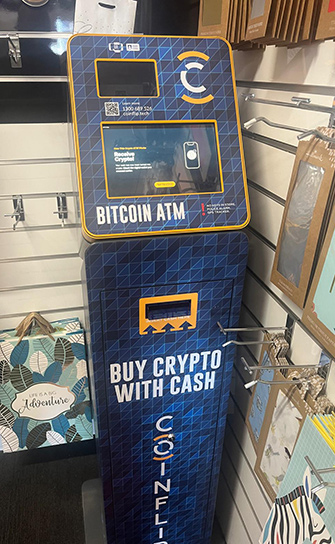
At a suburban newsagent in Melbourne’s north, behind the magazines and gift-wrapping paper, there is a blue machine that you’d be forgiven for thinking is a normal ATM.
This, however, is a cryptocurrency ATM, and it’s one of thousands popping up at petrol stations, tobacco shops, newsagents and convenience stores around Australia.
In 2019 there were 23 crypto ATMs across Australia. Today there are more than 2000. Despite our relatively small population, Australia has the third-highest number of these machines in the world, behind only the United States and Canada.
Australia has the third-highest number of crypto ATMs in the world
“They are very popular,” the owner of the newsagent says when asked about the machine. It’s owned by CoinFlip, a US-based company, which is one of four major operators of crypto ATMs in Australia.
They’re marketed as a harmless way to purchase bitcoin, tether, ether and other crypto currencies using cash, but authorities say scams facilitated by these machines are growing rapidly and there are calls for them to be banned altogether.
The Australian Transaction Reports and Analysis Centre (AUSTRAC), which is responsible for fighting criminal activity in the financial system, says crypto ATMs are being used for scams and fraud-related transactions at a rate that is “impossible to ignore”.
“Crypto ATMs provide a fast, irreversible way for victims to send money to scammers,” AUSTRAC CEO Brendan Thomas says.
“They’re easy to locate, often operating 24/7, and designed for quick cash transactions with no human intervention, making them highly attractive to criminals.”
Claude Von Arx, a senior financial counsellor at the Consumer Action Law Centre in Melbourne, says he has worked with clients who’ve had money stolen through scams via crypto ATMs. He says the massive growth in their popularity in recent years has come at the expense of some of the older, financially vulnerable people he assists.
Betty* lives in regional Victoria and is over 65 years old. She’s still working, and worried she won’t have enough superannuation to retire comfortably. Last year she saw an ad for an investment opportunity on Facebook and made contact. The person she spoke with spent months grooming her while setting up a scam.
Over a period of weeks, Betty transferred $5000 a day out of her superannuation account to her bank account, then withdrew it in cash and fed it into a crypto ATM at her local petrol station. The money was then transferred to the scammer’s crypto wallet before disappearing. In the end she lost around $140,000 – her entire retirement savings.
Betty transferred $5000 a day out of her superannuation account to her bank account, then withdrew it in cash and fed it into a crypto ATM at her local petrol station
“This woman had never used crypto before the scam, she was taught how to use the machines and given step-by-step instructions,” says Claude Von Arx from Consumer Action Law Centre. “She would go to the petrol station and then stand on the phone and the scammer would walk her through the process, right there in the open, she was coached through it. One note at a time.”
Betty is far from alone.
AUSTRAC says around 150,000 transactions take place on crypto ATMs in Australia every year. The agency estimates one in ten transactions are linked to suspicious activity, including organised crime and scams.
Data from nine crypto ATM providers shows most users are over the age of 50
AUSTRAC’s Cryptocurrency Taskforce says data from nine crypto ATM providers shows most users are over the age of 50, while 60–70-year-olds alone account for 29% of all transactions by value. These demographics, which are in stark contrast to the generally much younger demographics of cryptocurrency traders, suggest these machines may be being used by scam victims rather than crypto enthusiasts.
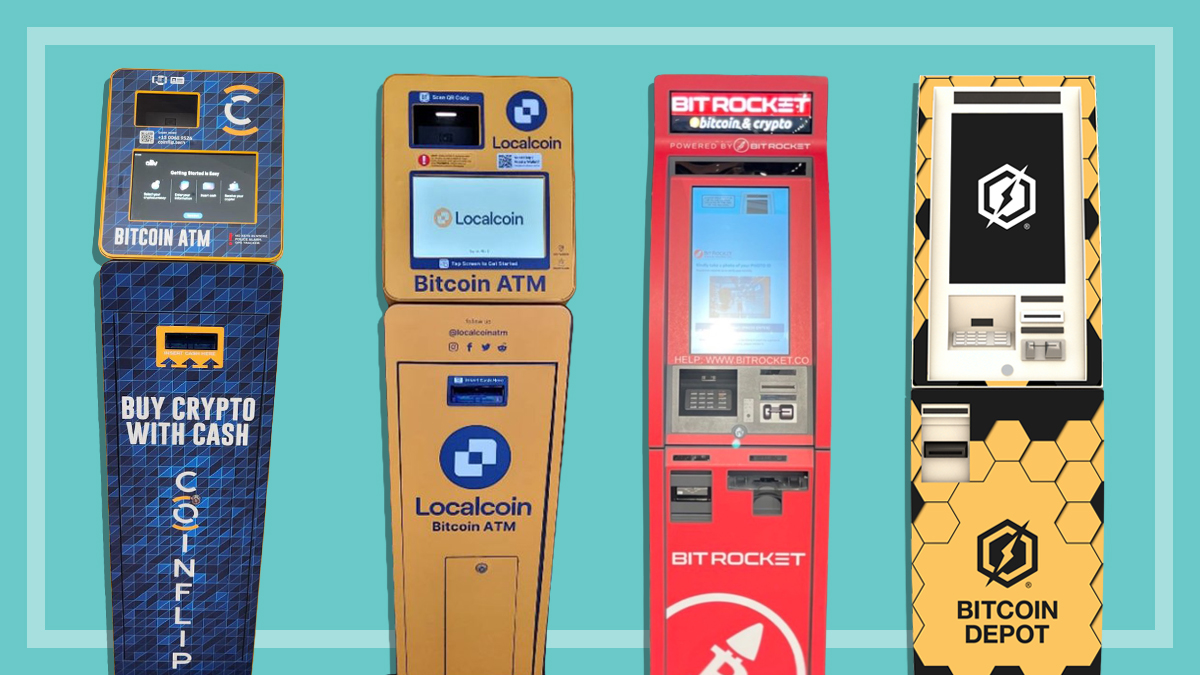
Most of the crypto ATM companies operating in Australia are based in North America, where the market is more established. Four of the major companies operating locally are CoinFlip, Localcoin, BitRocket and Bitcoin Depot.
CoinFlip boasts 210 machines in NSW alone and another 145 in Victoria.
These companies partner with local business shopfronts who provide the space to host the ATMs in return for income. CoinFlip says businesses who host a kiosk can “increase foot traffic, generate monthly rental income, and earn revenue from transactions”.
Meanwhile, Localcoin says ATM hosts will “generate over $2000 annually through rental income”.
The reason these machines may be shunned by some genuine crypto enthusiasts and traders is the extremely high fees they charge on transactions. Someone purchasing bitcoin through a Localcoin ATM can expect to pay an 18% service fee, plus an additional $4 flat fee. Online crypto exchanges typically charge fees of around 1% to purchase bitcoin.
Some machines also offer people the option to sell bitcoin and other crypto currencies and withdraw cash, though similar fees are charged.
Both the Australian Federal Police (AFP) and the Australian Competition and Consumer Commission (ACCC), which runs the National Anti-Scams Centre, are keen to highlight the scam warning signs they’ve placed on crypto ATMs.
“Mandatory scam warnings and increasing the capacity to monitor transactions should help reduce opportunities for criminals to misuse these ATMs,” says Catriona Lowe, deputy chair of the ACCC.
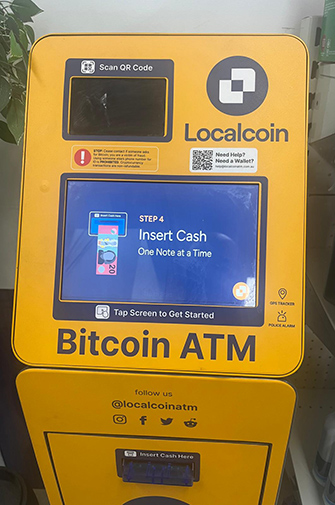
The Localcoin ATM we visited in Melbourne did have a message, in small print, warning customers that if someone asks for bitcoin it could well be a scam.
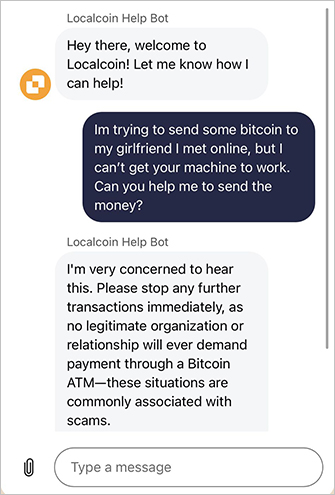
When we contacted the Localcoin service assistance chatbot posing as someone trying to send money to a woman they had met online, the bot promptly warned us to cease the transaction as we were likely being scammed. It didn’t provide an option for continuing the transaction or provide any links or support to set up accounts.
The CoinFlip ATM carried no printed warnings on the machine (the company says a digital on-screen scam warning appears later in the process) and when we called their service assistance line we got a different response to the Localcoin chatbot.
Posing as someone trying to send bitcoin to a ‘girlfriend’ we met online who lived overseas and claimed her mother was sick, there were red flags of a scam (as identified by the ACCC in their warnings around romance scams) for the CoinFlip staff member, who said they were based in the US.
“Just so you know everything on the blockchain is permanent and irreversible, which means if you send her funds and you realise she has stopped talking to you that money is gone. There is no way to get it back. Are you aware of that?” the staff member asked. “I trust her,” we replied, and later added, “she wouldn’t lie to me”.
The staff member asked a number of other probing questions, but never mentioned the word ‘scam’
“Are you sure she is who she says she is? Like, have you talked to her on the phone, like in person, like video and all that?” the staff member asked us. We answered in the affirmative, intending to imply we had spoken over video (CoinFlip disputes this and says the staff member received confirmation we had met this person face-to-face).
The staff member asked a number of other probing questions, but never mentioned the word “scam”, and in the end sent links on how to set up an account with CoinFlip and offered to talk us through the steps.
We sent questions to CoinFlip about the interaction. The company replied that “CoinFlip takes consumer protection seriously and holds itself to the highest standard of compliance and transparency”.
“In this instance, CoinFlip’s agent went above and beyond to educate the caller, cautioning them about trusting the intended recipient of the funds, explaining that blockchain transactions cannot be reversed once completed, and encouraging careful consideration before proceeding. At no point did any funds move, and no transaction occurred,” the spokesperson says.
CoinFlip says that had we attempted to complete the transaction using the same information given on the call, the account would be “flagged, reviewed and suspended by a member of our local dedicated compliance team as part of CoinFlip’s multilayer protection mechanisms”.
No transaction occurred in this scenario because it was merely a simulation. It is not suggested that CoinFlip knowingly or recklessly facilitates scam transactions, however, this scenario demonstrates how a potential victim such as Betty can use crypto ATMs at the insistence of scammers to transfer significant funds in an untraceable way.
In 2025, AUSTRAC placed conditions on all crypto ATM operators, including a $5000 transaction limit.
But Claude Von Arx from Consumer Action Law Centre says that isn’t enough.
“It’s like whack-a-mole – everyone is working hard to try and tighten the banking process, scams are already on the next scenario. Crypto ATMs are an easy way to circumvent the banking system and controls,” he says.
“Crypto is already untraceable, but getting the money into crypto is so much easier now. Some banks don’t allow funds to go to online crypto exchanges, and that’s now pushed scammers to these ATMs.”
AFP detective superintendent Marie Andersson says Australia should be moving in the direction of countries like New Zealand, who have banned crypto ATMs outright, and Singapore, where restrictions have made them commercially unviable.
When asked if banning crypto ATMs would make policing scams easier, she says, ‘the simple answer is yes’
“It’s something AUSTRAC and the regulators need to seriously consider,” Andersson says. When asked if banning crypto ATMs would make policing scams easier, she says, “the simple answer is yes”.
CHOICE understands the Department of Home Affairs is developing legislation that would enable AUSTRAC to prohibit “high-risk” products that “cause harm to the community”, and the federal government plans to introduce legislation at some point in 2026.
A department spokesperson says these high-risk products may include crypto ATMs.
Von Arx says any ban can’t come quick enough to prevent more people from falling victim.
“What is the argument for crypto ATMs, what is their purpose? It’s hard to build a business case for them. What do they add to society?”
Jarni Blakkarly is an award-winning Senior Investigative Journalist at CHOICE. Jarni has worked for news organisations such as SBS, Reuters, Al Jazeera English, ABC 730, Radio National, BBC World Service and Deutsche Welle.
Jarni won the Walkley Foundation's young journalist of the year student category award in 2016 and was the recipient of a Melbourne Press Club Michael Gordon fellowship in 2022. In 2023 he was a highly commended finalist in the Quill Awards and a winner at the 2024 Excellence in Civil Liberties journalism awards. In 2024 he was elected to serve on the Federal Council (National Media Section) of the MEAA. Jarni has a Bachelor of Communications (Journalism) from the Royal Melbourne Institute of Technology (RMIT).
Jarni Blakkarly is an award-winning Senior Investigative Journalist at CHOICE. Jarni has worked for news organisations such as SBS, Reuters, Al Jazeera English, ABC 730, Radio National, BBC World Service and Deutsche Welle.
Jarni won the Walkley Foundation's young journalist of the year student category award in 2016 and was the recipient of a Melbourne Press Club Michael Gordon fellowship in 2022. In 2023 he was a highly commended finalist in the Quill Awards and a winner at the 2024 Excellence in Civil Liberties journalism awards. In 2024 he was elected to serve on the Federal Council (National Media Section) of the MEAA. Jarni has a Bachelor of Communications (Journalism) from the Royal Melbourne Institute of Technology (RMIT).
For more than 60 years, CHOICE has been fighting the good fight for Australian consumers.
In the past year alone we've uncovered systemic issues with sunscreens, investigated shonky supermarket pricing, fought for stronger scam protections and helped make complex energy pricing fairer and clearer.
CHOICE is here to provide unbiased advice and independent testing in our world-class labs. We buy the products we test, just like you do, and our expert reviews are influence free. We’re here to help you choose smarter. Hopefully you’ll also save some money along the way.
Thanks to CHOICE, you’ll never be alone when a business treats you unfairly. You can support our work by joining or donating to our cause.