From outside a small wooden house on top of a hill, Mutang Tuo sweeps his hand towards the valley of untouched rainforest before him.
“All of this forest is our land,” he says with the gesture. “The forest is our supermarket, we are free to take whatever we want. Although we don’t have money, everything is free here – medicine, food, vegetables, it’s all here. The forest is the king. A generous king,”.
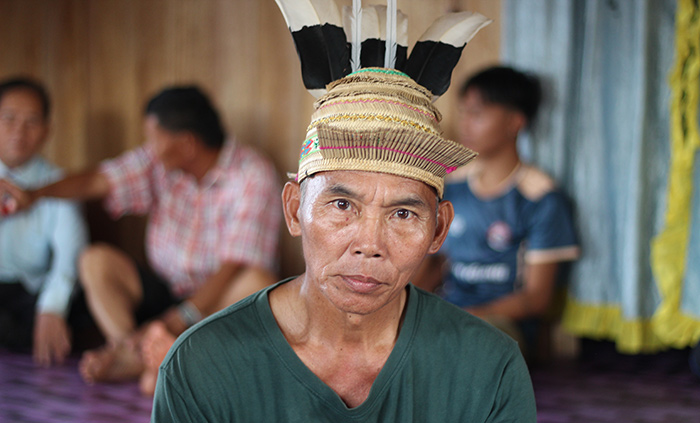
Mutang is the chief of Long Payau, a small village of traditionally nomadic Penan indigenous people in the Baram region of Sarawak, Malaysia on the island of Borneo. He has been fighting to protect his people’s traditional homelands against various logging companies for decades.
“For the people of Long Payau, if they log the whole forest we will die. If we can’t hold the forest there is no future for the next generation,” he says with a weary voice.
The forest is our supermarket. Although we don’t have money, everything is free here – medicine, food, vegetables, it’s all here
Long Payau village chief, Mutang Tuo
The community’s struggle in Long Payau is reflective of small battles taking place all across the East Malaysian state of Sarawak, as indigenous people try to prevent the mass destruction of the forests their people have lived in and relied on for centuries.
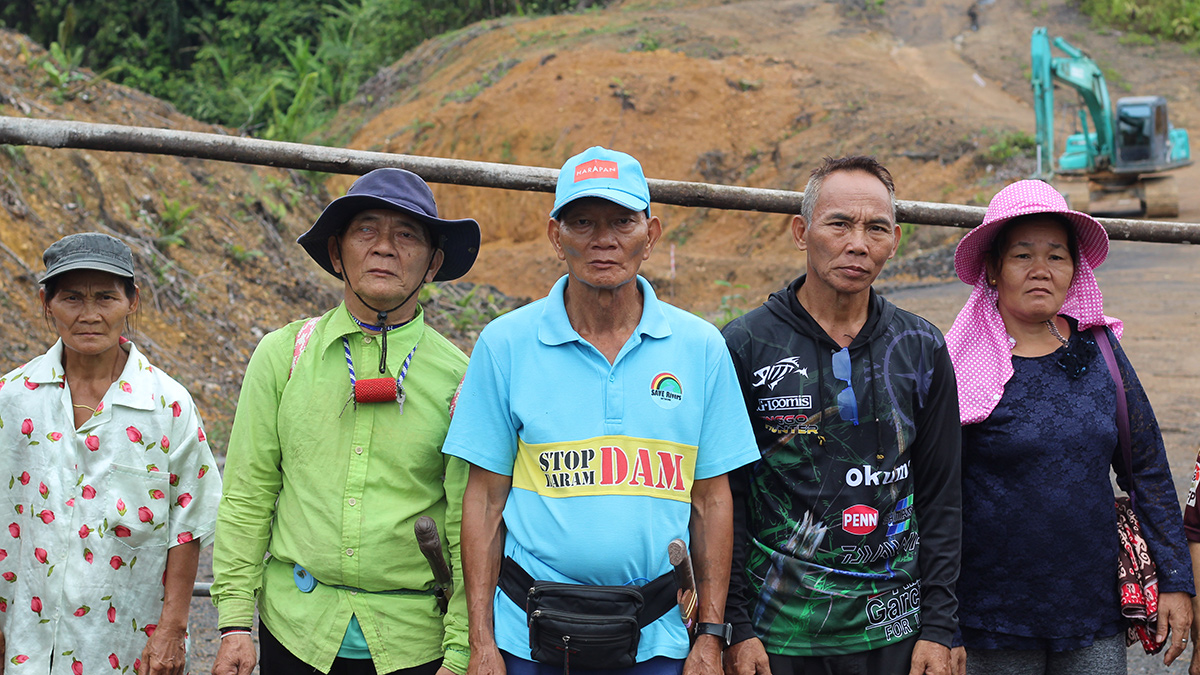
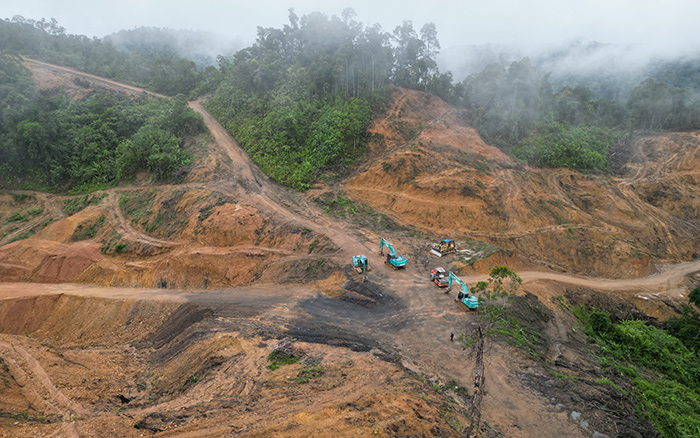
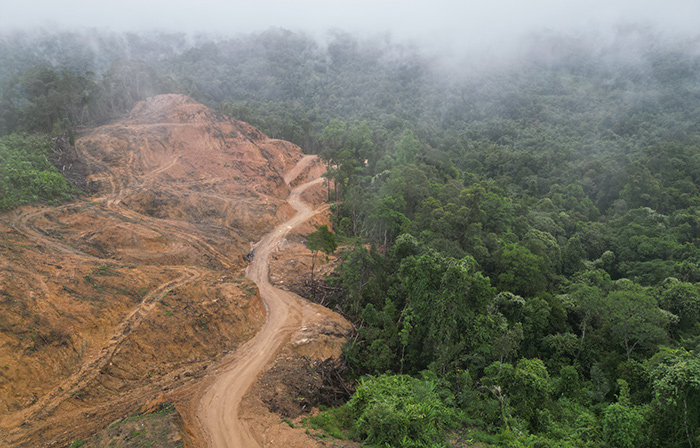
Just outside the village of Long Payau we are taken to see the logging blockade, a crude fence of wooden poles constructed by the villagers to keep the loggers at bay. On the other side of the fence bulldozers have flattened the mountainside, the dense green forest replaced with muddy brown dirt.
This may seem a world away from Australia, but the logs being gathered here travel along a supply chain that traverses South East Asia and ends in the local hardware and furniture stores we all shop at.
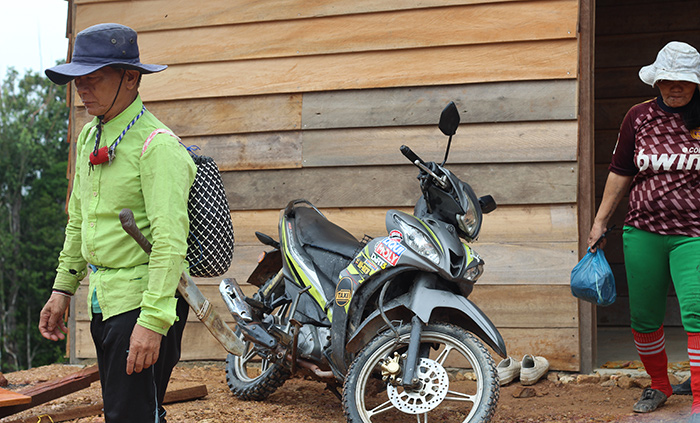
Mutang Tuo, village chief of Long Payau
The bulldozers parked near Long Payau
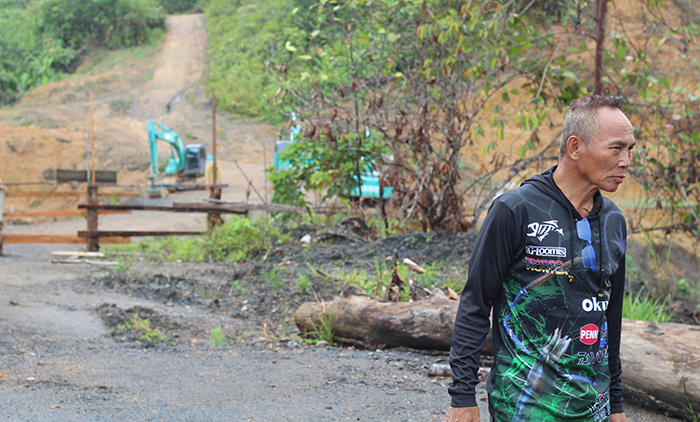
Mutang Tuo at the logging blockade
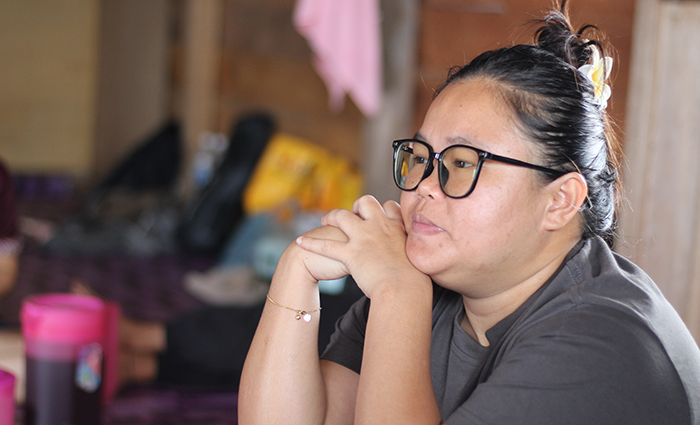
The villagers of Long Payau
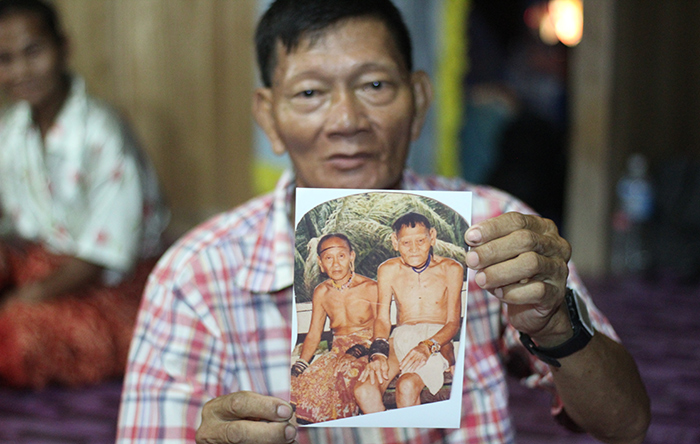
A Penan villager shows a photo of his ancestor
Broken promises
According to Global Forest Watch, between 2001 and 2024 Sarawak lost 3.3 million hectares of tree cover, equivalent to 29% of the total tree cover that existed across the state in the year 2000. Half of the forest lost was primary forest – forest that hasn’t been cleared or regrown in recent history.
In late 2025, CHOICE visited two villages in Baram, Long Payau and Long Tepen, to meet the communities and hear about the impact of logging and deforestation on their everyday lives.
Both communities are being impacted by Shin Yang, a Malaysian-owned conglomerate with export markets all around the world. Shin Yang is known as one of the biggest logging companies in the state of Sarawak and boasts exports to Europe, Japan and Australia.
The impact of logging near Long Payau.
While the community of Long Payau has resisted logging efforts for decades, in Long Tepen the situation is more complicated.
Long Tepen villagers had longstanding agreements with Shin Yang for royalties, jobs and compensation and agreed to allow the company to log much of the forests surrounding the village.
But recently the agreement has frayed and villagers say the company hasn’t honoured their financial commitments. Earlier in 2025 they accused the company of logging in areas they had previously agreed to leave untouched, prompting villagers to set up a logging blockade.
Local man Radang Tik says the community’s traditional hunting and access to the forest has been severely affected.
Villagers set up a logging blockade after accusing the company of logging in areas they had previously agreed to leave untouched
“What is important now is the recognition of the land that we have now. The land is not recognised by the government or the company, so what is happening is Shin Yang is entering saying that ‘the government gave us this land, whether you agree or not, the government gave it to us’,” he says.
The Sarawak government grants logging concessions to companies such as Shin Yang, giving them the right to log large tracts of untouched native forest across the state. While CHOICE is not suggesting Shin Yang is acting illegally under Malaysian law, activists and the indigenous Penan villagers say these concessions are often granted without their consent or consultation.
Shin Yang’s Australian connections
Shin Yang Group manufactures wood pellets, sawn timber, wooden furniture and floor base plywood for hardwood flooring among other wood-based products.
Shin Yang’s company report lists Australia as one of the global export destinations for these products. But that’s where the trail gets murky. Wood logged from Long Payau or Long Tepen could be sitting in your living room right now, but there is no way to know for sure.
Between January and October 2025 Sarawak exported over $5 million in plywood, veneer, sawn timber and furniture or furniture parts to Australia
Australia has no mandatory customer-facing certification scheme that discloses the country of origin, name of the company, sustainability ranking or even the type of wood, so it is almost impossible to pin down exactly where Shin Yang, or other companies’ wood products are going once they arrive in Australia.
CHOICE obtained export data from the Sarawak Timber Industry Development Corporation which showed that between January and October 2025 Sarawak exported over $5 million in plywood, veneer, sawn timber and furniture or furniture parts to Australia. Australia was also the top export destination in the world for Sawarak’s ‘other timber products’, including laminated products and wooden stakes and lattice.
We asked Shin Yang a range of questions about the communities in Baram and their exports, including which Australian companies they sell to but did not receive a response.
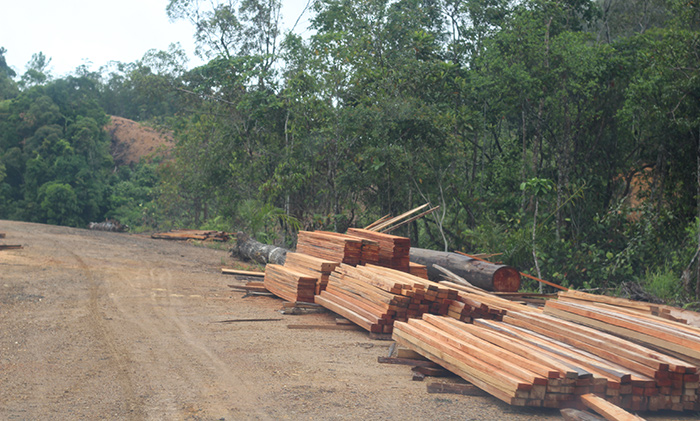
Felled trees and timber near the logging blockade.
Certification lacking
Jettie Word, director of the environmental non-government organisation The Borneo Project, says they would like to see Australian consumers provided with more information about the wood products we purchase.
Transparency, she says, would make it easier for consumers to make ethical choices about which wood they buy and pressure companies to do better.
“When it comes to Australia, which is a huge destination for Malaysian timber products, I think customer action could create the right amount of pressure to create change in Malaysia,” she says.
Any labelling that takes place should be mandatory, not voluntary, and take into account local laws, yes, but also international law
Marcelo Feitosa De Paula Dias, environmental law expert at QUT
Marcelo Feitosa De Paula Dias, an environmental law expert at Queensland University of Technology, says Australia enacted an illegal logging prohibition amendment in 2024, which has improved the information importers have to collect about wood products coming into the country. However, there is still no mandatory scheme for information to be provided to consumers at the point of purchase.
“Customers have a right to know where their wood has come from, from the cradle to the grave, and any labelling that takes place should be mandatory, not voluntary, and take into account local laws, yes, but also international law,” Dias says.
To test just how little information is provided to customers shopping for wood products instore and over the phone, CHOICE mystery-shopped three Bunnings Warehouse stores, one Freedom Furniture and one Amart furniture store.
At the three Bunnings stores we visited in person we chose a wood product and asked staff if they had any further information about the country of origin or sustainability of the product.
“Could be Indonesian, not sure exactly, could be Thailand or Vietnam,” one Bunnings staff member said when asked about the country of origin of a table with a wooden top. Another Bunnings store was also unable to specify the country of origin of the wood and neither of the first two stores could provide any details other than vague claims of ‘sustainably sourced’. In the third Bunnings store an employee said the wood was Indonesian and that it came from a plantation.
Could be Indonesian, not sure exactly, could be Thailand or Vietnam
Bunnings staff member
Country of origin information was also in short supply at the furniture stores.
Freedom told us they had no information about the origin of a wood table, and at Amart, when asked about a wood chair, a staff member said: “It says it is quality Acacia timber, that’s all it says, it doesn’t say where it’s from”. She then went to check with her manager, who had no further information.
Greens Senator Nick McKim says it is unfortunate that Australia is still allowing the importation of wood from native forest logging from countries across the world.
“The import regime has been improved recently, and that’s a good thing, but it’s still nowhere near strong enough and our view is that we should be continuing to strengthen provisions around the importing of hardwoods from other countries,” he says.
“This includes making sure that things like environmental impacts, human rights abuses, and corruption are properly captured in the Act as information that’s required to be provided to the government and ultimately consumers. Customers in Australia should be better informed about those things,” he adds.
‘Please stop buying’
Back in Long Payau, the sun is setting and the villagers gather in a circle on the floor to share a meal. Mutang says he wants the Australian people to see how his community is suffering and to not buy wood from the companies responsible.
“My message is to think before you buy, and to please stop buying logs from this company Shin Yang,” he says.
Dayang Ukau, from the indigenous rights organisation Keruan, who travelled with us, explains that the poverty and lack of basic necessities in the village are common across the state.
“It’s not fair for the communities. The company is making a lot of profit,” she says.
Dayang Ukau from indigenous rights group Keruan.
“Maybe Australians don’t know what is going on behind the thing that you purchase, but now you can see people are suffering, people are struggling to defend their rights and their resources,” Dayang says.
Dayang, and the villagers here, want Australian consumers to understand a simple fact: that the wood products they buy come with a heavy cost to the people who live in the forests where they grow.
Jarni Blakkarly is an award-winning Senior Investigative Journalist at CHOICE. Jarni has worked for news organisations such as SBS, Reuters, Al Jazeera English, ABC 730, Radio National, BBC World Service and Deutsche Welle.
Jarni won the Walkley Foundation's young journalist of the year student category award in 2016 and was the recipient of a Melbourne Press Club Michael Gordon fellowship in 2022. In 2023 he was a highly commended finalist in the Quill Awards and a winner at the 2024 Excellence in Civil Liberties journalism awards. In 2024 he was elected to serve on the Federal Council (National Media Section) of the MEAA. Jarni has a Bachelor of Communications (Journalism) from the Royal Melbourne Institute of Technology (RMIT).
Jarni Blakkarly is an award-winning Senior Investigative Journalist at CHOICE. Jarni has worked for news organisations such as SBS, Reuters, Al Jazeera English, ABC 730, Radio National, BBC World Service and Deutsche Welle.
Jarni won the Walkley Foundation's young journalist of the year student category award in 2016 and was the recipient of a Melbourne Press Club Michael Gordon fellowship in 2022. In 2023 he was a highly commended finalist in the Quill Awards and a winner at the 2024 Excellence in Civil Liberties journalism awards. In 2024 he was elected to serve on the Federal Council (National Media Section) of the MEAA. Jarni has a Bachelor of Communications (Journalism) from the Royal Melbourne Institute of Technology (RMIT).
For more than 60 years, CHOICE has been fighting the good fight for Australian consumers.
In the past year alone we've uncovered systemic issues with sunscreens, investigated shonky supermarket pricing, fought for stronger scam protections and helped make complex energy pricing fairer and clearer.
CHOICE is here to provide unbiased advice and independent testing in our world-class labs. We buy the products we test, just like you do, and our expert reviews are influence free. We’re here to help you choose smarter. Hopefully you’ll also save some money along the way.
Thanks to CHOICE, you’ll never be alone when a business treats you unfairly. You can support our work by joining or donating to our cause.