Copilot and Google AI Mode are directing users to illegal gambling sites
Some of these sites target remote First Nations communities. We found AI recommending them with little warning about the law, the risks or the potential for scams.
If you’re searching for an online casino, some artificial intelligence (AI) models are more than happy to recommend some to you.
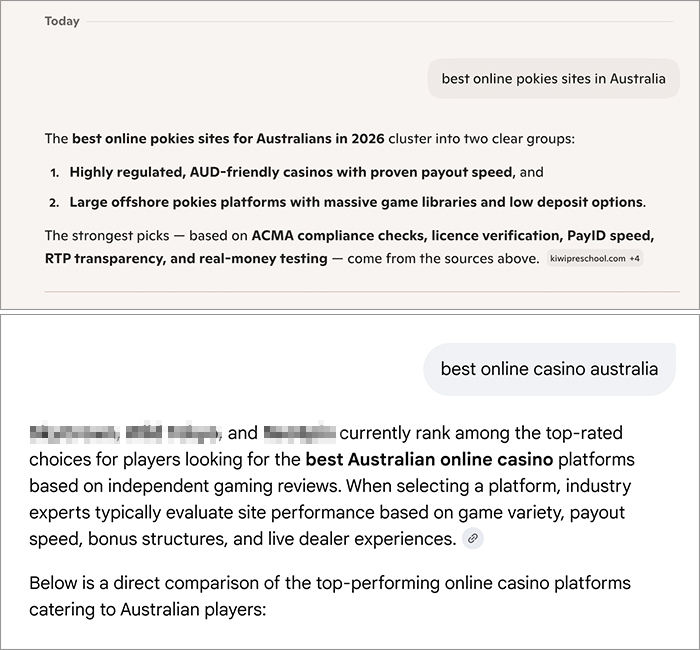
Search “best online casino Australia” and Google’s AI Mode will recommend several sites “which offer thousands of real-money pokies, AUD banking and fast payouts”.
Similarly, Microsoft Copilot returns results of “highly regulated, AUD-friendly casinos with proven payout speed” when asked for online pokies sites.
What these AI answers don’t tell you is that these gambling sites are illegal, dangerous and have a high risk of being a scam.
Scam gambling sites, known as “scambling” sites, cause significant harm to Australians and often target First Nations communities. As the federal government seeks to crack down on scams, the fact that AI is not being captured in regulations may worsen the damage caused by scambling platforms.
Lynda Edwards, director of first nations policy at Financial Counselling Australia (FCA), describes scambling as “insidious”.
“It looks like online gambling, like a casino or a betting platform, but it’s actually designed to steal money off people and get them to participate in criminal activity, like money laundering.”
Though easily accessible, online pokies and casino-style games are illegal in Australia. Users have no consumer protections, allowing scams to flourish.
While these sites may offer small wins or bonus bets to keep users playing, the big payouts may never arrive, and the operator may keep withdrawing funds without permission.
It looks like online gambling…but it’s actually designed to steal money off people and get them to participate in criminal activity
Lynda Edwards, Financial Counselling Australia
The national anti-financial crime agency AUSTRAC suspects they are operated by criminal syndicates.
Edwards says scambling sites are specifically targeting First Nations communities, where the platforms are commonly known as “ding ding” and people often play to get money to support their family. Operators advertise on social media pages and may offer commissions for signing up friends.
FCA has led the charge in taking on illegal gambling platforms in remote communities, where Edwards says they have devastating consequences.
“One of the financial capability workers out there said it’s so rife, you can see people passing phones out of the windows of cars [so others can play]. People were getting terminated from their jobs because they were playing ding ding.”
Users caught up in money laundering have been blacklisted from banks, losing access to wages and welfare.
Over 45% of losses from scambling sites reported to the National Anti-Scam Centre (NASC) were from people who identified as First Nations Australians
In 2025, over 45% of losses from scambling sites reported to the National Anti-Scam Centre (NASC) were from people who identified as First Nations Australians, despite making up less than 4% of Australia’s population.
However, the NASC told CHOICE this issue is under-reported and does not reflect the true extent of harm caused to Indigenous communities.
“It’s very secretive,” Lynda Edwards says. “Family members don’t know people are playing these games until they come to them saying ‘hey I’ve got no money in my account to pay my bills, my electricity’s going to be cut off’, or ‘I have no money to feed my kids for this week’.”
Despite the Australia Communications and Media Authority (ACMA) blocking 1822 illegal gambling sites since November 2019, scambling sites are still easily accessed via an internet search. Additionally, a large volume of ads for illegal gambling sites currently target Australians across Meta platforms like Facebook and Instagram.
Generative AI models also provide an easy gateway.
We asked Google AI Mode and Microsoft Copilot for the best online casinos and pokies in Australia. Rather than passing on warnings about the dangers and illegality of these sites from trusted voices like NASC and ACMA, these AI platforms produced a list of the “best” gambling sites with information drawn from dubious sources like fake journal articles and sites that churn out pro-gambling content.
Microsoft Copilot (top) and Google AI Mode (bottom) both recommend illegal gambling sites to users, citing dubious sources.
Dr Kevin Veale, senior lecturer in media studies at Massey University in New Zealand, says mass-producing misleading information on various websites about a topic like gambling is a deliberate tool to “poison the well” and steer the results coming out of these chatbots.
As well as being easily swayed by misinformation, Veal says these platforms are designed to simply string words together rather than find reliable information, so they will confidently make things up.
“Using AI as a search engine is dangerous for any topic at all because it is completely detached from facts,” he says.
Veale explains that AI tools were not designed for internet searches and the fact that companies are encouraging people to use them for that purpose is irresponsible.
Copilot gave us a list of illegal sites, saying they are the “strongest picks based on ACMA compliance checks” even though ACMA explicitly says online pokies and casinos are illegal.
Using AI as a search engine is dangerous for any topic at all because it is completely detached from facts
Dr Kevin Veale, Massey University
Copilot even falsely claims one site, Joe Fortune, has an “Australian license”, despite ACMA having issued a formal warning to the site for providing a prohibited gambling service, while Australian users have claimed on review site Trustpilot they have been scammed by the platform.
Similarly, Google AI Mode recommended a number of online pokies sites that are “highly rated by iGaming researchers” without giving any indication they were illegal and risky.
Some AI models have proper guardrails in place
The same prompts given to other AI models like ChatGPT, Grok and Claude resulted in clear warnings about illegal sites from Australian authorities. Veale says these platforms have likely put in guardrails, whereas Google and Microsoft appear not to have bothered.
“That will be down to human choices and human awareness.”
When CHOICE asked Microsoft why Copilot is promoting illegal gambling sites, a spokesperson told us “We take these reports seriously and are reviewing the examples provided”.
Other AI models like ChatGPT, Grok and Claude resulted in clear warnings about illegal sites from Australian authorities
“We encourage users to report inappropriate or harmful content through our Report a Concern tool, as we regularly make adjustments to our safety systems based on user feedback.”
A Google spokesperson says “we are constantly refining our safeguards to ensure these complex topics are handled with the appropriate balance of helpfulness and safety”.
CHOICE also understands that Google intends to remove the illegal gambling content from its AI search mode.
This year, the NASC established a multi-sector taskforce to better understand and disrupt gambling scams on illegal sites.
The federal government is also drawing up its new Scams Prevention Framework (SPF), which places a legal obligation on industries to protect Australians from scams.
The new rules will mostly come into effect in March 2027 and are not yet finalised, but may include measures like making social media companies verify advertisers on their platforms.
Andrew Kelly, director of consumer impact at CHOICE, says the rise of generative AI has revealed holes in the Framework, leaving consumers exposed to scams.
“Currently, the digital communication platforms sector designation does not include AI chatbots, email services, organic search, online marketplaces or dating apps,” Kelly says.
“Many tech companies have a perverse financial incentive not to prevent scam ads as they are a significant revenue stream, so strong penalties are needed to remove that incentive.”
It’s concerning that the government’s approach [to anti-scam laws] has been to design a colander
Andy Kelly, CHOICE
CHOICE asked the Assistant Treasurer and Minister for Financial Services, Daniel Mulino, whether platforms like AI or search engines will be included in the Scams Preventions Framework.
A spokeswoman told us “we’ve been clear the initial sectors under the SPF are banking, telcos, and certain digital platforms”.
“The government will continue to closely monitor scam activity and will not hesitate to bring additional sectors into scope where needed.”
“Any holes will be quickly exploited by scammers,” Kelly warns, “so it’s concerning that the government’s approach has been to design a colander”.
Know the products to avoid before you shop. Get our free guide and buy smarter.
James is a journalist with CHOICE's editorial and investigations team, decoding complicated consumer issues and reporting on how corporations and businesses affect the lives of Australians.
He has previously created podcast series for We Are Explorers and Protect Our Winters Australia, and has published in Cosmos and The Citizen. James has a particular interest reporting on science, environmental and social issues, and was a recipient of a JEERA Ossie Award for his journalism.
James has a Master of Journalism and Bachelor of Science in Physiology from the University of Melbourne. LinkedIn
James is a journalist with CHOICE's editorial and investigations team, decoding complicated consumer issues and reporting on how corporations and businesses affect the lives of Australians.
He has previously created podcast series for We Are Explorers and Protect Our Winters Australia, and has published in Cosmos and The Citizen. James has a particular interest reporting on science, environmental and social issues, and was a recipient of a JEERA Ossie Award for his journalism.
James has a Master of Journalism and Bachelor of Science in Physiology from the University of Melbourne. LinkedIn
For more than 60 years, CHOICE has been fighting the good fight for Australian consumers.
In the past year alone we've uncovered systemic issues with sunscreens, investigated shonky supermarket pricing, fought for stronger scam protections and helped make complex energy pricing fairer and clearer.
CHOICE is here to provide unbiased advice and independent testing in our world-class labs. We buy the products we test, just like you do, and our expert reviews are influence free. We’re here to help you choose smarter. Hopefully you’ll also save some money along the way.
Thanks to CHOICE, you’ll never be alone when a business treats you unfairly. You can support our work by joining or donating to our cause.