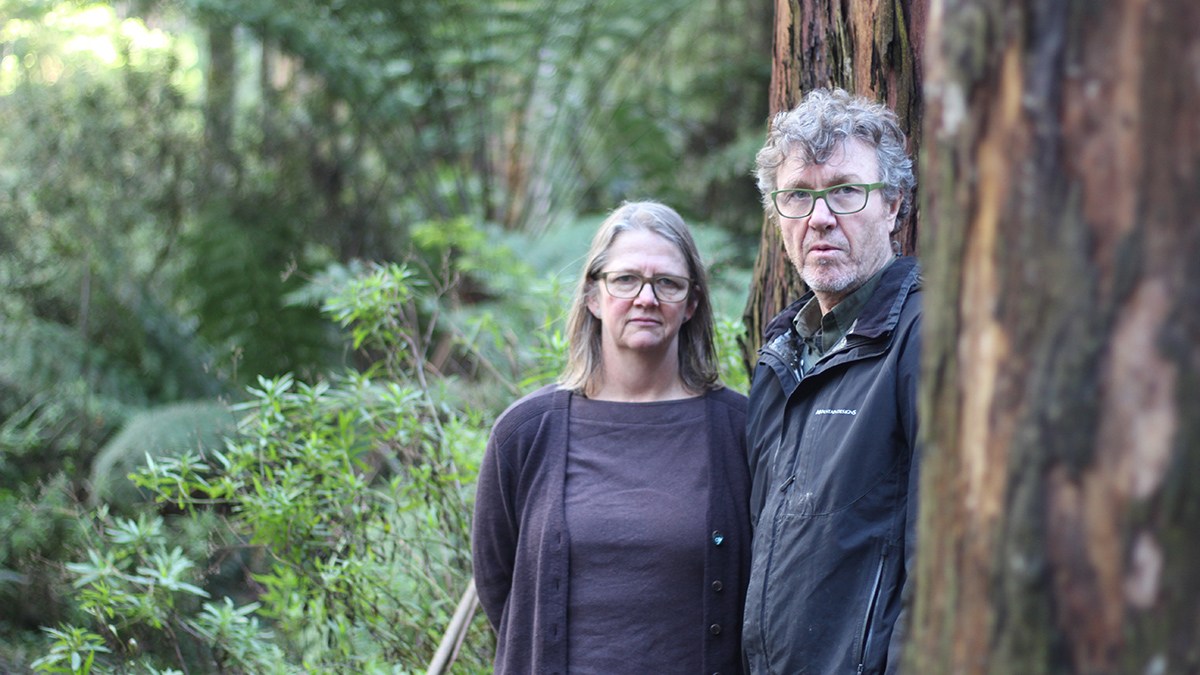
Stuart Inchley is a man who is passionate about trees.
As his wife Victoria Johnson drives the four-wheel drive along a windy mountain road, Inchley springs forward from the back seat and tells her to stop the car.
“Look, look! A slender tree fern, there’s a whole lot of them,” he says with excitement, spotting the critically endangered tree.
In the lush, dense rainforests that line the gullies of the Strzelecki Ranges, it’s easy to see the beauty that gets Inchley so worked up. And it’s easy to see why he and his wife are fighting so hard to protect it.
Across the Strzeleckis in the Gippsland region of Victoria, Inchley and Johnson estimate there are 3500 hectares of native Mountain Ash forest scheduled to be logged and turned into pine plantations.
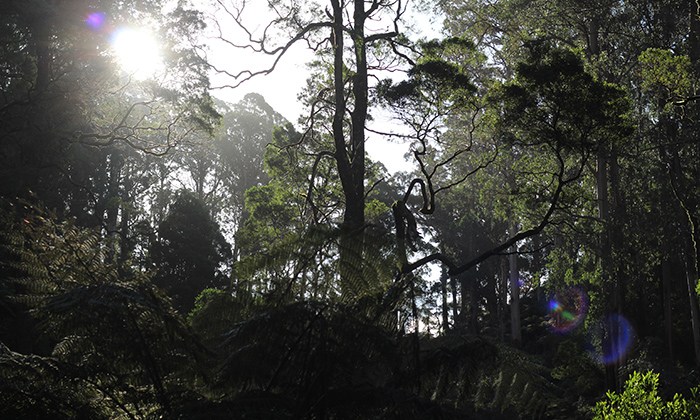
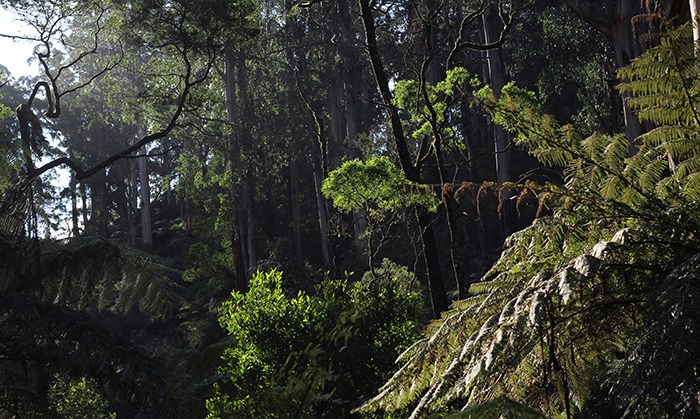
The sun shining through native forest trees in the Strzelecki Ranges.
“They are often home to a lot of the important threatened species that live around here, you’ll find gang-gang cockatoos and blue-winged parrots in the Mountain Ash here and they also create habitat for a whole lot of understory like the tree ferns and special orchids,” Johnson says.
She says imagining forests like this being turned into pine plantations is not what consumers expect when they buy wood products certified as sustainable.
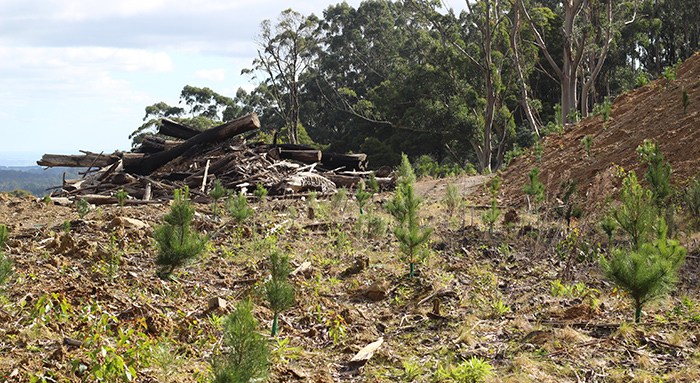
Mountain Ash trees are being replaced with pine plantations, which smother the landscape and provide little undergrowth for habitat or wildlife
Logging native trees and replacing them with pine plantations has been happening here for decades. The battle over the future of what remains of the “native forest” in Gippsland highlights bigger questions about the quality and reliability of sustainability certifications across the country.
There is a debate about whether these areas are plantations or native forests.
The logging company claims they have the right to replace what they’ve cut down with what they choose. Here, Mountain Ash trees are being replaced with pine plantations, which smother the landscape and provide little undergrowth or habitat for wildlife.
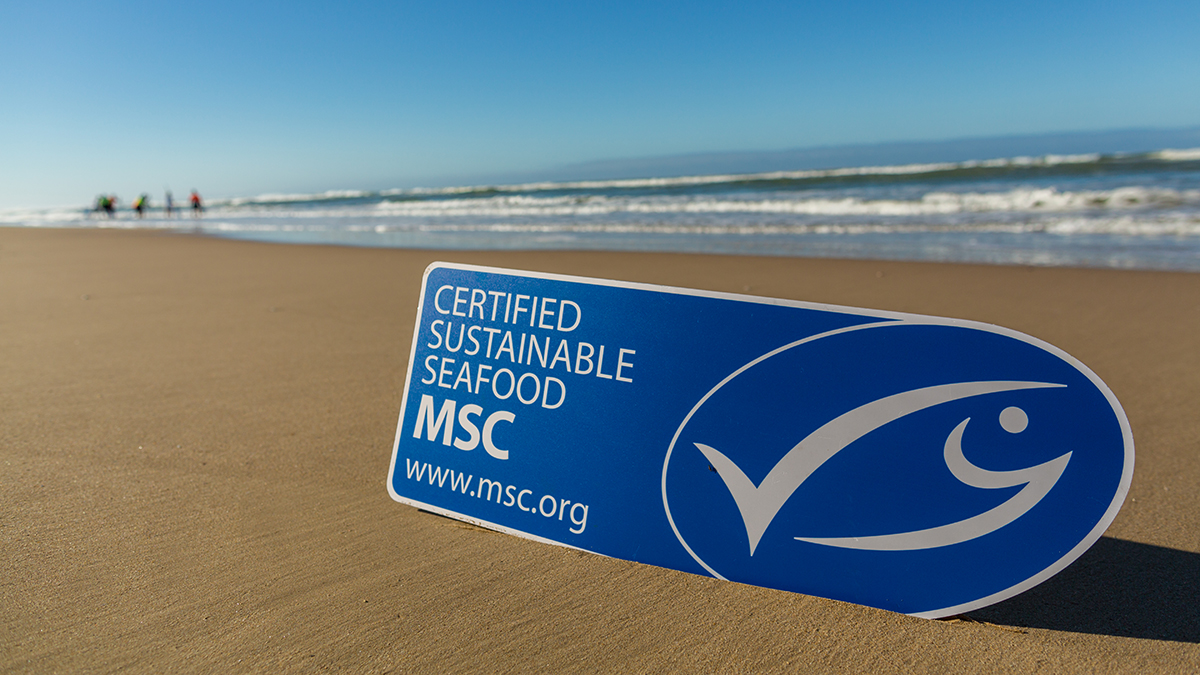
The logging taking place here is certified and stamped with the approval of an environmental certification scheme many Australians recognise and trust, but activists say that scheme is letting consumers and the environment down. They argue that it allows logging companies to harvest from native forests while misleading consumers into thinking their purchasing choices help protect them.
Logger disputes ‘native forest’ claim
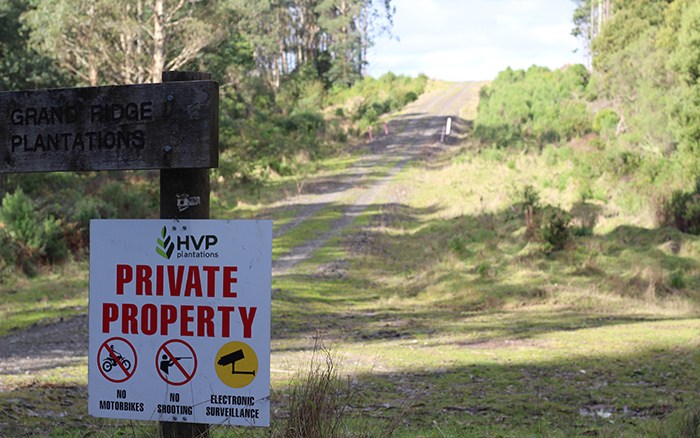
Lisa Barrand from the Gippsland Forest Guardians, an organisation she runs with Johnson and Inchley, explains that the land here is licensed in perpetuity to the logging company Hancock Victorian Plantations (HVP), which has the licence to log plantation timber. Meanwhile, it remains crown land.
HVP describes itself as one of Australia’s largest private timber plantation companies, owned by a mix of Australian and international investors.
“HVP’s mission is to manage the plantation estate in a safe and sustainable way to optimise the return to our investors whilst balancing the needs of our employees, customers and local communities,” the company claims.
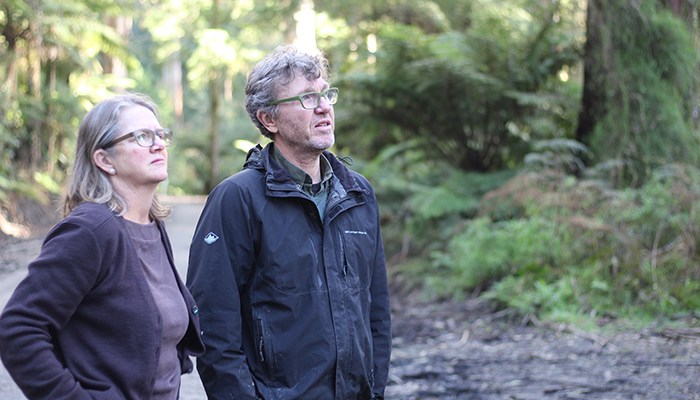
Victoria and Stuart observe the forest
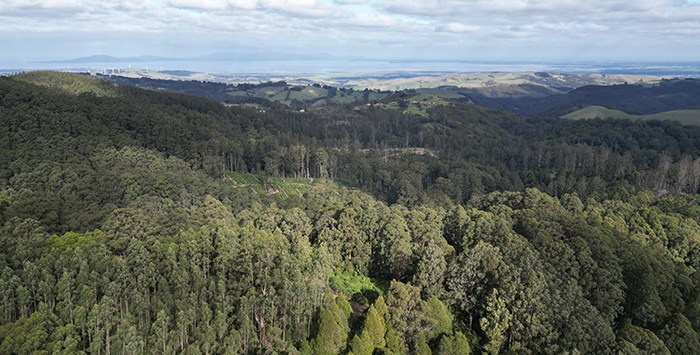
Hill cleared by HVP for pine plantation
Ferns in native forest in the Strzelecki Ranges
HPV private property sign for logging licence on crown land
But Barrand says some of the areas being logged in this region, particularly those with Mountain Ash, are native forests that shouldn’t be cut down to be replaced with pine.
“What we have said is ecologically, when you’re down there, it’s a forest. It’s not a plantation. You might have a map and someone has written on the map ‘plantation’, and maybe someone even sold it to you saying it was a plantation, but it certainly looks exactly like a forest now and meets the Forest Stewardship Council (FSC) criteria of native forest,” she says.
When you’re down there, it’s a forest. It’s not a plantation
Lisa Barrand, Gippsland Forest Guardians
According to a spokesperson, HVP doesn’t regard the Mountain Ash in question as “forest” and refers to it as “planted hardwood”.
“HVP does not harvest native forest and that has been confirmed by our professional qualified certification auditors,” they told CHOICE.
“We proudly plant, nurture, harvest and replant trees in a safe and sustainable way.”
Two certification bodies, two very different standards
There are two main certification bodies in Australia for sustainable wood product labelling, FSC and Responsible Wood. HVP holds certification from both bodies.
Conservation biologist and ecologist Professor David Lindenmayer from Australian National University says the standards of certification maintained are much higher with FSC than Responsible Wood, but that these standards remain poorly understood by the community.
“It’s kind of like chocolate. You see a stamp that says ‘Fair Trade’ and you assume a certain standard is being maintained, but the reality might be something different,” he says.
No Australian consumer can categorically have confidence that the wood they are purchasing is sustainably managed,
Tim Cadman, Griffith University
Tim Cadman, adjunct senior research fellow at Griffith University, says while the FSC system is far from perfect, there are also problems with bad actors in the logging industry that engage in a practice known as “forum shopping”.
If FSC makes more stringent demands for sustainability than companies are willing to follow, they’ll switch to the less restrictive Responsible Wood certification. In the end, it’s largely the loggers who are controlling the sustainability narrative.
“No Australian consumer can categorically have confidence that the wood they are purchasing is sustainably managed,” Cadman says.
The scarred landscape of the Strzelecki Ranges
FSC responds
FSC says they set standards for responsible forest management that certificate holders must meet, but they “do not make decisions about whether certification should be granted, maintained, suspended or withdrawn”. They said decisions are made by third-party bodies that regularly audit certificate holders and assess their conformity with FSC requirements.
“FSC takes stakeholders’ concerns seriously and has an established complaints procedure that provides a clear pathway for concerns to be raised, investigated and actioned where substantiated. FSC also has a process to clarify requirements as needed to ensure standards are interpreted and applied consistently,” a spokesperson for FSC Australia and New Zealand says.
The body says in regards to HVP, a “third and final interpretation” is in the process of being developed to “determine the circumstances under which it is permissible under FSC standards to re-establish harvested native species plantations with an exotic species”.
This interpretation is due to be handed down later this year.
Barrand is calling on the FSC certification body to act to ensure faith is maintained in the scheme.
“It’s fundamental to the whole country that these FSC systems work, I want them to work for all of us,” she says.
“For anyone who cares about the environment, you should be really worried that these things are still going on. Even if you don’t care about the environment, you should feel ripped off as a consumer because you are paying a premium for poor forestry practices.”
There’s not much like this left around and so the bits that we’ve got, we’ve got to really protect them
Stuart Inchley, speaking about the Mountain Ash forest
Driving back along the road surrounded by Mountain Ash, Stuart Inchley says it is important to protect the forest for future generations, adding that he hopes FSC will do the right thing and force HVP to stop turning this area into pine plantations. He says the threat of losing their certification is powerful leverage.
“There’s not much like this left around and so the bits that we’ve got, we’ve got to really protect them,” he says.
Get the inside story on our investigations, campaigns and the difference they make.
Jarni Blakkarly is an award-winning Senior Investigative Journalist at CHOICE. Jarni has worked for news organisations such as SBS, Reuters, Al Jazeera English, ABC 730, Radio National, BBC World Service and Deutsche Welle.
Jarni won the Walkley Foundation's young journalist of the year student category award in 2016 and was the recipient of a Melbourne Press Club Michael Gordon fellowship in 2022. In 2023 he was a highly commended finalist in the Quill Awards and a winner at the 2024 Excellence in Civil Liberties journalism awards. In 2024 he was elected to serve on the Federal Council (National Media Section) of the MEAA. Jarni has a Bachelor of Communications (Journalism) from the Royal Melbourne Institute of Technology (RMIT).
For more than 60 years, CHOICE has been fighting the good fight for Australian consumers.
In the past year alone we've uncovered systemic issues with sunscreens, investigated shonky supermarket pricing, fought for stronger scam protections and helped make complex energy pricing fairer and clearer.
CHOICE is here to provide unbiased advice and independent testing in our world-class labs. We buy the products we test, just like you do, and our expert reviews are influence free. We’re here to help you choose smarter. Hopefully you’ll also save some money along the way.
Thanks to CHOICE, you’ll never be alone when a business treats you unfairly. You can support our work by joining or donating to our cause.