When heading overseas, many countries now allow you to apply for a visa or fill out an arrival card online, meaning that long embassy visits or asking for a pen mid-flight are becoming a thing of the past.
While this can make travel admin smoother, it also creates opportunities for fraudsters to fool unsuspecting travellers.
Scammers are mimicking official foreign government websites, tricking you into handing over your money and personal information.
Here’s how to watch out for this online scam when heading abroad.
It can be hard to tell if a foreign government website is legit. We’re unlikely to recognise whether or not the domain name looks right, or if the government graphics look real or fake.
Scammers capitalise on this confusion, with official-sounding web addresses and sleek-looking designs.
The Indian government, for example, has identified hundreds of fake visa sites. While the official visa site is indianvisaonline.gov.in, scammers have registered domains such as indianevisagov.in or indianvisa.org.in. And since Thailand introduced a digital arrival card in 2025, its government says at least 10% of foreign arrivals have mistakenly used scam or rip-off sites.
Some websites might provide legitimate documents, but slap exorbitant fees on top of existing government charges, and there is no telling what these sites might do with your personal information.
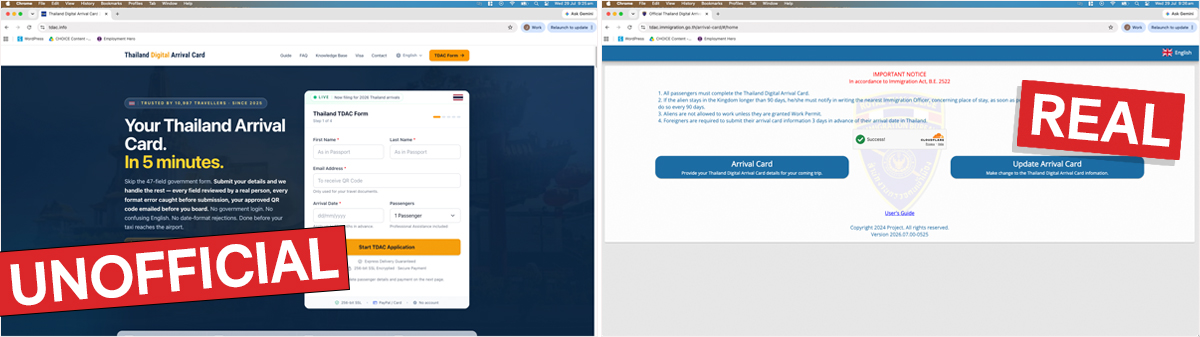
For example, scam or unofficial versions of the Thai website offer express approvals and charge up to $150 for arrival cards, whereas the official process is generally instant and free.
Other countries such as Singapore, China and Malaysia, where travellers must also fill out a free digital arrival card, have issued warnings about similar websites.
On the left is an unofficial site charging fees in exchange for a Thai arrival card, while the one on the right is the legitimate government website.
Some fraudulent or unofficial websites have also run ads on Google, meaning they may appear at the top of search results for visas or arrival cards. Travellers asking AI for assistance have also reported being sent to scam sites.
Aside from handing scammers your money and information, arriving into a country with fake documents might land you in trouble.
In the best case scenario, you may be able to buy a real visa when you land. However, Australia’s Department of Foreign Affairs and Trade warns that you could be accused of trying to enter a country illegally, and be arrested or jailed.
CHOICE insurance expert Jodi Bird says most travel insurance policies won’t reimburse money you’ve sent away before your trip for a visa that’s fake or didn’t arrive.
“Travel insurance primarily covers events that occur when you’re already on a trip, so presuming the booking was made at home, before your departure, it won’t be covered,” Jodi explains.
If you have fallen for a fake site while travelling, it’s a similar story.
Insurers generally won’t cover you for costs incurred as a result of you not organising the appropriate passport, visa or travel permits.
CHOICE looked through the product disclosure statements of 89 travel insurance policies from well-known providers, and Jodi’s interpretation suggests you won’t likely be covered for website scams.
“Many policies contain an exclusion that relates to a ‘cyber act’,” Jodi says. “Cyber acts can be a threat or hoax threat involving access to, processing of, use of or operation of a computer system.”
Insurers generally won’t cover you for costs incurred as a result of you not organising the appropriate passport, visa or travel permits
Hoax websites would likely fall under this definition.
Only one policy CHOICE analysed considers several common travel scams a “cyber incident”, and offers cover for disruptions they cause.
Given it’s unlikely your travel insurance will bail you out of these scams, prevention is the best protection.
To avoid these scams, remember: Stop. Check. Protect.
Stop
If you’re applying for travel documents last minute or tired after a long flight, it can be easy to click on the wrong website.
Scammers are counting on this. Don’t rush into handing over your passport details, personal information or money. Give yourself plenty of time to research and apply for visas.
Just because a site appears at the top of your search results doesn’t mean it is legitimate. Scammers pay for sponsored ads to snare jetlagged travellers. When you land, avoid Googling “digital arrival card”.
And don’t trust AI to send you to the right site.
Check
It can sometimes be hard to tell a legitimate foreign government website from a real one. Luckily, the Australian government has found the correct sites so you don’t have to.
Click “Destinations” at the top of the page. Find your country, and scroll down to the “Travel” section. Here you will find visa and arrival card information, and the right websites to visit.
With arrival cards, often your airline will tell you where to go to fill it out. If you’re still unsure, seek official signage for a web address or QR code when you land, or ask immigration staff.
Generally, filing out an arrival card is free, so be wary of websites trying to charge you.
Some sites might also offer faster processing times, but since visas or arrival cards are handled by the government, no external organisation can legitimately claim this.
Protect
If you think you’ve been scammed, contact your bank immediately. If you have handed over your passport details, there is a risk it may be used for identity fraud.
James is a journalist with CHOICE's editorial and investigations team, decoding complicated consumer issues and reporting on how corporations and businesses affect the lives of Australians.
He has previously created podcast series for We Are Explorers and Protect Our Winters Australia, and has published in Cosmos and The Citizen. James has a particular interest reporting on science, environmental and social issues, and was a recipient of a JEERA Ossie Award for his journalism.
James has a Master of Journalism and Bachelor of Science in Physiology from the University of Melbourne. LinkedIn
For more than 60 years, CHOICE has been fighting the good fight for Australian consumers.
In the past year alone we've uncovered systemic issues with sunscreens, investigated shonky supermarket pricing, fought for stronger scam protections and helped make complex energy pricing fairer and clearer.
CHOICE is here to provide unbiased advice and independent testing in our world-class labs. We buy the products we test, just like you do, and our expert reviews are influence free. We’re here to help you choose smarter. Hopefully you’ll also save some money along the way.
Thanks to CHOICE, you’ll never be alone when a business treats you unfairly. You can support our work by joining or donating to our cause.