When Özge was searching for a place to live in Melbourne’s north this year, she found herself doubting her own reality.
Between working as a librarian and raising two kids as a single mother, Özge had limited time to inspect properties. When she saw online photos of a tidy-looking home in Jacana, she thought she might have been onto a winner and decided to attend an inspection.
“I stepped in, looked at the carpet and I’m like, are we in the right house?”
To Özge, the discoloured floor, kitchen cabinets hanging off the walls, mould and cracks looked vastly different to the online listing.
CHOICE has found examples across Australia of real estate images that have been manipulated by artificial intelligence (AI). Regulators warn that digitally-altered images may be illegal where they misrepresent properties.
Amid a housing crisis, consumers and experts are concerned that digitally altered real estate pictures are making house-hunting even harder.
Digital tools like photo editing and virtual staging, where a room is filled with digital furniture, have long been available to real estate agents and homesellers wanting to show a property in its best light or even hide undesirable features.
But with the rapid development of generative AI, photo editing tools can be deployed instantly at a low cost and doctored images are a growing trend on real estate websites, a practice known as “housefishing”.
Jeannie Paterson, professor of consumer protection law at the University of Melbourne says manipulating an image of a rental property or property for sale may be considered misleading and deceptive conduct, an offence under Australian Consumer Law. She says undisclosed use of AI to alter images adds another layer of deception.
“You don’t need to show that a loss has been suffered, you just have to show that it is likely to mislead, ” Paterson says. “And in any case, there is a loss, a loss of people’s time and interest”.
Homebuyer Özge says she could only take her two young children to a few inspections before they grew impatient and bad-tempered, as young children do, and the time wasted at houses that she felt she’d been tricked into inspecting meant she missed out on seeing other properties.
“When it’s your own time, energy and sanity wasted because a real estate agent got a little bit too excited with some AI tools, it’s not fair.”
In addition to federal consumer law, changing the appearance of a property for sale or rent may also be an offence under state laws in many jurisdictions.
When it’s your own time, energy and sanity wasted because a real estate agent got a little bit too excited with some AI tools, it’s not fair.
Özge, homebuyer
In September, New South Wales parliament legislated obligations for agents to disclose the use of AI in images that could deceive tenants, adding onto existing laws that prohibit misleading property advertising across rentals and sales.
Any use of AI to alter real estate images must be disclosed in NSW, including the addition of AI-generated furniture, which the state government says could hide structural damage or misrepresent room proportions.
Queensland also requires agents to clearly label any AI-generated image and disclose any difference between the image and actual home.
Queensland’s Office of Fair Trading says even though a buyer or tenant may conduct their own searches of a property, this does not lessen the responsibility of the agent to maintain transparency.
“Even if you are not aware that content generated by AI is inaccurate, you may still be liable for misrepresentation,” the Queensland regulator warns.
Generative AI is known to hallucinate, creating false or inaccurate information and passing it off as fact. The use of AI image tools on real estate listings may create unintended changes to images.
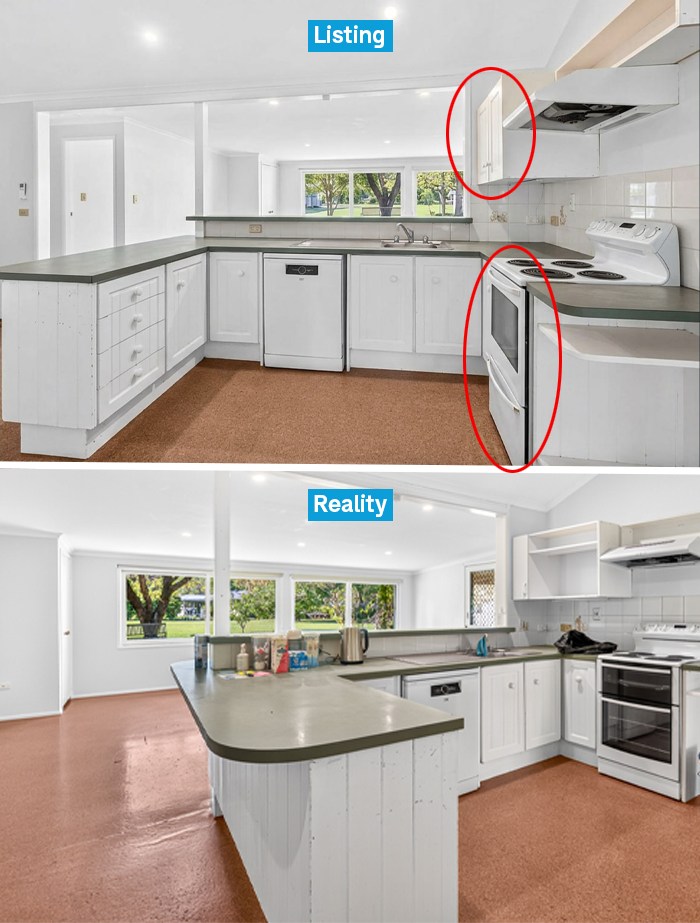
One house listed online for sale in Mullumbimby, New South Wales was advertised in October with images that were digitally altered with AI. The agent told CHOICE the technology was used to remove items the previous tenants had not yet cleared.
While the AI tool had digitally cleaned the house, it also redesigned the kitchen bench and installed a new oven and cupboards.
When the NSW real estate agency used AI to remove clutter from an image, the technology “hallucinated”, changing the oven and cupboards.
The inaccurate benchtop has since been removed from the listing, and other pictures containing inaccuracies now bear messaging stating that AI editing tools have been used for illustrative purposes.
One renter told CHOICE they were shocked after inspecting a property in Victoria’s Heidelberg Heights listed by real estate agency Nelson Alexander.
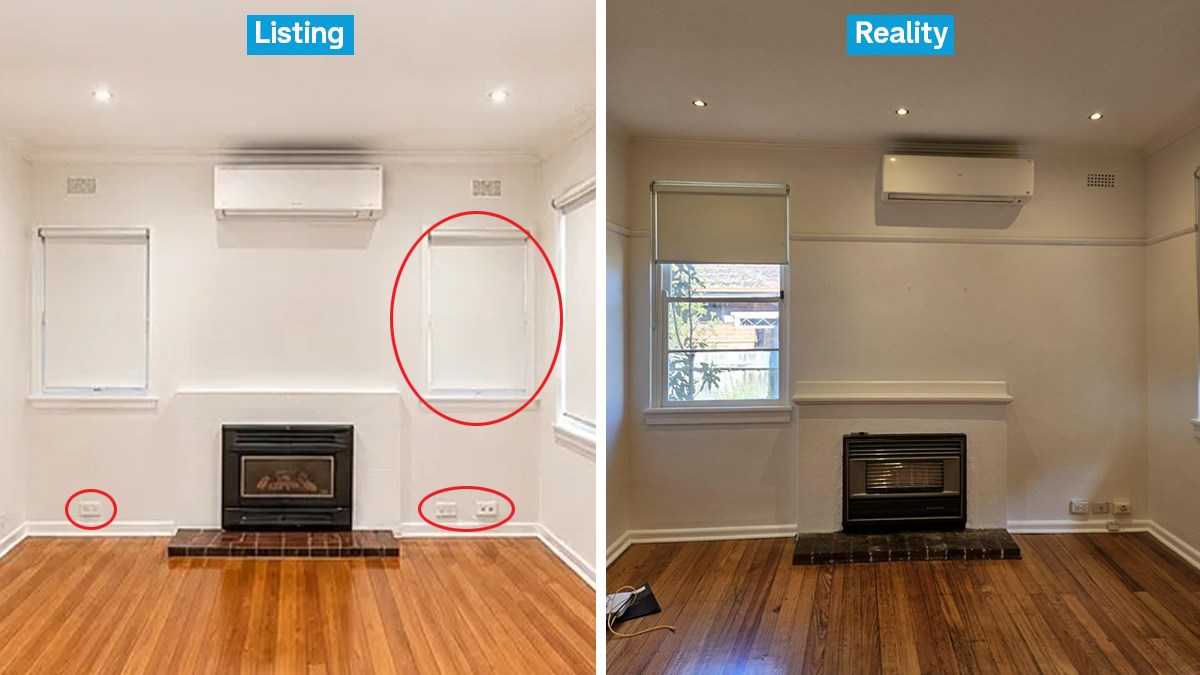
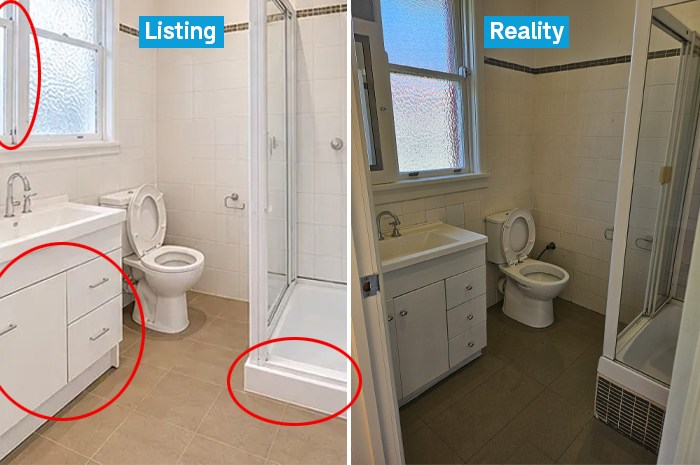
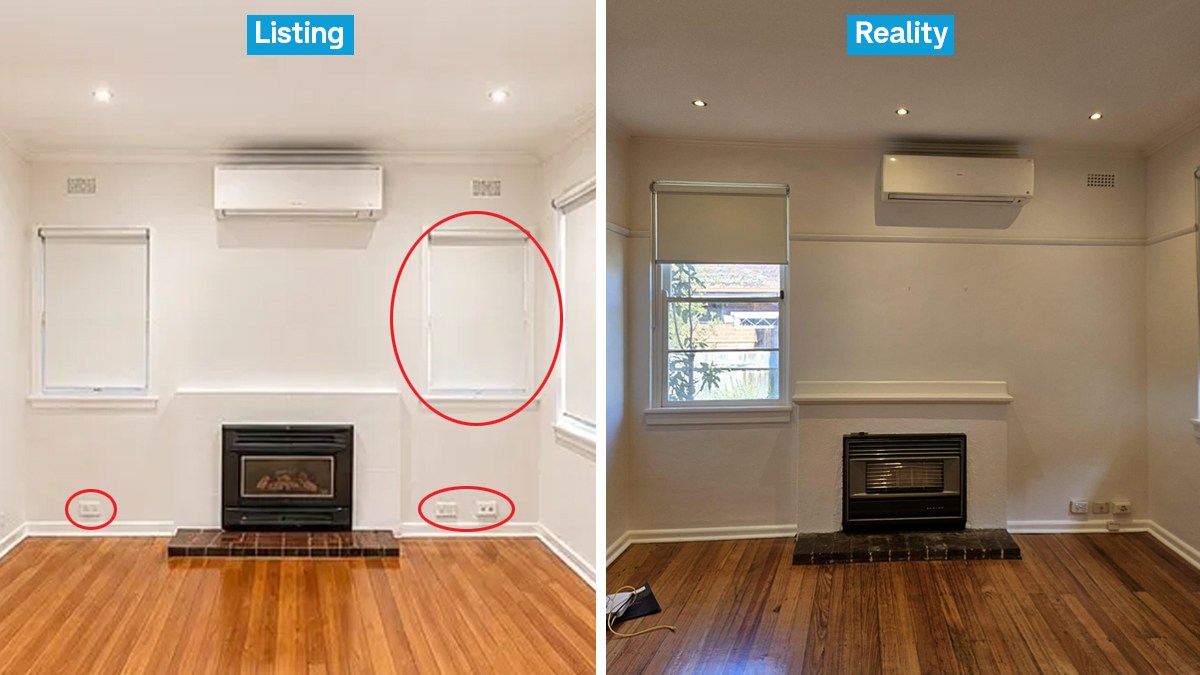
Compared to unedited pictures taken at the property inspection, the images used by Nelson Alexander included extra windows, a new shower and redesigned cupboards in the kitchen and bathroom.
The AI-altered image of the property posted online by Nelson Alexander featured a different shower and cupboards, and an additional window.
Nelson Alexander confirmed the use of AI tools on this property listing and told CHOICE it should not have occurred, acknowledging that the images were not an accurate representation of the property.
“We have previously communicated to our teams that AI should never be used to alter or edit any property images,” Nelson Alexander COO Jamie Owen says.
“The use of AI-generated or materially altered property images is not an accepted practice at Nelson Alexander and is not in line with our policies and expectations.”
Nelson Alexander’s AI-altered image in the online property listing included an additional window and power points.
Like elsewhere in Australia, it is unlawful in Victoria to make false or misleading representations about the characteristics of a property, the state’s consumer watchdog says.
“Consumer Affairs Victoria takes reports of real estate agent misconduct seriously and will investigate and take action where necessary.”
Deputy CEO of Tenants Victoria Cameron Bloye says AI-manipulated images may be convincing renters to visit properties under false pretenses, making the house hunt harder.
“With the difficulty of securing a rental property, people are going to more inspections and applying for more properties than they would have in the past.”
There is absolutely a risk that renters are induced to enter into a rental agreement without realising that there’s damage that’s been obscured
Cameron Bloye, Tenants Victoria deputy CEO
Bloye says Tenants Victoria is also concerned AI is being used to hide mould or other damage that does not meet minimum property standards. From October, Victorian landlords and agents must keep records to show that a property met minimum standards before it was advertised. Prospective tenants may not be able to check every detail in the limited time they have to inspect a property, Bloye says, and have to trust the images on property listings.
“I think there is absolutely a risk that renters are induced to enter into a rental agreement without realising that there’s damage that’s been obscured from the way the photos have been edited,” Bloye says.
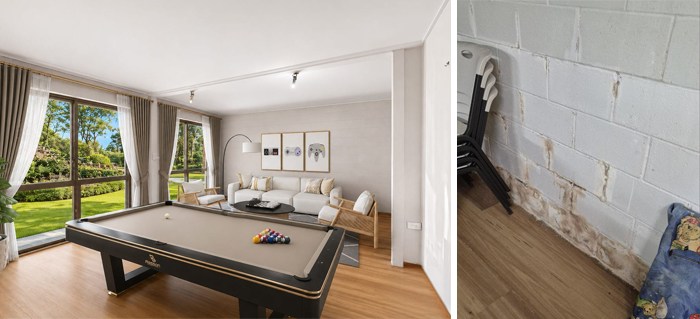
One prospective homebuyer inspecting a property this year in southeast Queensland encountered poor conditions that did not appear in the online photos. An image they had taken during the inspection, shared with CHOICE via Reddit, shows mould growing on a discoloured brick wall inside the house. The online listing, however, shows a clean, uniformly painted wall, partially blocked by furniture which the homebuyer suspects was AI-generated. A SynthID detector, which looks for hidden AI watermarks, found the image was made or edited by OpenAI.
The image in the property listing (left) contained an AI watermark and appears to hide the mould and discolouring on the back wall which can be seen in the photograph (right) taken by a prospective buyer.
CHOICE contacted the real estate agency to ask about its use of digital tools. The agency did not respond.
If you have encountered real estate advertising you think is misleading or deceptive, you can report it to your state or territory’s fair trading body.
While NSW will soon require labelling of AI in rental ads, some say that does not go far enough. Ahead of the state election, the Victorian Greens announced in October that, if elected, they would introduce an outright ban on AI-altered images in rental listings.
“Slapping a tiny AI disclaimer on a misleading photo doesn’t cut it. If an image doesn’t accurately show the property, it shouldn’t be in the ad,” Victorian Greens spokesperson for renting Gabrielle de Vietri says.
Beyond real estate, businesses everywhere have adopted AI tools, but Australian consumers don’t share this enthusiasm.
We’re already seeing the disastrous impacts AI can have on consumers, and without safeguards, this is likely to worsen
Jordan Cornelius, CHOICE senior campaigns and policy advisor
Research conducted by CHOICE in June 2026 found less than one in ten Australians think AI is making products and services better.
The nationally-representative survey also found that 70% of Australians disagree that businesses should be trusted to use AI how they think is best.
“We’re already seeing the disastrous impacts AI can have on consumers, and without safeguards, this is likely to worsen,” CHOICE senior campaigns and policy advisor Jordan Cornelius says.
“We urgently need the government to introduce laws that address the emerging risks AI poses to consumers.”
CHOICE is calling on the federal government to introduce laws mitigating the risks of AI to consumers, from more resources to tackle the misuse of AI against consumers to more obligations on businesses to stop AI supercharging scams on their watch.
James is a journalist with CHOICE's editorial and investigations team, decoding complicated consumer issues and reporting on how corporations and businesses affect the lives of Australians.
He has previously created podcast series for We Are Explorers and Protect Our Winters Australia, and has published in Cosmos and The Citizen. James has a particular interest reporting on science, environmental and social issues, and was a recipient of a JEERA Ossie Award for his journalism.
James has a Master of Journalism and Bachelor of Science in Physiology from the University of Melbourne. LinkedIn
For more than 60 years, CHOICE has been fighting the good fight for Australian consumers.
In the past year alone we've uncovered systemic issues with sunscreens, investigated shonky supermarket pricing, fought for stronger scam protections and helped make complex energy pricing fairer and clearer.
CHOICE is here to provide unbiased advice and independent testing in our world-class labs. We buy the products we test, just like you do, and our expert reviews are influence free. We’re here to help you choose smarter. Hopefully you’ll also save some money along the way.
Thanks to CHOICE, you’ll never be alone when a business treats you unfairly. You can support our work by joining or donating to our cause.