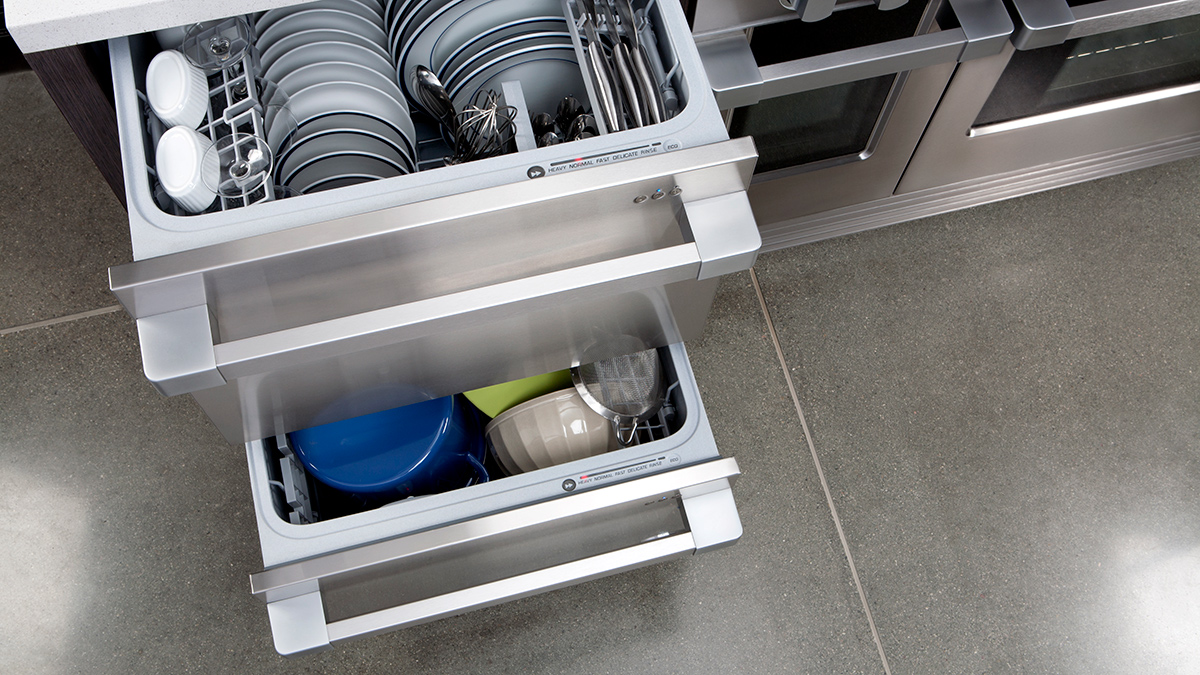
As far as product names go, drawer dishwashers couldn’t be more on the money. Instead of using a hinged door, the racks slide in and out like, well, a chest of drawers.
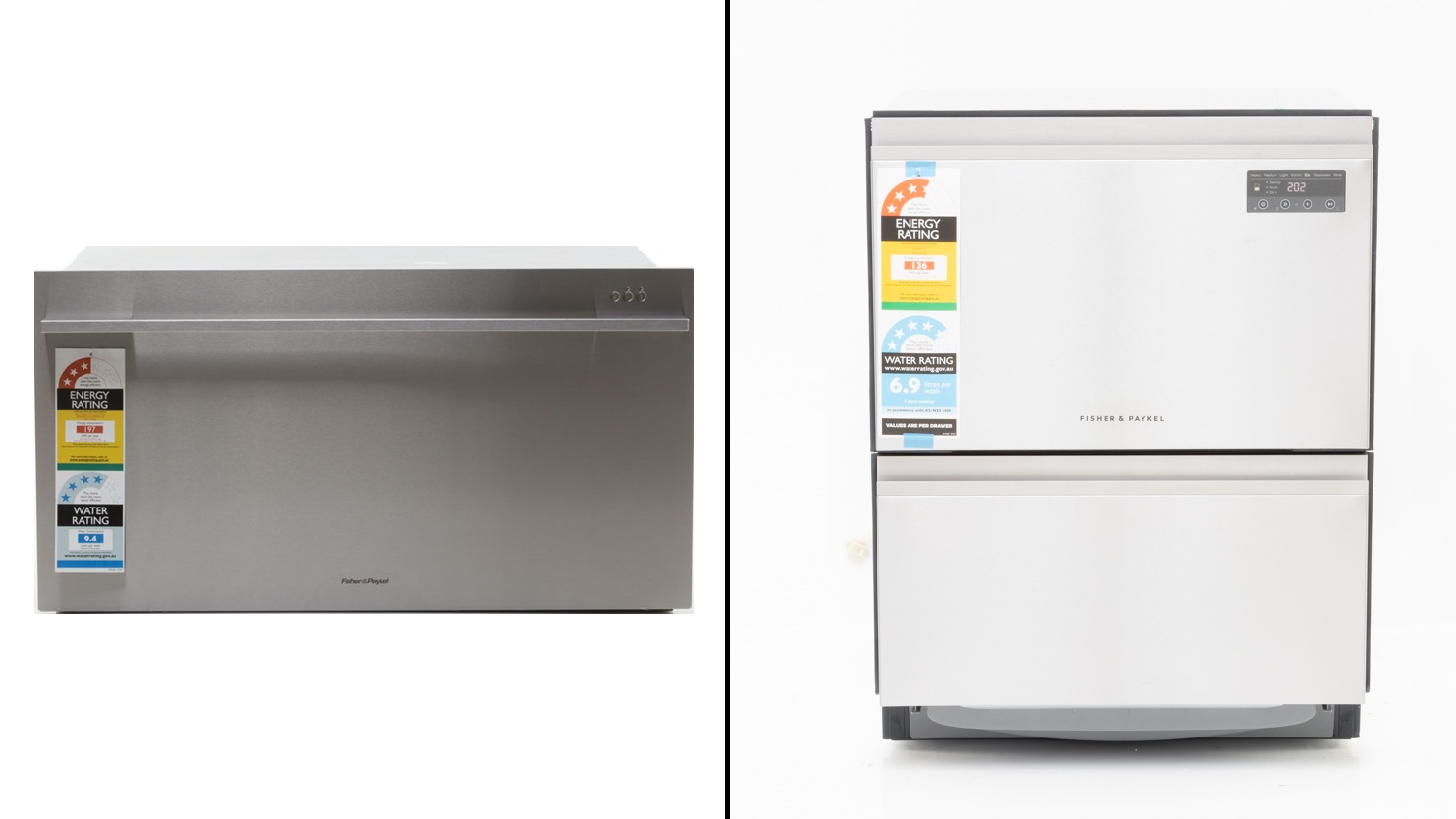
Available in single and double designs and almost exclusively made by Fisher & Paykel (in Australia), this style of dishwasher is often touted as being a great space-saver. But there are other advantages and a few notable shortcomings.
Are they better or worse than conventional dishwashers? Do they consume less water and energy across the course of the year? Are they easy to use? Our lab experts have the answers.
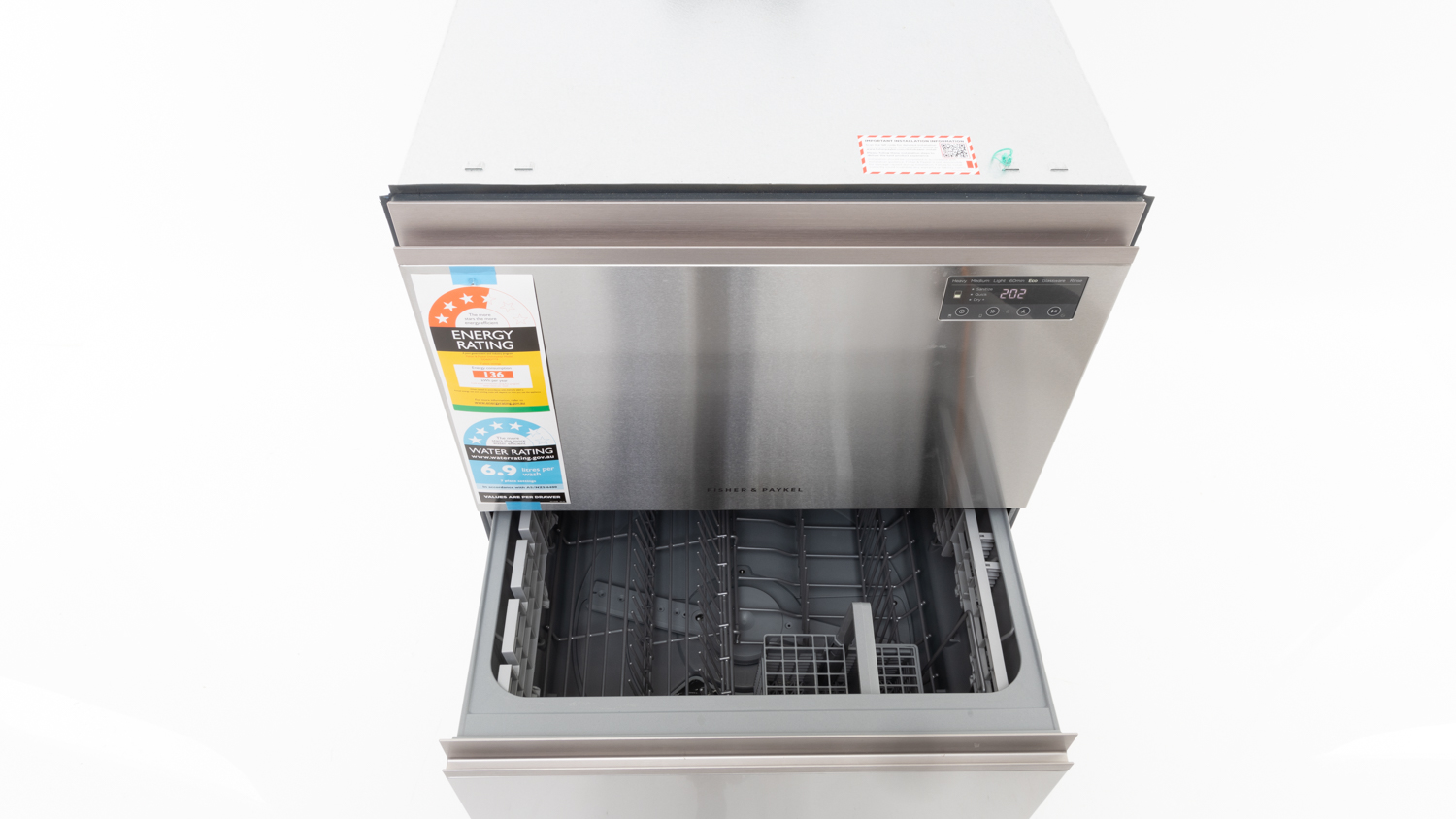
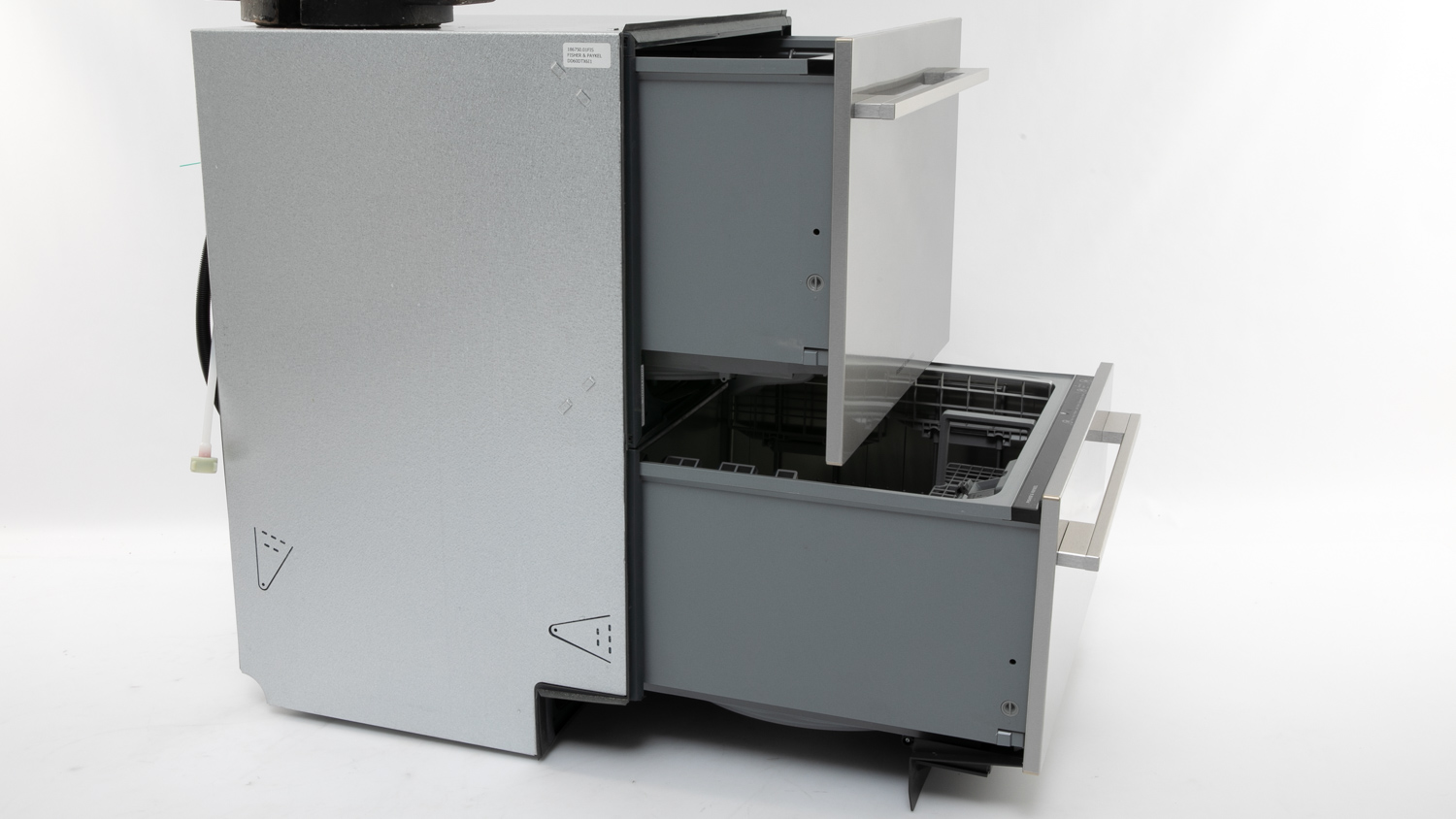
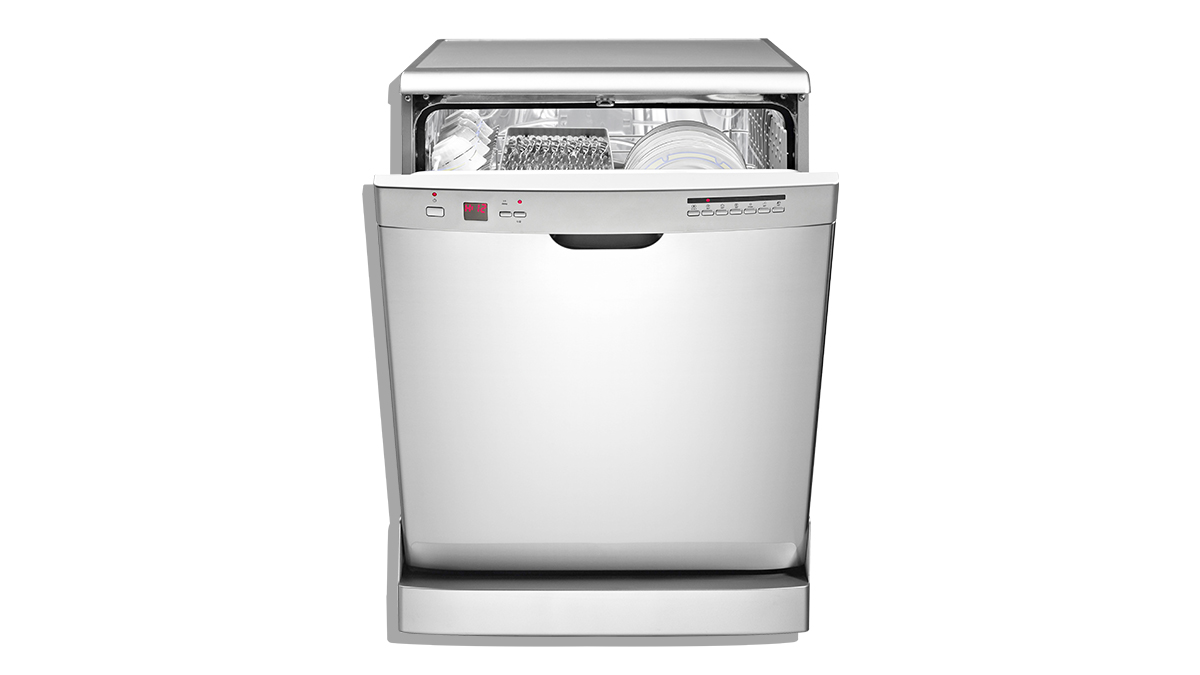
These dishwashers come in two flavours: single- and double-drawer. Double-drawer systems are basically two single drawers stacked on top of each other. They’re about the same size as a conventional dishwasher.
Drawer dishwashers are available in single and double configurations.
Should I buy a Fisher & Paykel drawer dishwasher?
In Australia, if you’re looking for a drawer dishwasher, you don’t have much of a choice. As of 2026, Fisher & Paykel is the only major manufacturer of drawer dishwashers with widespread distribution in Australia.
Smeg, Inalto, Omega and a few other brands gave it a shot but ended up sticking with conventional models, for the most part. If you come across a drawer dishwasher that isn’t made by Fisher & Paykel, it’s probably old stock, a factory second or pre-owned.
How much do drawer dishwashers cost?
Single-drawer dishwashers start at around $1500 while double-drawer models range from $2200–$3000. Prices have steadily gone up since we started testing these models and though they aren’t the most expensive options in our test, they’re getting close.
At around $200 per year, double-drawer dishwashers aren’t exactly cheap to run. In fact, they’re among the models with the highest annual running costs in our test.
Single drawers aren’t so bad, costing around $100 each year. This is comparable to most small or slimline dishwashers. Though these costs could blow out if you find yourself running excessive loads each week, because of the washer’s smaller size.
Our testers found that the cleaning performance and energy consumption of drawer dishwashers is mostly good, but not great. Dishwasher expert Shafi Noor explains.
“Drawer dishwashers earned OK to good cleaning results in our tests, which is fine for everyday loads,” he says. “But we haven’t come across any models that match top performing conventional dishwashers.”
“The main recurring weakness is redisposition of certain foods like cereal and spinach, instead of cleaning these things away. They also tend to struggle with stubborn, dried-on foods and sauces.”
“And as for efficiency, a fully loaded, double-drawer dishwasher uses a similar amount of water and energy as a conventional model during a cycle, but that doesn’t tell the whole story,” he adds.
“Drawer dishwashers don’t have as much interior space, so on a per-item basis, they actually tend to use more water and energy. The water and energy advantages only really come through if you’re constantly running small loads.”
Are drawer dishwashers hard to install and maintain?
Experienced DIYers shouldn’t have much trouble installing a drawer dishwasher. They’re similar to conventional models with a few quirks, according to Shafi.
Double-drawer dishwashers use two drain hoses so they can operate independently, which may be a problem if the kitchen plumbing only has a single drain line.
“You can fix this with a supplied drain hose joiner,” says Shafi. “Though that adds a bit of extra work compared to a conventional install.”
“Leveling is also more important,” he adds.” Conventional dishwashers tolerate small misalignments more gracefully whereas drawer dishwashers need to be pretty precise.”
Be wary that maintenance can get expensive and may not be within the abilities of some less experienced general appliance technicians.
Be wary that maintenance can get expensive
“Fisher & Paykel design and dominate the drawer dishwasher format, so most components come from them,” says Shafi. “There’s almost no aftermarket competition, which keeps part prices firmer than they would be for other brands.”
“Some general appliance techs can work on them, but the unique drawer mechanism, lid seal and motor may mean less-experienced service people could require more repair time, which can get expensive,” he adds. Equally, if you live in a regional or rural area you may have trouble finding someone with the requisite skills.
That said, Fisher & Paykel’s warranty service is generally well-regarded and readily available across the country.
Text-only accessible version
Should you buy a drawer dishwasher?
Drawer dishwasher pros:
Space saving: Single drawer models may suit small kitchens. Flexible cleaning: Double drawer models can run different cycles at the same time. Smaller loads: Can reduce water and energy bills with a smaller load in a single drawer. Easier to access: Don’t need to bend down as far if the top drawer is level with the bench. Easier to load: Can still fill most of the drawer if it’s partially closed.
Drawer dishwasher cons:
Single manufacturer: Fisher & Paykel dominates the market, limiting variety and increasing costs. Can be expensive: Single drawer dishwashers start at about $1500, double drawers range from $2200-3000. Limited vertical space: Rules out items like tall stockpots, large mixing bowls, oversized platters and so on. Can use a lot of water: Most double drawer dishwashers in our test use 18–21 litres of water per cycle.
Drawer dishwasher pros
So far, drawer dishwashers haven’t presented an overly compelling case to ditch your conventional cleaner. But there are a few advantages.
They save space
Space saving is the big selling point, especially for single drawer systems. They can be a good option for smaller kitchens and living areas, like apartments and inner-city houses.
“But they can also work in kitchens with small thoroughfares,” says Shafi.
Think about it, have you ever tried to roll out the racks of a traditional dishwasher when the hinged door can’t open all the way down?
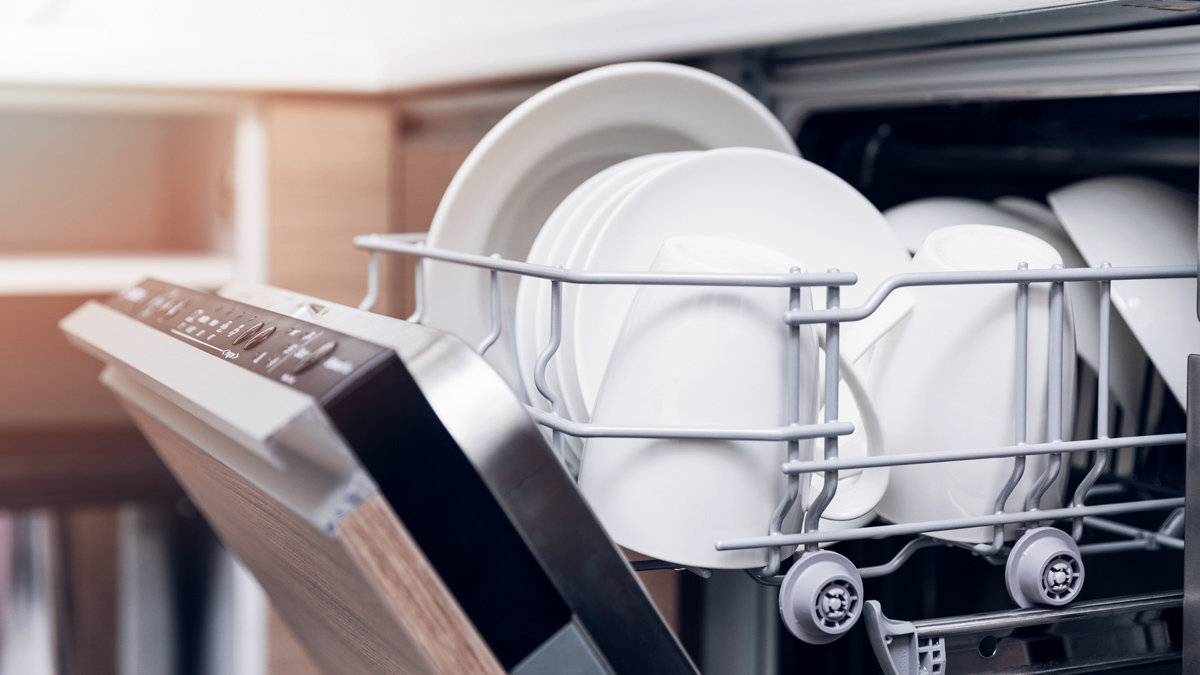
A drawer dishwasher doesn’t have this problem – even if you can only open it partially, you can still stack plenty of dishes inside.
You can partly load a drawer dishwasher without opening it all the way.
They have flexible cleaning cycles
Conventional and drawer dishwashers have a variety of cleaning cycles suited to different items. But conventional models can only run one cycle type at a time – a limitation that double-drawer dishwashers don’t face.
“Double-drawer dishwashers can operate two independent cycles at the same time, which is a big timesaver,” says Shafi.
“You could set the bottom section to clean really dirty plates while the top half runs a delicate cycle for glassware, with everything finishing around the same time,” he explains.
Single drawer dishwashers can run much smaller loads which should use less water (depending on the cycle). This may be a more economical option if you’re often running half-full loads in a conventional dishwasher.
You may also want to run smaller loads every few days, such as one up top and one below, rather than a single full load at the end of the week. This can keep clean kitchenware in constant rotation, though it may not be very energy efficient in the long run.
They’re easier to access
You don’t need to bend down quite as far to use a single drawer dishwasher if it’s installed at the same height as your benchtop. Loading and unloading can be much easier if you have limited accessibility, strength or dexterity.
“With just one big brand dominating the drawer dishwasher market, you’re not going to find much variety in terms of performance, features and design,” says Shafi. “They can also get pretty expensive.”
While there are lots of integrated (built-in) dishwashers that can be designed to match your cabinetry, Fisher & Paykel’s selection is pretty limited. Only a handful of models can be customised and they start at around $2000.
Vertical space is limited
“Standard single and double drawer dishwashers don’t have a lot of vertical space,” Shafi explains.
“This rules out items like tall stockpots, large mixing bowls and oversized platters.”
Fisher & Paykel does sell a small selection of “tall” drawer dishwashers with extra headroom and customisable shelving (some state 310mm in the manual). But they still don’t have as much space as a conventional model.
Drawer dishwashers lack the height to accommodate tall or large items.
They can use a lot of water
Most of the double drawer dishwashers in our test use 18–21 litres of water per cycle.
“This isn’t the worst we’ve seen, but it’s up there,” says Shafi. “There are plenty of conventional dishwashers that use far less per load.”
Are drawer dishwashers worth the expense?
Drawer dishwashers are more of an interesting alternative than a must-buy for most households. Though the models we’ve tested performed quite well, they aren’t among the top performers in our test.
Still, Shafi says a drawer dishwasher might be the right move if you:
Rarely fill a conventional dishwasher and tend to wash smaller loads.
Have a small kitchen (single drawer is ideal).
Regularly wash delicate items, like glassware, separately from heavily-soiled cookware on the same day.
Have accessibility requirements that make it difficult to load a conventional dishwasher.
Just bear in mind that drawer dishwashers come with a mid-range to premium price tag and relatively hefty ongoing costs. Single drawer models are a more economical option, but you’re still paying more on a per item basis.
But what’s the best? Our experts have tested close to 500 dishwashers over the years, including a number of currently available and discontinued drawer models. Head over to our test results to see how the different models compare.
Know the products to avoid before you shop. Get our free guide and buy smarter.
Peter Zaluzny is a Content producer in the Digital home team. He covers everything from home entertainment and personal safety devices to tech for your car and mattresses.
Peter enjoys cutting through the nonsense to help people understand the products they’re considering to buy. He helps consumers make educated, informed decisions.
Peter has a Bachelor's degree in Journalism and a Bachelor of Arts from the University of Wollongong.
Peter Zaluzny is a Content producer in the Digital home team. He covers everything from home entertainment and personal safety devices to tech for your car and mattresses.
Peter enjoys cutting through the nonsense to help people understand the products they’re considering to buy. He helps consumers make educated, informed decisions.
Peter has a Bachelor's degree in Journalism and a Bachelor of Arts from the University of Wollongong.
For more than 60 years, CHOICE has been fighting the good fight for Australian consumers.
In the past year alone we've uncovered systemic issues with sunscreens, investigated shonky supermarket pricing, fought for stronger scam protections and helped make complex energy pricing fairer and clearer.
CHOICE is here to provide unbiased advice and independent testing in our world-class labs. We buy the products we test, just like you do, and our expert reviews are influence free. We’re here to help you choose smarter. Hopefully you’ll also save some money along the way.
Thanks to CHOICE, you’ll never be alone when a business treats you unfairly. You can support our work by joining or donating to our cause.