After installing a home battery, the next big question you’re probably considering is “is it worth joining a virtual power plant?” After all, every battery installed under the federal government’s Cheaper Home Batteries Programs rebate needs to be VPP-compatible, but actually joining one is voluntary.
Exporting surplus battery power via a VPP can be a great way to earn more money and reduce your electricity bills, but joining does come with some hefty considerations too.
If you’ve just gone through the intensive process of buying a battery (which, let’s be honest, can do your head in), you might baulk at going through another to assess VPPs and whether they’re worth it.
Exporting surplus battery power via a VPP can be a great way to earn more money and reduce your electricity bills
To make it easier, we’ve put together this handy guide to VPP incentives and what you can potentially earn for joining. We look at recent government data on electricity bill savings across the board and talk to two customers on their own VPP journey about their earnings and learnings along the way.
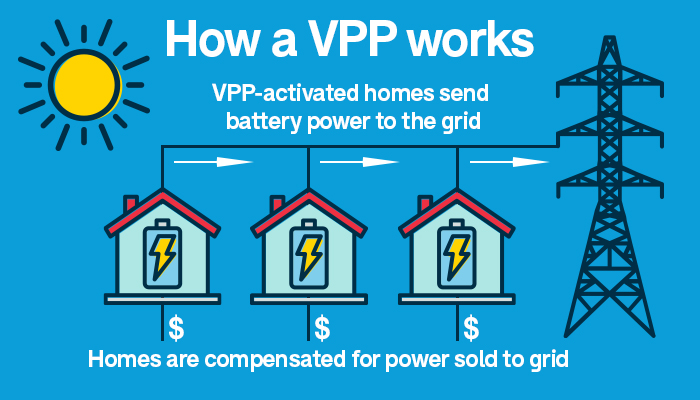
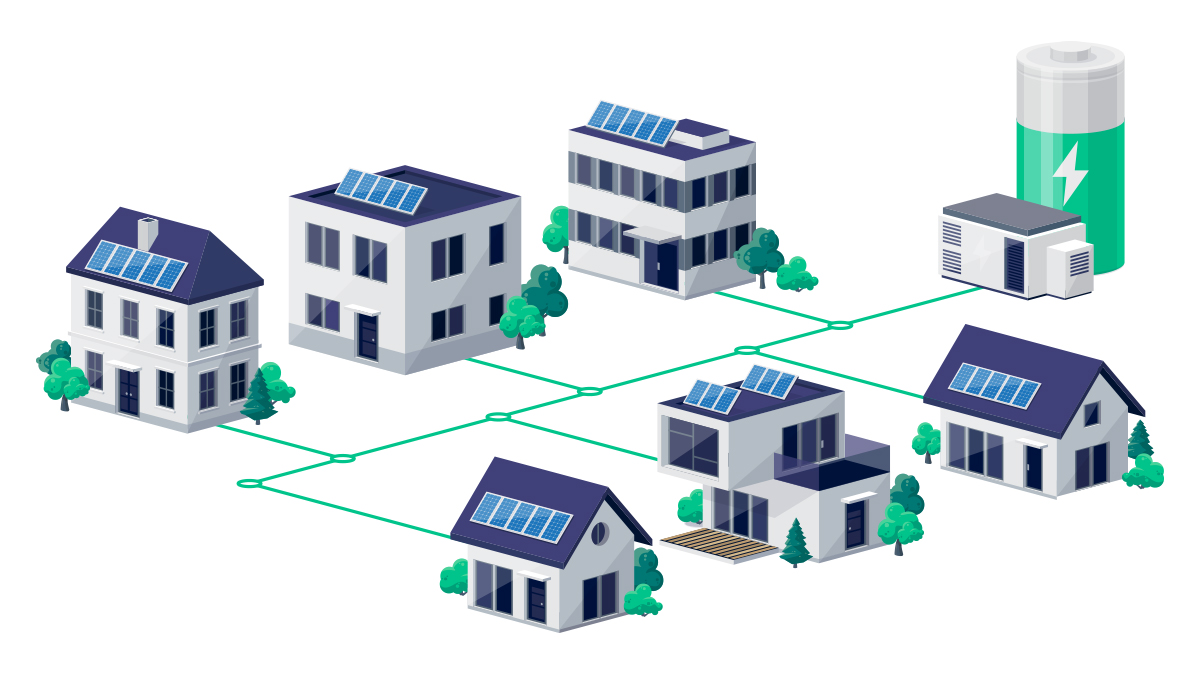
A virtual power plant company runs a giant network of residential home batteries “virtually” linked together by their custom software or hardware, and the internet*.
VPPs can be operated by an electricity retailer (like Origin, AGL, EnergyAustralia), a battery brand (Tesla) or an independent company (Amber, ShineHub, Globird).
By drawing on a portion of electricity from each battery, the network becomes a “virtual power plant” that’s capable of aggregating large amounts to sell to the grid.
It does this by remote-controlling your battery to charge during the day (when electricity is cheapest) through solar or top-ups from the grid. Then when grid demand is high (like in the evening) and wholesale prices rise, the VPP directs its batteries to send power into the grid to sell for maximum profits.
In return, residents are paid benefits by the VPP – see the next section for more info.
*VPPs can also link electric vehicle (EV) chargers, hot water systems and air conditioners, but currently, most operators focus on batteries.
What do VPPs pay?
In exchange for sharing your battery, VPP companies offer a range of financial incentives that can reduce your power bills and help pay off your battery faster.
Given VPPs are a relatively new market, the number and type of incentives available vary wildly as companies try different ways to attract customers. This can make comparing benefits between VPP operators and picking the right one quite tricky.
Incentives can include one or a combination of the following:
upfront one-off incentives or discounts on batteries
bill credits (monthly, quarterly or annually)
premium feed-in tariff (FiT) rates during peak export times
higher export rates during special grid price spikes (like during heatwaves or cold snaps)
free electricity periods during the day
wholesale market revenue sharing.
The last one is a more dynamic approach used by VPPs like Amber and Discover. Instead of offering fixed benefits, these operators allow customers to earn the actual wholesale value of the electricity sold, or a share of it, at the time (this is different to the higher retail price you pay when you buy from the grid, which includes network charges and other fees).
This model promises higher rewards and the chance to make more money during extreme grid spikes when the wholesale price soars (i.e. during a heatwave or cold snap), but it does require more of your time to monitor the app and market (to ensure the app AI is working properly and trading at the right time). Additionally, earnings can be unpredictable and vary a lot annually.
.
Why we've partnered with SolarQuotes

We've partnered with SolarQuotes to help you find and buy the right solar, battery, heat pump and EV charger. While we make money if you use SolarQuotes to find an installer, this doesn't influence our ratings. 100% of the money we make goes directly back into our nonprofit mission.
Can you really get $19 per kWh during grid spikes?
In recent years, VPPs like Amber have grabbed a lot of attention for paying customers extremely high export prices (up to the maximum wholesale rate of $19 per kWh) when the grid is under maximum pressure.
Sadly, this is becoming a lot rarer. With the government’s battery scheme now in full swing and more stored solar going into the grid at peak times, such windfalls are probably a thing of the past.
While you can still get competitive rates during grid spikes compared to retailers’ usual feed-in tariffs (depending on your plan), it’s wise not to count on them too much in your energy bill calculations.
Recent data has shown joining a VPP can save you a notable amount, but exactly how much depends dramatically on your situation and set-up.
In a new report released in June, the Australian Competition & Consumer Commission revealed that annual power bills for customers participating in VPPs were $762 to $1093 (57–63%) lower than regular customers in the financial year 2024–2025.
By comparison, customers with just a battery and solar system, but not connected to a VPP, saved less, with bills that were $329 to $909 (20–52%) lower than regular customers. The extremely large range reflects variables like location, VPP operator and retail plan, battery size and more.
It’s important to note that these ACCC figures span 2023–2025, which was before the government’s battery rebate was introduced on July 1, 2025.
The resulting boom has seen more than 500,000 batteries installed, with plenty now exporting power to the grid. This influx will no doubt impact wholesale electricity prices and possible returns through VPPs over time – a good reminder that the market is always in flux.
Power bills compared: VPP vs battery vs solar only
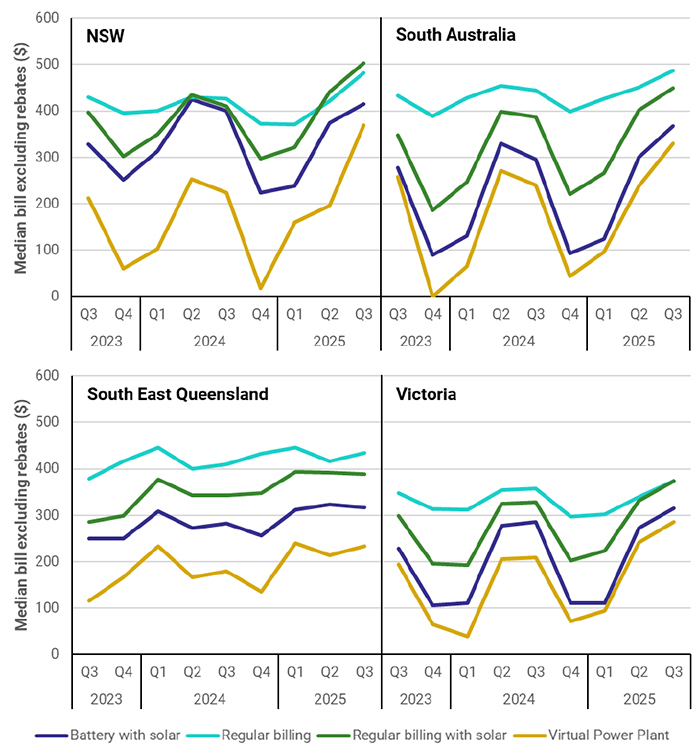
Additionally, the ACCC report features this snapshot of median power bills across a number of regions, clearly showing customers on VPPs (shown in yellow) have consistently paid less in recent years.
ACCC report June 2026. Median bills paid by each residential customer type, by region, excluding Energy Bill Relief Fund rebates, quarter 3 2023 to quarter 3 2025. Source: ACCC analysis of AEMO’s Distributed Energy Resource register and retailer billing data. Nominal dollars excluding GST.
Case study 1: “I made about $100 in about 10 minutes”
In November 2025, Phil installed a home battery in his four-bedroom house in Sydney’s south, choosing a 19kWh battery and a 10.5kWh inverter.
After doing a lot of research online, he joined Amber’s SmartShift VPP, which gives him live wholesale price updates and lets him sell power to the grid and earn the wholesale rate.
I built up more credits over summer to bank them for winter and my last bill in June was still $4 in credit
Phil also got a handy $800 rebate through the NSW state government’s Peak Demand Reduction Scheme for joining the VPP, as well as two payments of $120 for referring a friend and a Commonwealth Bank co-promotion.
That plus his peak-time trading has meant he hasn’t paid for electricity since he started.
“The VPP has definitely helped – I think my first bill was over $200 in credit,” he says. “I built up more credits over summer to bank them for winter and my last bill in June was still $4 in credit.”
Event spikes lucrative, but rare
Phil adds that grid event spikes – something VPPs like Amber have become famous for – can be lucrative but are few and far between.
“In January, I made about $100 in about 10 minutes, but I think those spikes are controlled and quite limited. It’ll be interesting to see what happens this summer [now there’s more batteries exporting power to the grid].”
Phil’s power trading usually involves far smaller gains. For example, he’ll charge his battery via his solar panels or cheaply from the grid for 5 cents per kWh and then sell it to the grid at peak night times for 12 cents per kWh, accumulating helpful savings over time.
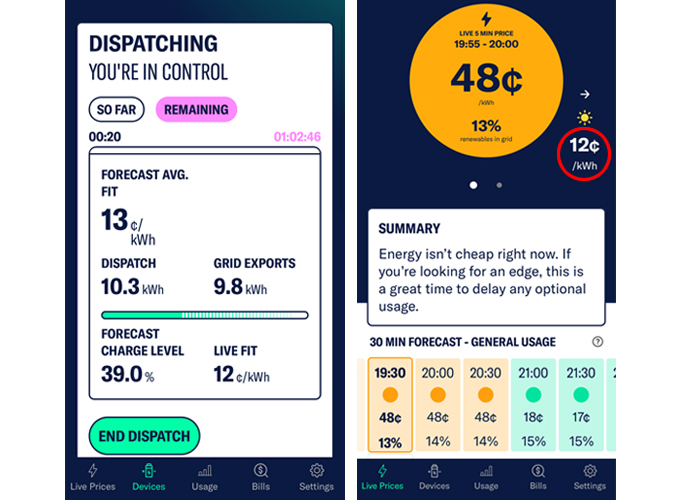
Phil’s Amber app showing the current wholesale electricity price (circled in red) that he can earn at that moment. The retail rate (48c) is also shown.
VPP worth it after initial set-up
He says joining a VPP has been beneficial but it can be quite hands-on and time-consuming initially, as the app AI takes time to “learn” how to optimise trading and some manual intervention is required.
“It’s good but you do need time to keep an eye on it and sometimes take manual control – you can’t set and forget, at least for the first couple of months,” he explains.
“Now I’m quite comfortable that the app is working the way I’d expect it to work and it’s dispatching my battery at key times when I can actually get a bit of money back and it’s understanding my usage.”
We’d love to be able to say that joining a VPP will earn you a set amount yearly so you can simply decide whether it’s right for you. Unfortunately, it’s often a lot more complex than that.
That’s because there’s a head-spinning array of external and personal variables at play for every household. Key factors determining your earning potential include:
battery size and how much you can export to the grid
your own energy consumption at home
where you live – this determines local electricity prices, weather (i.e. how much sun you get), additional rebates and VPP companies available in your area
fluctuating wholesale market electricity prices
your chosen VPP and the incentives that pay you
how often they charge and discharge your battery
other fees you pay your retailer (e.g. daily supply charges).
VPP earnings can vary greatly depending on your battery size, location, energy consumption and more.
Other consideration when joining a VPP
Financial incentives often get all the attention, but there’s many things you should consider before you jump aboard a VPP. These include:
the additional wear and tear on your battery
the VPP’s peak electricity charges and daily usage fees
the VPP’s possible monthly subscription and equipment fees (if applicable)
potential lock-in contracts (these are rare unless an upfront discount is offered)
When it comes to getting hands-on, Brody might just take the cake. An electrical engineer by trade, he’s spent the last few years optimising his family home in Oyster Bay, NSW, to be fully electrified and carbon negative.
Brody outside his fully electrified home in Sydney’s south.
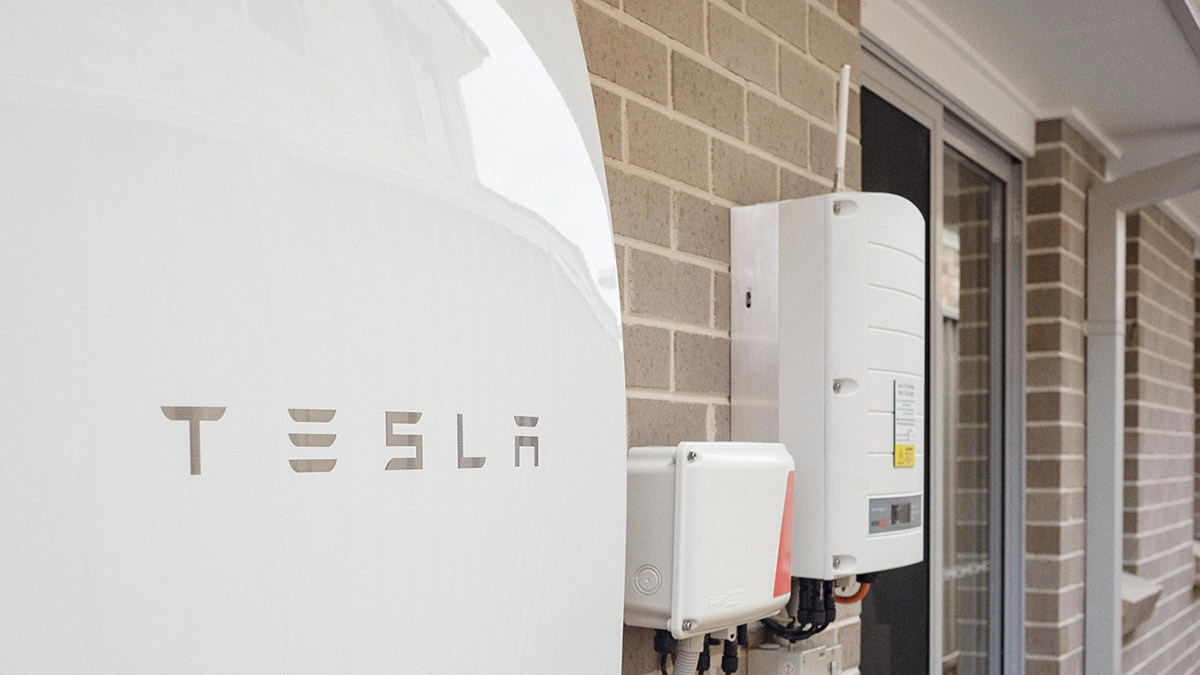
Four years ago, he installed 18.6kW of solar panels and two Tesla 13.5kWh Powerwalls and purchased a Hyundai EV with a 22kW charger. He also uses open-source software called Home Assistant which manages their home’s electrical devices and has even written his own code to customise it further.
He joined Amber in 2023, attracted by its ability to sell to the grid dynamically and earn wholesale rates.
I said to my wife ‘let’s go out for dinner tonight because it’s literally on the house’
“Often our monthly bills were about $50–$120 in credit but occasionally [due to extreme grid event spikes] we’d get these crazily outsized returns,” he recalls.
“We made $700 in a night once – I said to my wife ‘let’s go out for dinner tonight because it’s literally on the house’.”
However, Brody says the market has dramatically changed in the last 12–16 months with the introduction of the federal government rebate and the flood of new batteries feeding power into the grid.
“That intraday volatility – the ‘buy low, sell high’ opportunity – is practically gone now and the very good feed-in amounts and credits going previously, the rivers of gold, have dried up over the past year,” says Brody.
Batteries are still a good thing
He adds that more batteries being installed is “great for the market and the environment”, but it just means that “everyone needs to look a little bit differently” at power self-consumption, joining a VPP and considering how their plan and incentives work for them.
Recently, Brody has left Amber and signed up to independent energy retailer Globird instead. He can’t join their VPP plan as the company doesn’t currently support Tesla Powerwalls, but he’s found their ZeroHero plan quite competitive and the simple time-based pricing works much better to control a Tesla PowerWall.
In the end Amber started costing us money
Battery owner Brody who’s changed over to Globird
The plan offers three hours of free power daily (between 11am and 2pm) and his exports currently earn Brody a small credit on his bills each month in winter.
“In the end Amber started costing us money. As the [market] peaks have levelled out, I found its smart software wasn’t smart enough to really maximise the earnings there. Plus it started occasionally charging our battery from the grid during peak periods and costing us a lot of money.”
Keep an eye on the changing market
While case studies like Brody’s and Phil’s are quite different, both illustrate just how fast the energy market is moving – from the providers and plans available to changing wholesale prices to what you can earn for your home.
Whether you’re on a VPP or not, it emphasises the need for every battery owner to assess their individual situation and keep an eye out for options that best work for them.
The content has been produced with funding support from the Clean Energy Finance Corporation (CEFC). CHOICE maintains full editorial independence, and the views expressed are those of CHOICE. CEFC funding does not constitute an endorsement of any provider, product or service. Any links, tools or services enabling users to request quotes or connect with providers are operated independently by CHOICE and are not endorsed or recommended by the CEFC.
Jason is a Content Editor and journalist at CHOICE. He writes about a diverse range of subjects, from solar to robot vacuums to why Easter eggs are a rip-off. He's previously written for Sydney Morning Herald, Rolling Stone and many other publications.
Jason is a Content Editor and journalist at CHOICE. He writes about a diverse range of subjects, from solar to robot vacuums to why Easter eggs are a rip-off. He's previously written for Sydney Morning Herald, Rolling Stone and many other publications.
For more than 60 years, CHOICE has been fighting the good fight for Australian consumers.
In the past year alone we've uncovered systemic issues with sunscreens, investigated shonky supermarket pricing, fought for stronger scam protections and helped make complex energy pricing fairer and clearer.
CHOICE is here to provide unbiased advice and independent testing in our world-class labs. We buy the products we test, just like you do, and our expert reviews are influence free. We’re here to help you choose smarter. Hopefully you’ll also save some money along the way.
Thanks to CHOICE, you’ll never be alone when a business treats you unfairly. You can support our work by joining or donating to our cause.