CHOICE and test partners PV Lab have reviewed popular panels from Trina, SunPower, Jinko, Aiko and more
We assess each panel’s power output under standard lab conditions, and conduct rigorous stress tests to see how they’ll cope with heat and rain
Inferiors panels can dud you out of electricity and leave you with higher power bills and longer panel payback times
When you’re throwing down thousands of dollars for a new solar system, you want to be sure your chosen panels deliver the electricity they promise.
If they don’t, you’ll be missing out on valuable sunshine day in, day out, for the panels’ 20–30 year lifespan.
That means less power generated for your home to use or to sell back to the grid, as well as higher power bills and longer payback times for your system.
And if you do buy inferior panels, it’s unlikely you’ll ever know. Because once installed, it’s easy to blame under-performing solar generation on poor weather, shading or other external variables – plus, you probably don’t have much to compare it to if you’ve never have solar before.
Bad panels means less power generated for your home to use or to sell back to the grid
And given you can only get the federal government’s solar panel rebate once per home, it’s a decision you want to get right from the get-go.
That’s why CHOICE has been reviewing panels for over a decade. To do so, we partner with PV Lab, an accredited world-class photovoltaics test laboratory in Canberra with specialised equipment and expertise.
PV Lab evaluates each panel’s power output under standard lab conditions, and conducts rigorous stress tests to see how they’ll cope on a rooftop in heat and rain.
New to solar panels? Check out our buying guide to learn about price ranges, how to size your system and government rebates.
.
Why we've partnered with SolarQuotes

We've partnered with SolarQuotes to help you find and buy the right solar, battery, heat pump and EV charger. While we make money if you use SolarQuotes to find an installer, this doesn't influence our ratings. 100% of the money we make goes directly back into our nonprofit mission.
How we test solar panels
To be comprehensive, our experts test three different sample panels of each model, with all subjected to a range of rigorous assessments. These include:
Power output test (85%)
This measures each model’s panel power output under standard test conditions: 25°C, sea level air mass and irradiance (power density) of 1000Watts (W) per square metre.
PV Lab tests three different panels of each model, and then calculate the average of the results for their performance for power output. This helps detect any variations between samples.
This test makes up 85% of our final CHOICE Expert Rating for each model.
It’s worth noting that solar panels in the real world will usually deliver a lower power yield than what’s measured in stable, standardised lab conditions. On your roof, they are exposed to higher temperatures, cloud cover and changing sun angles across the day and across seasons.
This test looks for any obvious faults, such as damage to the panel or electrical connections, which can happen in the factory or in transit. A few small imperfections are often found, but these don’t usually affect performance.
Any defect that’s detectable to the naked eye could indicate a risk to the reliability of the panel and it may be more likely to fail sooner than its warranty indicates. This test comprises 5% of the CHOICE Expert Rating.
Electroluminescence testing (5%)
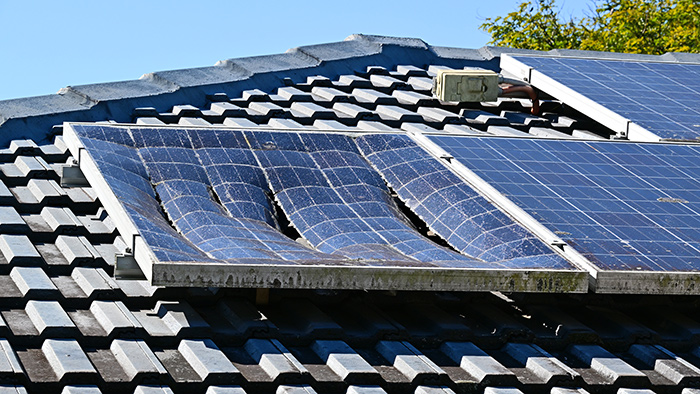
This takes the inspection to a more advanced level, and uses infrared photography to identify any microcracks or other flaws in the panel that are invisible to the naked eye.
A fail here means the lab found something serious in that check. It usually won’t mean lower efficiency or power output initially, but this weak point could make the panel more likely to fail after a few years on the roof after being exposed to continual micro expansion and contraction in the heat and rain. This test comprises 5% of the CHOICE Expert Rating.
Faulty panels can be costly to replace or remove from your roof.
Wet leakage (5%)
This testing involves submerging the panel in water and measuring electrical resistance across the panel. This tests how well the panel will resist moisture penetration from rain, dew, fog and other wet weather. This test comprises 5% of the CHOICE Expert Rating.
In our latest round of testing, we’ve assessed 20 different panels from popular brands including Trina, SunPower, Jinko, Aiko, Canadian Solar, REC, Risen, DAS and more.
Models range in price from $120 to $280 and in claimed output from 430W to 475W.
Don’t judge a brand by one model
If we’ve learnt one thing from decades of testing different products, it’s that quality can vary across a brand’s range and the performance you get can be very different for each individual model. That’s why testing is so vital.
The priciest panel in our test actually rated the lowest
Likewise, higher prices are never an instant guarantee of quality – our test saw cheaper panels outperform more expensive ones. In fact, the priciest panel in our test actually rated the lowest!
Our full test results are available exclusively to our members. To see the full solar panel test results, consider becoming a CHOICE member today.
While our experts found plenty of impressive panels at varying price points, they also saw others that seriously failed to shine. To avoid ending up with lacklustre panels, avoid these models that rated lowest in our power output test.
1. REC 460AA Pure-RX
Panel price: $280
Claimed power output: 460W
Tested power output: 426W
Output difference: -7.3%
This panel scored the solar wooden spoon in our tests. Why? Because its claimed output is 460W but it only delivered 426W in our test, which means it’s short-changing you a hefty 7.3%.
That difference might not sound like much initially, but it’s a fair chunk of electricity to miss out on every day for the next few decades. With peak-time electricity prices on the rise, no doubt your home and power bill could use that extra 7.3%.
Its poor performance stings even more given this panel is the most expensive one in our test, giving you another big reason to avoid it. Our experts found panels with a bigger capacity that are cheaper and rated much higher.
In better news, it scored 100% for its visual, electroluminescence and wet leakage tests.
Get at least three quotes from reputable installers before you choose one.
2. Winaico WST-450NGX-D3
Panel price: $198
Claimed power output: 450W
Tested power output: 427W
Output difference: -5.12%
Sadly, you won’t be winning too much with this Winaico model. This 450W panel undercut its claimed power output, providing a disappointing 427W instead. That’s a discount of just over 5% that you never wanted.
Alarmingly, this model scored only 33% in the lab’s electroluminescence assessment (which uses infrared to identify any microcracks) with just one of its three sample panels passing the inspection with no faults.
With the third lowest score for output difference, this panel’s definitely not the brightest spark either. It promised 440W of output, but our test revealed it managed just 418W, squeezing you out of 5% along the way.
Like the Winaico, this panel also displayed some worrying faults – but these ones were actually visible to the naked eye. It scored 67% in our visual inspection with just two sample panels out of three passing the test. It was the only product in our test not to get 100% in this assessment.
But when our experts took an even closer look using infrared photography in our electroluminescence test, the news got worse. The model rated just 33% after two panels out of three failed the assessment.
Jason is a Content Editor and journalist at CHOICE. He writes about a diverse range of subjects, from solar to robot vacuums to why Easter eggs are a rip-off. He's previously written for Sydney Morning Herald, Rolling Stone and many other publications.
Jason is a Content Editor and journalist at CHOICE. He writes about a diverse range of subjects, from solar to robot vacuums to why Easter eggs are a rip-off. He's previously written for Sydney Morning Herald, Rolling Stone and many other publications.
For more than 60 years, CHOICE has been fighting the good fight for Australian consumers.
In the past year alone we've uncovered systemic issues with sunscreens, investigated shonky supermarket pricing, fought for stronger scam protections and helped make complex energy pricing fairer and clearer.
CHOICE is here to provide unbiased advice and independent testing in our world-class labs. We buy the products we test, just like you do, and our expert reviews are influence free. We’re here to help you choose smarter. Hopefully you’ll also save some money along the way.
Thanks to CHOICE, you’ll never be alone when a business treats you unfairly. You can support our work by joining or donating to our cause.