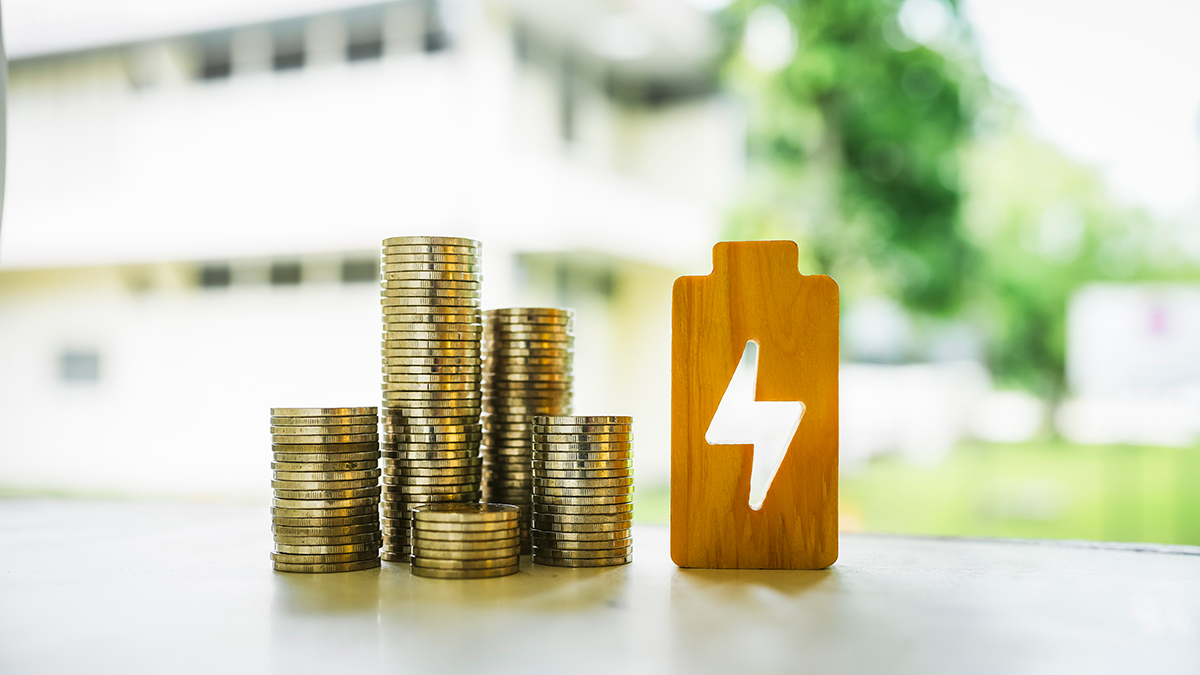
Feed-in tariffs (FiTs) are credits that electricity retailers pay for surplus power you export to the grid
Australia’s solar boom has caused daytime FiTs to fall dramatically
Some retail plans now include daily export caps, while others offer free power at certain times
Once upon a time, electricity retailers would pay a pretty penny for the surplus power sent from your solar panels to the grid during the day.
In the late 2000s, some state governments were even offering tariffs as high as 40 to 60 cents per kilowatt-hour (kWh) in a bid to boost solar uptake.
Fast forward to the present and those incentives have definitely paid off. Australia now leads the world for solar adoption, with 4.2 million solar photovoltaic (PV) systems now installed across the country, according to the CSIRO (as of June 2025).
Feed-in tariffs have tumbled to an average of around five cents per kWh
Of course, that’s great news for consumer energy independence and cutting power bills and climate pollution. But along the way, feed-in tariffs have tumbled to an average of around five cents per kWh, or even zero depending on your retail plan.
With many solar owners still counting on a decent FiT to reduce bills, the crash has left many asking why it’s fallen so far, and what they should do now with their surplus solar power.
We take a look at why FiTs have flatlined, the current rates still available, the emergence of new export charges, and how to best use your excess energy in future.
Richard Foxworthy is an industry expert and the CEO of Bill Hero, a savings service that compares utility bills for customers across Australia. Since 2014, his company has analysed thousands of electricity retail plans, including the FiTs they offer.
He says there have been three main phases of FiT pricing.
1. The FiTs ‘premium’ phase: 2008–2016
State governments offered huge FiTs (44c–60c/kWh) to kickstart the industry. Most of these ‘premium’ schemes have now ended or will end soon (for example, Queensland and South Australia in 2028).
2. The ‘fair value’ era: 2017–2020
As government subsidies ended, many state energy regulators set ‘minimum’ FiTs, with these rates decreasing yearly. They typically hovered around 10–12c/kWh.
South Australia and Victoria stopped setting minimum FiTs in 2017 and 2025 respectively, while NSW never did (it does have voluntary benchmarks). Only Tasmania, Western Australia, the Northern Territory and regional Queensland still regulate FiTs.
3. The ‘solar surplus’ era: 2021–present:
The combination of high solar uptake and cheaper, more-efficient panels has rapidly increased daytime energy production, which has crashed wholesale electricity prices.
.
Why we've partnered with SolarQuotes

We've partnered with SolarQuotes to help you find and buy the right solar, battery, heat pump and EV charger. While we make money if you use SolarQuotes to find an installer, this doesn't influence our ratings. 100% of the money we make goes directly back into our nonprofit mission.
Why have daytime FiTs dropped so much?
“It’s ultimately supply and demand – the more solar kWh that get generated as more systems are installed, the lower the wholesale electricity spot price will go during those solar production hours,” says Foxworthy.
Bill Hero CEO Richard Foxworthy has been monitoring FiTs for years. Image: Bill Hero.
“With the spot price so radically reduced compared to what it used to be, many electricity retailers can’t offer higher feed-in tariffs because literally at that time, the energy is not really worth much in the marketplace.”
If retailers do offer higher feed-in tariff rates, it’s part of their marketing strategy to attract and retain customers. But higher-FiT plans can have shortcomings (see the next section).
It’s a tricky question, given FiTs vary widely due to a range of factors. These include your electricity retailer, your location, the electricity plan you’re on and when you signed on.
The good news is that while spot prices might hit zero during the day, many retailers still offer small FiTs to remain competitive in the market and attract customers.
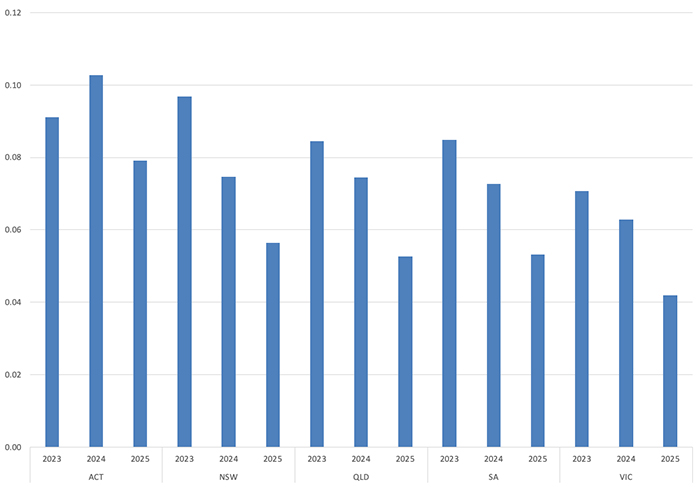
The graph below shows average FiTs by state and territory over the past three years.
As you can see, rates hover around five cents per kWh, with some variance across locations, although Bill Hero’s Richard Foxworthy expects that to continue to drop in the near future.
Average FiT by state and year, based on Bill Hero data
Note: WA and NT are not included as they are independent networks and not part of the National Electricity Market (NEM), which Bill Hero services.
Some plans still spruik above-average rates, but Foxworthy warns this shouldn’t be your only criteria when choosing a plan.
“There are plans out there offering higher FiTs, which sound great, but they’re very likely to have a correspondingly unattractive daily usage rate. You need to consider the entire plan holistically.”
At the same time, he says solar owners shouldn’t instantly dismiss plans that offer zero FiT.
“We know from direct experience that there’s plenty of situations where a zero FiT plan can still represent the best value for a consumer, because you’ve got to also consider the consumption charges that come with it. Once again, there’s a trade-off that’s baked into every one of these plans.”
Evening / peak time FiTs: While feed-in tariffs have always been synonymous with daytime exports, many retailers now offer higher FiTs to customers if they export power from their batteries to the grid during evening peak times. This is another element to consider when choosing a retail plan.
New factors: Variable rates and caps, free power and export charges
In response to the solar surge, many retailers have dramatically changed their plans and FiT payouts. Some now offer free electricity during the day, while others pay variable FiTs depending on times, and/or they cap FiTs to certain kWh limits per day.
No doubt these new dynamics will make choosing the right electricity plan even more complicated (as if they weren’t complex enough).
Variable FiTs and limits
Instead of flat rate FiTs, some retailers now pay variable rates based on the time of the day. These time-of-use (TOU) rates usually pay lowest during 10am to 3pm, slightly better in the early morning and late afternoon, and much higher after 4pm when the grid is hungriest.
Other plans taper FiTs to a certain kWh limit each day. For example, Alinta’s Solar Balance plan currently pays customers 10 cents per kWh for the first 10kWh exported daily and five cents for anything over that.
The daytime solar surplus has seen some retailers start offering free electricity during the day.
‘Free electricity’ windows now available
With the over-supply of solar power, several retailers are now offering customers free electricity during certain time periods during the day (note: supply charges still apply and their peak rates can be more expensive).
It’s a practice we’ll definitely see more of when the federal government’s new Solar Sharer Scheme comes into play on 1 July.
In a bid to lower power bills for everyone and ease peak demand in the evening, the scheme requires retailers to offer all residential customers at least three hours of free electricity during the day.
Initially the scheme will be available in states covered by the Australian Energy Regulator’s Default Market Offer (DMO) price cap, which is NSW, South Australia and South-East Queensland. Customers must opt in via their plan and have a smart meter installed.
In a sign of how quickly the market’s shifting, some customers may ultimately be penalised for exporting too much solar power.
Last year, the Australian Energy Regulator (AER) permitted electricity distributors (the companies that own the infrastructure and provide power to retailers) to implement two-way pricing tariffs and charge a small fee per kWh if exports exceed a certain threshold during set times (usually 10am to 3pm).
For example, NSW electricity distributor Ausgrid now lets customers export 200kWh a month between 10am to 3pm for free, but over that, it will charge retailers 1.23 cents per kWh exported. Between peak grid times of 4pm and 9pm, Ausgrid pays a FiT of 3.85 cents.
Electricity distributors can now charge retailers if household exports exceed set limits.
Whether these charges will be passed on to customers directly will depend on each retailer and their plans – some retailers might absorb them, but just reduce the FiTs they pay out.
This so-called ‘sun tax’ has angered many solar owners, but retailers argue it’s required to maintain grid stability and encourage customers to use their own generated electricity, or store it in a battery to use for later.
Sadly, the sun is setting on daytime FiTs, with the long-term forecast looking grim and rates expected to slide further.
“The fundamental reality is that solar FiTs are rapidly trending towards $0, and therefore no longer represents a major financial reason for a solar investment alone,” says Foxworthy.
The fundamental reality is that solar FiTs are rapidly trending towards $0
Richard Foxworthy, Bill Hero CEO
“Before long, solar export will attract network access fees for most solar households, so as well as earning very low FiTs, households can expect to be charged for the privilege of exporting their solar kWh.”
With that in mind, unless you’re on an older legacy plan still offering great FiTs, it’s probably wise to review your power bill and consider other ways to optimise those extra kWhs.
So with daytime FiTs fading, where does that leave solar owners and their excess electricity? And what are the best options to use it going forward?
Rather than sending solar to the grid for pennies, or being charged to do so, Foxworthy says home owners should aim to “maximise self-consumption of solar generation and minimise the need for high-priced kWh imports at other times of day”.
There’s two key ways to do this:
1. Shift your power use to peak solar hours
This requires changing up your routine to run appliances like dishwashers or washing machines, or charging your EV or e-bike, either side of midday rather than at night (using your appliances’ timers can be quite helpful for this).
For example, a dishwasher uses around one kWh per cycle on average. Run it through the day and it’ll cost nothing with solar, but use it at night and it’ll chew up peak grid rates – let’s say it’s 35 cents per kWh, for this example. It might not seem like much, but using solar for one wash a day will save you $127.75 yearly.
Using solar for one wash a day will save you $127.75 yearly
Of course, time-shifting sounds great but it is difficult if work or other commitments mean you’re not home much. Plus at night, you’ll always need to use some power for cooking, lights, heaters and other appliances. That’s where a home battery comes in handy.
Running dishwashers and other appliances with solar power instead of at night can considerably lower your bills.
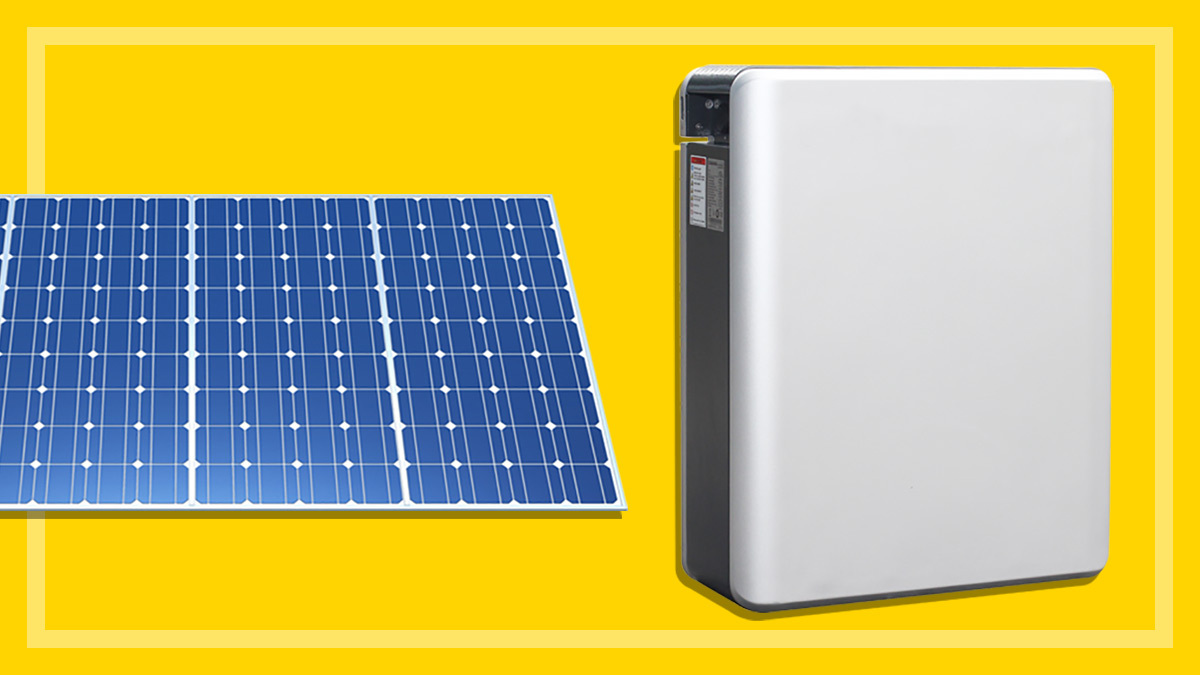
2. Store power in a battery
Historically, home batteries have been very expensive, but that’s changed considerably with the federal government’s solar battery rebate now offering a discount of around 30% off the installation price.
Still, they don’t come cheap – even with the rebate, a 10kWh battery installed costs between $7,000-$11,000 – so you’ll need to do some maths to ensure it’s right for your budget and home power usage. See our battery buying guide for more on prices and payback periods.
You can use that electricity later to avoid buying expensive peak-time grid power
Richard Foxworthy, Bill Hero CEO
If you do install one, you can bank all that juicy sunshine during the day (and even charge it during the aforementioned ‘free power’ windows) and use as you please.
“A battery allows you to capture and store the excess kWh that otherwise would be exported at very low FiT rates,” says Foxworthy.
“You can use that electricity later to avoid buying expensive peak-time grid power that will cost 35 cents or more. The financial opportunity for the battery is in the spread between the high price you avoid paying and the low FiT price that you forgo earning.”
If you still have excess power left over, you can also export it to the grid when FiTs are much higher, or funnel it to a virtual power plant for extra credit.
Jason is a Content Editor and journalist at CHOICE. He writes about a diverse range of subjects, from solar to robot vacuums to why Easter eggs are a rip-off. He's previously written for Sydney Morning Herald, Rolling Stone and many other publications.
Jason is a Content Editor and journalist at CHOICE. He writes about a diverse range of subjects, from solar to robot vacuums to why Easter eggs are a rip-off. He's previously written for Sydney Morning Herald, Rolling Stone and many other publications.
For more than 60 years, CHOICE has been fighting the good fight for Australian consumers.
In the past year alone we've uncovered systemic issues with sunscreens, investigated shonky supermarket pricing, fought for stronger scam protections and helped make complex energy pricing fairer and clearer.
CHOICE is here to provide unbiased advice and independent testing in our world-class labs. We buy the products we test, just like you do, and our expert reviews are influence free. We’re here to help you choose smarter. Hopefully you’ll also save some money along the way.
Thanks to CHOICE, you’ll never be alone when a business treats you unfairly. You can support our work by joining or donating to our cause.