With Australia in the middle of a home battery boom, there’s plenty of hype around virtual power plants (VPPs) and just as many myths and misconceptions. It’s not a surprise: VPPs are both relatively new and complex with a huge amount of operator models and variables on offer.
To help you sort the truth from the tall tales, we dive into this exciting new energy space and put the biggest myths under the microscope.
What is a virtual power plant?
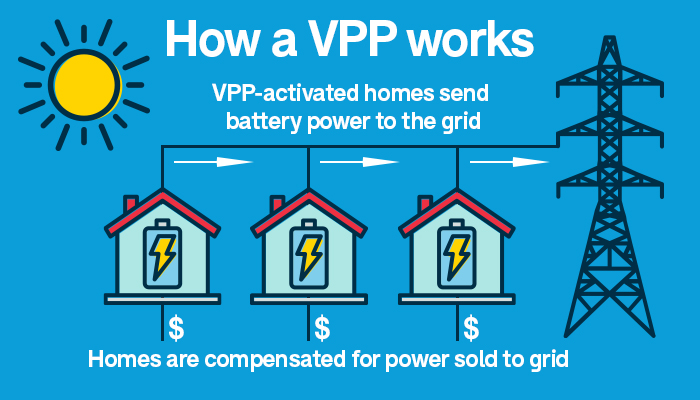
Heard the term but not 100% sure what it means? A VPP company runs a giant network of residential home batteries “virtually” linked together by their custom software or hardware, and the internet*.
By drawing on a portion of electricity from each battery, the network becomes a “virtual power plant” that’s capable of aggregating large amounts to sell to the grid.
It does this by remotely directing your battery to charge during the day (when electricity is cheapest) through solar or top-ups from the grid. Then when grid demand is high (like in the evening) and wholesale prices rise, the VPP directs its batteries to send power into the grid to sell for maximum profits.
Residents are paid benefits in exchange for access to their batteries, with VPP companies paying either an upfront bonus, high feed-in tariffs (FiTs), bill credits or a share of the wholesale electricity rate the grid pays at that time.
*VPPs can also link electric vehicle (EV) chargers, hot water systems and air conditioners, but currently, most operators focus on batteries.
Myth 1: VPPs give you free electricity
Reality check: A few companies offer this at certain times, but definitely not all (most likely because batteries can charge for free with solar panels during the day, weather pending).
At the time of writing, VPPs like Globird and Covau Energy do offer free power from the grid from 10am–2pm daily. Others like Amber automatically charge your battery whenever wholesale prices fall to zero, which often happens around midday.
But other VPPs forgo free power windows, preferring to entice customers with other incentives instead, like upfront bonuses, high feed-in tariffs (FiTs) or bill credits.
Some VPP companies offer free electricity timeframes while others pay other benefits like higher FiTs or regular bill credits.
If you like the sound of free power, it’s worth noting the government’s new Solar Sharer Offer (SSO) comes into effect 1 July, 2026.
Aimed at sharing the glut of solar electricity during the day, this new initiative stipulates that participating electricity retailers offer at least one plan with three hours of free power in eligible regions (currently NSW, SE Queensland and SA as they fall under the federal government’s Default Market Offer framework, whereas other areas do not). It’s available to solar and non-solar households, but you need to opt into the specific plan.
This doesn’t apply to all VPPs (as not all are technically retailers), but if a retailer also has a VPP service, they may offer this under their SSO requirements.
Just analyse all of the rates on any new plan – you may get free power, but you might also be charged more at other times of day or with a larger daily usage fee.
.
Why we've partnered with SolarQuotes

We've partnered with SolarQuotes to help you find and buy the right solar, battery, heat pump and EV charger. While we make money if you use SolarQuotes to find an installer, this doesn't influence our ratings. 100% of the money we make goes directly back into our nonprofit mission.
Myth 2: You can earn huge feed-in-tariffs (around $19/kilowatt-hour) during grid spikes
Reality check: Previously, yes, but they’re much rarer now. In the past you might have heard stories of people getting paid wildly high FiTs during extreme grid demand periods (like during a heatwave or cold snap).
Some VPP operators like Amber and others let you earn the actual market price of electricity sold at that moment (or a hefty share of it). So when the grid spikes, prices can theoretically rise to $19 per kWh, the maximum wholesale market price.
Such rates have become almost legend in solar circles, but sadly they’re becoming far less common. Why? Because more and more people have installed batteries thanks to the government rebate and more power is now being pumped into the grid, making demand spikes less extreme.
Such rates have become almost legend in solar circles, but sadly they’re becoming far less common
As an example, Amber reported that NSW had just 17 price spike events paying $3/kWh or more from January 2025 to June 2025.
As exciting as they sound, it’s best not to count on these high FiTs when doing your maths and choosing a VPP.
What do VPPs actually pay you?
This largely depends which VPP plan you choose. Given VPPs are relatively new, many offer a very disparate mix of incentives as they try to attract customers.
Benefits can include one or a combination of the following:
upfront one-off incentives or discounts on batteries
bill credits (monthly, quarterly or annually)
premium feed-in tariff rates during certain time windows or grid spikes
free charging periods
wholesale market revenue sharing.
Check out our VPP product pages to see what different plans pay in the Customer Benefits section.
Myth 3: VPPs take over your battery and drain it often
Reality check: This one is half-true, so let’s clarify.
Yes, a VPP needs to share control of your battery. That’s because they operate by dynamically charging it when power is at its cheapest (during the day) and then exporting it at peak times to get the best prices (usually evenings). They need control to do this quickly and effectively in real time.
But it doesn’t mean your battery is constantly drained, leaving you in the lurch. Instead, you can set your own battery reserve limits (usually around 10–30%) and preferences to ensure your own needs come first.
VPPs need access to your battery but you can reserve power for your own needs too.
You can also restrict VPP power exports to certain times of day (of course, this may limit your VPP earnings, but it’s your call).
Just be aware that certain VPP operator’s plans do require a certain level of availability. Check out our VPP product pages under Limitations to see what they are.
Myth 4: Using a VPP can heavily impact battery life
Reality check: Yes, it can definitely accelerate its lifespan, although the impact may be less severe than you might think.
Being on a VPP means your battery is charged and discharged more often than if you just used it for personal use. This can rapidly increase its number of daily cycles (a cycle equals one full charge and discharge sequence), which can add more wear and tear to your battery and possibly shorten its lifespan.
Being on a VPP means your battery is charged and discharged more often than if you just used it for personal use
Many home batteries come with a product warranty that covers ten years or around 6000 cycles (whichever comes first). The latter equates to around 16 years of use at one cycle a day, but obviously a trigger-happy VPP can speed that up and shorten the battery’s warrantied lifespan.
That said, many VPPs set limits on how often they can discharge your battery during high grid demand as well as setting an annual cap. For example, the Origin Loop VPP states “no more than 200kWh discharged in any 12-month period.”
Check out our VPP product pages under Limitations to see what they are.
VPPs can accelerate your battery’s lifespan, depending on how often they cycle it.
At the same time, if you’re getting good VPP rates, you might be happy to endure more wear and tear to earn bigger financial incentives and reduce your power bills significantly. As always, it’s a balancing act.
Reality check: Not true. We get it, sharing control of your battery can sound scary (especially after spending thousands on it), as is the idea that you’ll be locked into a VPP deal, even when it’s not working out for you and your bills.
But in reality, most VPPs offer relatively fair and flexible termination terms, requiring around 10–30 days’ notice. Again, check out our product pages for specifics and read the fine print before you join a VPP.
Some VPPS may charge exit fees, but that’s usually only if they gave you an upfront bonus or discount on an installed battery when you signed up.
The content has been produced with funding support from the Clean Energy Finance Corporation (CEFC). CHOICE maintains full editorial independence, and the views expressed are those of CHOICE. CEFC funding does not constitute an endorsement of any provider, product or service. Any links, tools or services enabling users to request quotes or connect with providers are operated independently by CHOICE and are not endorsed or recommended by the CEFC.
Know the products to avoid before you shop. Get our free guide and buy smarter.
For more than 60 years, CHOICE has been fighting the good fight for Australian consumers.
In the past year alone we've uncovered systemic issues with sunscreens, investigated shonky supermarket pricing, fought for stronger scam protections and helped make complex energy pricing fairer and clearer.
CHOICE is here to provide unbiased advice and independent testing in our world-class labs. We buy the products we test, just like you do, and our expert reviews are influence free. We’re here to help you choose smarter. Hopefully you’ll also save some money along the way.
Thanks to CHOICE, you’ll never be alone when a business treats you unfairly. You can support our work by joining or donating to our cause.