This versatile benchtop appliance may be pricey, but it has the performance to match, with excellent results across all the dry grains, beans and rice varieties we cooked – without you having to keep watch or figure out how much water to use. The touch controls and in-built scale are easy to use and understand, although they can sometimes be a little temperamental. At $499 you’ll need to be dedicated to cooking beans and grains regularly to get your money’s worth. Otherwise, a simpler rice cooker that can also handle quinoa and other common grains may fit the bill.
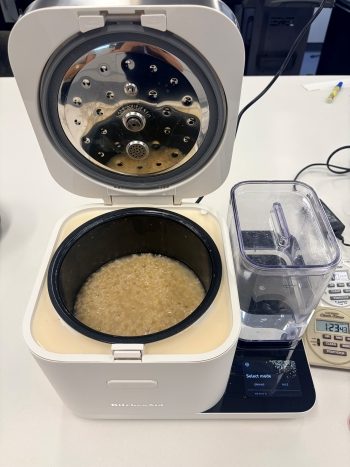
This new benchtop cooker is designed for people who regularly cook rice, grains and beans, as well as those put off by the hassle of preparing them. You simply select what you’re cooking from the preset menu, and add the dry (or pre-rinsed) ingredients into the ceramic non-stick pot. The KitchenAid Rice and Grain does the rest; weighing them and dispensing the precise amount of water required from its built-in tank. There’s no need for a separate measuring cup. A steamer basket for vegetables is also included.
Our expert tester Fiona Mair borrowed a review model from KitchenAid to see how well it performs and how easy it is to use.
The KitchenAid can make 8 cups of cooked long grain rice.
The KitchenAid’s footprint is relatively small (22cm high, 34cm wide, and 23 cm deep); taking up around as much space as a typical rice cooker or small air fryer.
It weighs 5.7kg, and has a capacity equivalent to 8 cups of cooked long grain rice. It has 21 presets for virtually all types of rice, common grains (including steel cut oats, quinoa, couscous and barley), beans, lentils and chickpeas. There’s also a custom mode (if you want to get creative with larger or smaller staples and save your own specified parameters) and additional settings for unsoaked or soaked foods.
It accommodates a maximum capacity of:
3.5–4 cups of dry rice
2–2.5 cups of dry beans and chickpeas (these absorb lots of water and froth up significantly while boiling, so overfilling could cause the vents to overflow)
3 cups of oats and quinoa (these expand quickly and excess amounts could block the automatic dispenser nozzle).
Minimum capacities start at just half a cup to one cup depending on the ingredient, so you can just cook what’s needed to minimise wastage and maximise freshness.
One notable feature is a delayed start time which is handy for allowing you to time your meal so it’s ready for you when you need it.
There’s also a keep warm function which runs for up to two hours after cooking and a soak mode if you’re still into cooking the traditional way.
Fiona conducted several cooking tests on the KitchenAid Rice and Grain cooker. “It impressed us with its excellent results across all the grains, beans and rice we tested,” she says.
For rice, you can choose from dry or rinsed and select your desired texture level (soft, medium or hard).
Fiona gave perfect scores to all the foods tested on their initial runs, which included:
Jasmine rice (35 minutes cooking time)
Short grain brown rice (70 minutes)
Steel cut oats (50 minutes)
Chickpeas (120 minutes)
Quinoa (24 minutes)
Beans (65 minutes)
As we are only borrowing the model for a limited period of time, we can’t comment on whether these perfect results are sustainable on an ongoing basis: some subsequent testing showed inconsistencies with cook times, although these improved once we refreshed the machine’s settings.
Steaming mode
You can steam vegetables in the basket too, which is a nice touch. We tested this mode using broccoli. Although the broccoli was a little dull in colour, it wasn’t soggy: it had a firm texture and slight resistance to biting.
Ease of use
The touch controls are easy to understand, with prompts to let you select the food type and texture. There’s also a countdown timer to let you know how the cooking is progressing. But Fiona discovered that the controls occasionally failed to respond if any residue found its way onto the screen. This was remedied once the screen was wiped clean (a common issue with touch-screen appliances).
The integrated scales were accurate but sometimes needed to be tared when adding the ingredient, which involves removing the food from the cooking bowl. “The scales may detect too much food or not enough food, and it will detect if the food is not levelled,” adds Fiona. This sensitivity may have caused some inconsistencies with subsequent cooking results, which improved once the machine’s settings were reset.
The ceramic non-stick pot is easy to wash up in a domestic sink
Keeping the appliance clean is easy with minimal areas for grime to accumulate, a removable inner gasket and a press-button lock release to help prevent condensation and splashing. The ceramic non-stick pot is easy to wash up in a domestic sink and claims to be scratch resistant (we haven’t tested this).
There’s also a descale mode for ongoing maintenance which involves flushing out any mineral deposits in the internal plumbing.
When removing the contents, be aware that if you are lifting out the pot, it will be hot, so you’ll need to use oven mitts. And if you intend to tip the contents out, there’s only a small lip around the bowl so pouring can be awkward if the bowl is full. Alternatively, you can empty the contents directly with a spatula.
A small printed recipe book is provided to give you some inspiration.
Fiona thinks this guesswork-saving appliance is worth considering particularly if you’re into cooking beans, and the cooking results across all food types were impressive with minimal intervention.
“While some regular rice cookers can cook dried beans, they generally take extra time, require careful water management and you will usually need to soak the beans first.”
This guesswork-saving appliance is worth considering particularly if you’re into cooking beans
Because we borrowed a review model, we haven’t tested the product over a longer period of time and can’t comment on the consistency of results. The internal scales can be sensitive, so make sure the appliance sits level, the water tank water is at room temperature, and the base of the bowl and cook plate are free from residue and moisture. It must also be cooled down between cooking cycles for at least 30 minutes.
If you are only into occasional experiments with dried staples (and for some the novelty could wear off quickly), many modern rice cookers can still successfully handle other common ingredients such as quinoa and oats, if you’re willing to put in some trial and error, and are far cheaper alternatives.
Know the products to avoid before you shop. Get our free guide and buy smarter.
Kim Gilmour is a Senior project officer. She manages a range of product tests such as coffee machines, stick vacuums, bassinets, high chairs and ovens, which are all tested in our in-house labs.
Kim’s work gives people access to robust, independent advice and helps consumers make informed decisions about their purchases. Her work also helps to keep manufacturers in check, by regularly exposing product flaws which can result in better and safer products.
Prior to CHOICE, Kim spent 16 years working as a technology journalist in Sydney and London. With several years as a senior researcher/writer at our UK sister organisation, Which?
Kim has authored how-to technology books such as Spotify for Dummies and Digital Photography for the Older and Wiser.
Kim has a Bachelor of Arts in Communication (Journalism) from Charles Sturt University. LinkedIn
For more than 60 years, CHOICE has been fighting the good fight for Australian consumers.
In the past year alone we've uncovered systemic issues with sunscreens, investigated shonky supermarket pricing, fought for stronger scam protections and helped make complex energy pricing fairer and clearer.
CHOICE is here to provide unbiased advice and independent testing in our world-class labs. We buy the products we test, just like you do, and our expert reviews are influence free. We’re here to help you choose smarter. Hopefully you’ll also save some money along the way.
Thanks to CHOICE, you’ll never be alone when a business treats you unfairly. You can support our work by joining or donating to our cause.