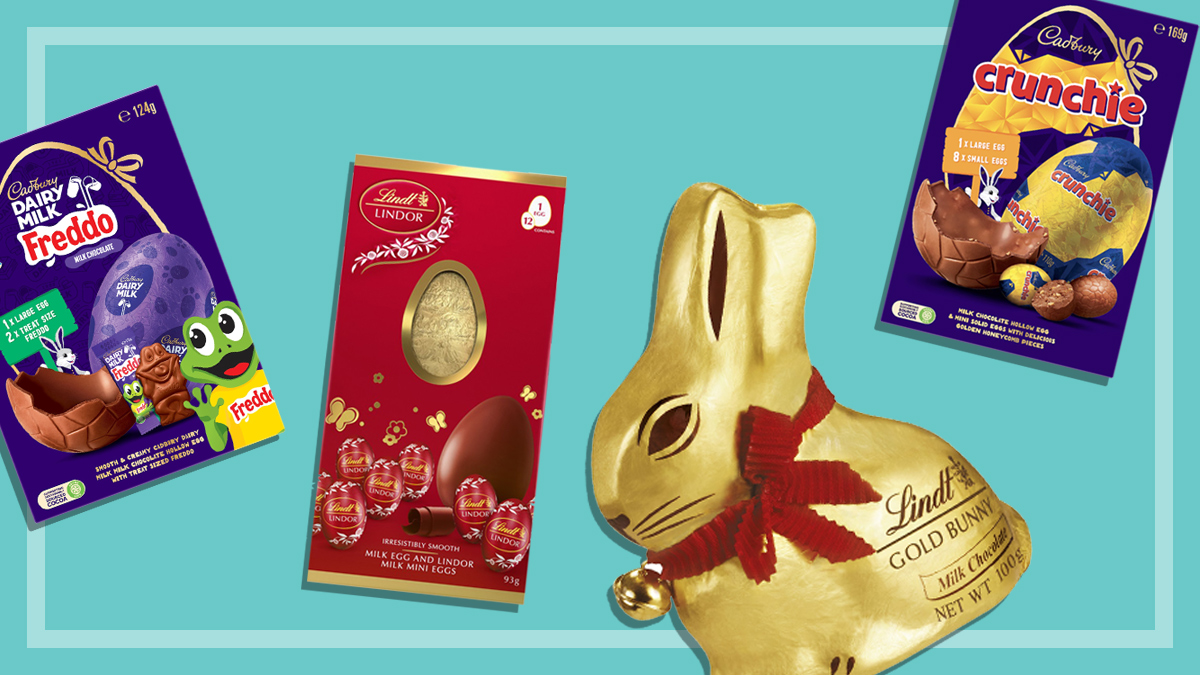
A whole range of Cadbury chocolate Easter eggs have become smaller and more expensive since last year
One box of Cadbury’s hollow eggs has shrunk for the second year running, with buyers now paying 73% more per 100g than in 2024
Meanwhile, Aldi has shrunk and raised prices for some of its hot cross buns
Another year, another round of shrinkflation for Australia’s favourite Easter treats. CHOICE has found chocolate eggs and hot cross buns that have become smaller and more expensive in the past 12 months.
To add insult to chocolate-coated injury, the cuts are being made by brands that already put the shrink on their Easter products last year.
In a standout case, Cadbury Dairy Milk has doubled down on its shrinkflation strategy, hitting the same product for a second year running.
For the second Easter in a row, its largest box of hollow chocolate eggs designed for Easter hunts has become not only smaller but more expensive too, costing a whopping 73% more per 100 grams than it did in 2024.
Cadbury and other manufacturers are still blaming high cocoa prices for the cuts. Even though wholesale prices have dropped significantly, agribusiness experts say consumers may not see the cost of chocolate come down anytime soon.
Now, a close look at products currently on shelves reveals manufacturers have resurrected the practice in time for Easter 2026, unafraid to make further cuts and raise prices higher for products already given the shrinkflation treatment previously.
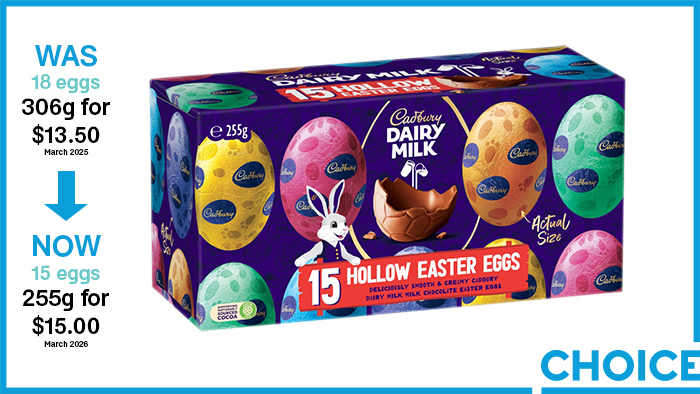
Cadbury’s 15-pack of hollow hunting eggs comes with three fewer eggs and costs $1.50 more than last year.
Cadbury drops some eggs
In the past 12 months, all of the products we looked at in Cadbury Dairy Milk’s range of boxed hollow hunting eggs have become smaller and more expensive – each box now comes with at least one egg less than it did last year.
The 15-egg box currently on sale for $15 at major retailers has replaced an 18-egg box that sold for $13.50 last year.
Meanwhile, the 10-pack is one egg lighter and almost $2 more expensive than it was 12 months ago, and last year’s 9-egg box has been replaced with an 8-egg version.
But the biggest crack in value for money comes in the form of the ‘largest’ box in Cadbury’s hollow hunting egg range.
All up, the 68g downsizing and $5.50 price hike since 2024 means shoppers are now paying almost 73% more
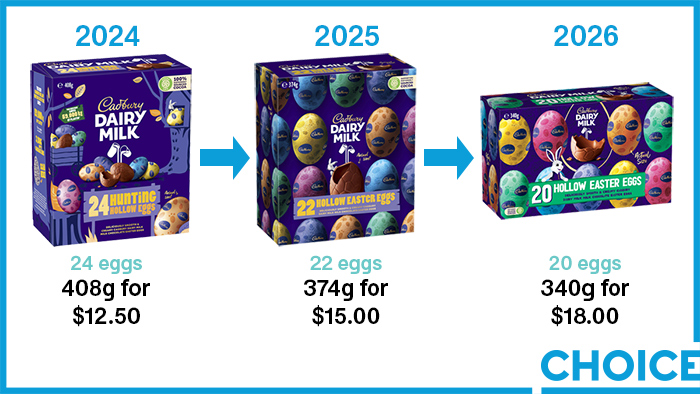
Last year, we revealed that the then-22-pack had lost two eggs and gone up in price by $2.50 since 2024.
Seemingly unconcerned with exposure as a serial shrinker, Cadbury has come back for more, cutting two more eggs from the product, while its price at major retailers has increased by another $3.
All up, the 68g downsizing and $5.50 price hike since 2024 means shoppers are now paying almost 73% more per 100g for this box of eggs than they were two years ago.
Cadbury’s largest pack of hollow hunting eggs has shrunk each year since 2024 and now costs 73% more per 100g.
It’s worth noting that some brands have made the unexpected decision to turn back the clock on shrinkage this Easter.
Case in point, last year we called out Aldi for shrinking packets of mini milk chocolate eggs sold under its Dairy Fine homebrand label.
These packets have since been restored to their former size, albeit with a 33% accompanying increase in price.
Price hikes across multiple brands
We’ve noticed many Easter-themed products that have stayed the same size, but simply gone up in price instead.
A Cadbury Dairy Milk deluxe egg we exposed for shrinking last year is still 340g, but at $23, now costs $3 more than it did last Easter.
Data from price comparison tool Zyft reveals this to be a broad trend across the market – the platform found the costs of Easter bunnies and eggs from Cadbury and Lindt have increased by as much as a third in the last 12 months.
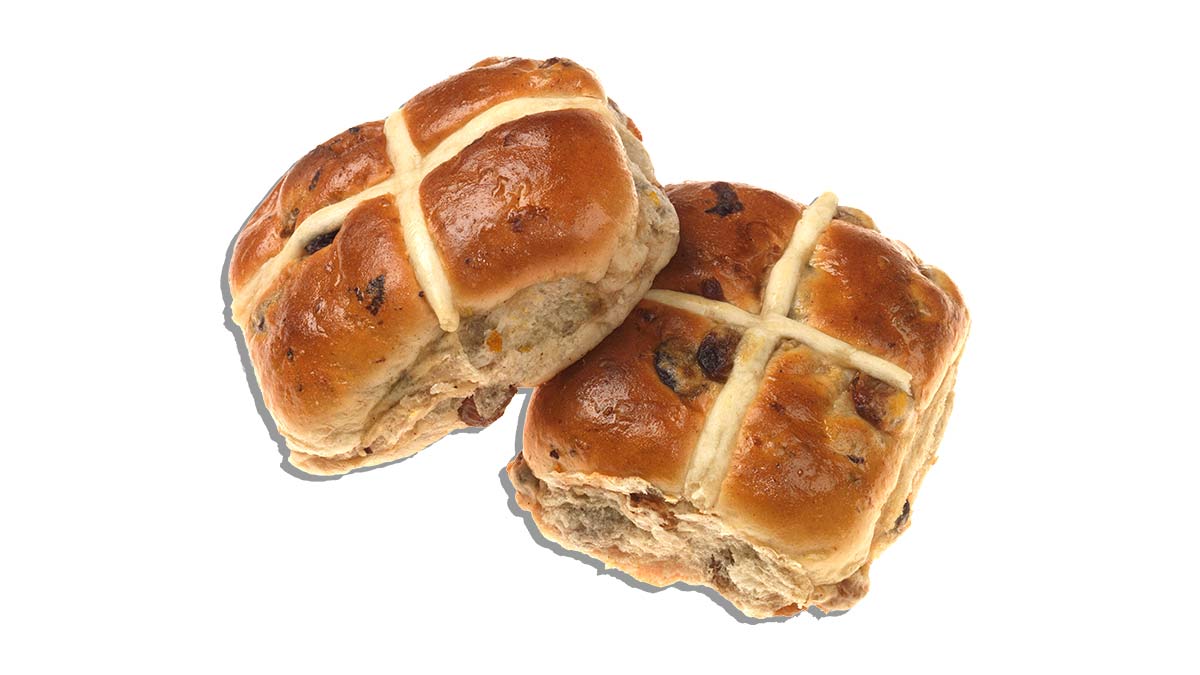
Nothing is sacred when shrinkflation is concerned – case in point, hot cross buns have also become smaller and more expensive since last Easter.
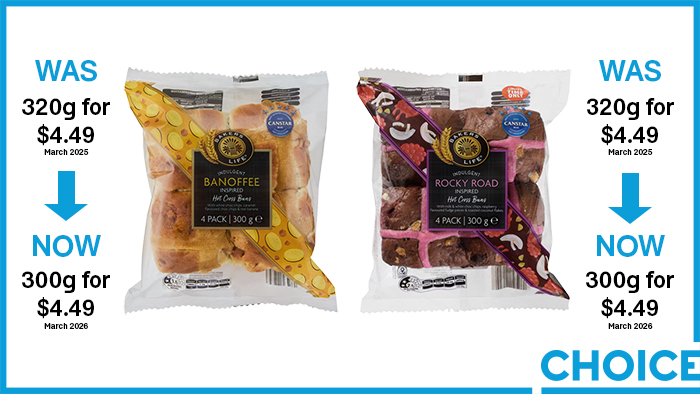
Packs of Rocky Road and Banoffee-flavoured buns sold under Aldi’s Bakers Life homebrand label are both 20g lighter than they were this time last year.
But with no subsequent cut in price, if you do decide to stump up for these novelty versions of an Easter staple, you’ll be paying nearly 7% more per 100g than you would have in 2025.
Not just eggs: Hot cross buns, another Easter staple, have also been hit by shrinkflation.
Why is this happening?
Manufacturers making the cuts say the rising cost of the goods and services they use in the making of these products and bringing them to consumers is the key reason for the downsizing.
When contacted, Cadbury owner Mondelez told us it’s made “adjustments” to its products in order to keep retail prices within a certain range while it “navigates significantly higher cocoa and input costs globally”.
Aldi similarly responded by saying the commodities it needs to produce hot cross buns have risen in price and that it’s made the decision to shrink some products to “keep prices consistent for customers”.
But haven’t cocoa prices come down?
High cocoa prices have been a reason perennially put forward by chocolate manufacturers shrinking their products, ever since costs for the key commodity spiked by almost 200% in early 2024.
However, after almost two years of elevation, these prices have dropped in recent weeks to levels close to what they were in 2023.
This is largely due to better weather and bigger harvests in key growing regions, says Michael Whitehead, Executive Director of Food, Beverage and Agribusiness Insights at ANZ.
But the cocoa price crash comes too late to provide any relief from this year’s Easter egg prices.
Text-only accessible version
Replace this with your text. Replace this with your text. Replace this with your text. Replace this with your text.
“The egg that you buy off the shelf now is probably from last year’s very expensive bean,” Whitehead explains. “The cocoa bean or the cocoa pods picked for that [egg] were probably picked over a year ago.”
Whitehead and other experts say the current lower cocoa price could start to flow through to consumers later this year or early 2027, but other factors could still scupper the prospect of lower or more stable chocolate prices.
Experts say the current lower cocoa price could start to flow through to consumers later this year or early 2027
“Cocoa is just a small part of the Easter egg that appears on a shelf,” Whitehead says.
“Can consumers expect … some kind of a price reduction? It depends on all those other components: the price of milk, sugar, packaging, power [and] the diesel to run the truck that gets it there.”
Mondelez, one of the world’s largest chocolate manufacturers, did not say if lower cocoa prices would have an impact on its products, confirming only that it buys cocoa well in advance and that shifts in the price of this commodity won’t immediately change prices seen in stores.
CHOICE has been shining a light on shrinkflation in Australia for several years, leading to the federal government turning its attention to the issue.
“The government is considering the adoption of notices telling shoppers when a product has undergone shrinkflation,” explains CHOICE senior campaigns and policy adviser Bea Sherwood.
Similar requirements have already been put on grocery retailers in some countries overseas, including France.
The government is considering the adoption of notices telling shoppers when a product has undergone shrinkflation
CHOICE senior campaigns and policy adviser Bea Sherwood
The Commonwealth has spent several months considering how such notices could work for Australian consumers and businesses and CHOICE has been putting forward its views.
“These notices should be clear and eye-catching and located close to the product for a reasonable period of time, long enough for consumers to be aware of the change,” Sherwood says.
“Shrinkflation is hard to spot, so these notices would be crucial in helping consumers avoid being caught out by this practice, but when and how they appear in stores and online remains to be seen.”
Liam Kennedy is a Journalist with the Editorial and investigations team. He answers consumers' most burning questions, from which scams to be aware of and how to save money, to whether new services and products are worth using and how the latest developments in consumer news could affect them.
Prior to CHOICE, Liam worked in production in daily news radio and podcasting.
Liam has a Bachelor of Communication (Journalism) and a Bachelor of Arts in International Studies from the University of Technology Sydney. LinkedIn
Liam Kennedy is a Journalist with the Editorial and investigations team. He answers consumers' most burning questions, from which scams to be aware of and how to save money, to whether new services and products are worth using and how the latest developments in consumer news could affect them.
Prior to CHOICE, Liam worked in production in daily news radio and podcasting.
Liam has a Bachelor of Communication (Journalism) and a Bachelor of Arts in International Studies from the University of Technology Sydney. LinkedIn
For more than 60 years, CHOICE has been fighting the good fight for Australian consumers.
In the past year alone we've uncovered systemic issues with sunscreens, investigated shonky supermarket pricing, fought for stronger scam protections and helped make complex energy pricing fairer and clearer.
CHOICE is here to provide unbiased advice and independent testing in our world-class labs. We buy the products we test, just like you do, and our expert reviews are influence free. We’re here to help you choose smarter. Hopefully you’ll also save some money along the way.
Thanks to CHOICE, you’ll never be alone when a business treats you unfairly. You can support our work by joining or donating to our cause.