Around 5% of Australians suffer from sleep apnoea – a type of sleep-disordered breathing. It’s more common in men than women; it’s estimated to affect roughly 20% of middle-aged men, and 10% of middle-aged women.
The good news is that sleep apnoea is highly treatable. Diagnosis is based on the results of a sleep study, and treatments range from making lifestyle changes or using devices while you sleep, to surgery. Here, we explore how sleep studies and treatments are covered by private health insurance and Medicare.
Sleep apnoea, or obstructive sleep apnoea, is a sleep disorder where not enough air can get into your lungs during sleep. You stop breathing momentarily, until your brain wakes you up a little to get your throat muscles to work again and allow air through the lungs. This can happen hundreds of times in a night, resulting in fatigue, concentration difficulties, and an increased risk of other health conditions.
Sleep apnoea, or obstructive sleep apnoea, is a sleep disorder where not enough air can get into your lungs during sleep
So, what should you do if you have sleep apnoea?
The first point of call if you think you may suffer from sleep apnoea is your GP. They can start by ordering a sleep study, referring you to a specialist, and talking through lifestyle changes that might help.
Is a sleep study covered by Medicare or private health insurance?
You can do a sleep study in your own home, or in a hospital. Sleep studies can be paid for in a public hospital by Medicare, or if you have private health insurance, this can help pay for a sleep study in a private hospital. Sleep studies are classed as a “Gold tier” category service – meaning that Gold hospital policies must include them, however they are also covered on plenty of Bronze Plus and Silver Plus policies too. Use our health insurance comparison tool to find the best value policy that includes sleep studies.
Hospital insurance won’t help if you opt to undergo a sleep study in your own home, but Medicare will foot the bill for an at-home sleep study if it’s bulk billed, otherwise you’ll have to contribute some of the costs from your own pocket.
Are CPAP machines and other treatments for sleep apnoea covered by Medicare or private health insurance?
There are many treatment options for sleep apnoea, including lifestyle changes, devices, and surgery. The treatment your doctor recommends will depend on what’s causing your sleep apnoea, the severity of your condition, and whether you have any other conditions as well. Some treatments are covered by Medicare, others – like CPAP machines – can be claimed on private health insurance.
Weight loss for sleep apnoea
The main lifestyle change that can help improve sleep apnoea is weight loss. Weight loss can make a difference because fat on the inside of the neck can narrow the throat and airways. Reducing your alcohol consumption is also recommended because alcohol makes the throat muscles relax more during sleep.
Weight loss can make a difference because fat on the inside of the neck can narrow the throat and airways
Medicare doesn’t cover medication for weight loss, weight loss programs or gym memberships. You may be eligible for a Medicare rebate for some sessions with a dietician and other allied health professionals if you qualify for a healthcare plan – your GP will need to give you a referral.
Some extras policies, generally the more expensive ones, will contribute towards dietary advice, exercise physiologists and/or health management services such as weight loss programs or gym memberships, if you have a doctor’s referral. Some will also contribute towards non-PBS medications.
Devices for the treatment of sleep apnoea
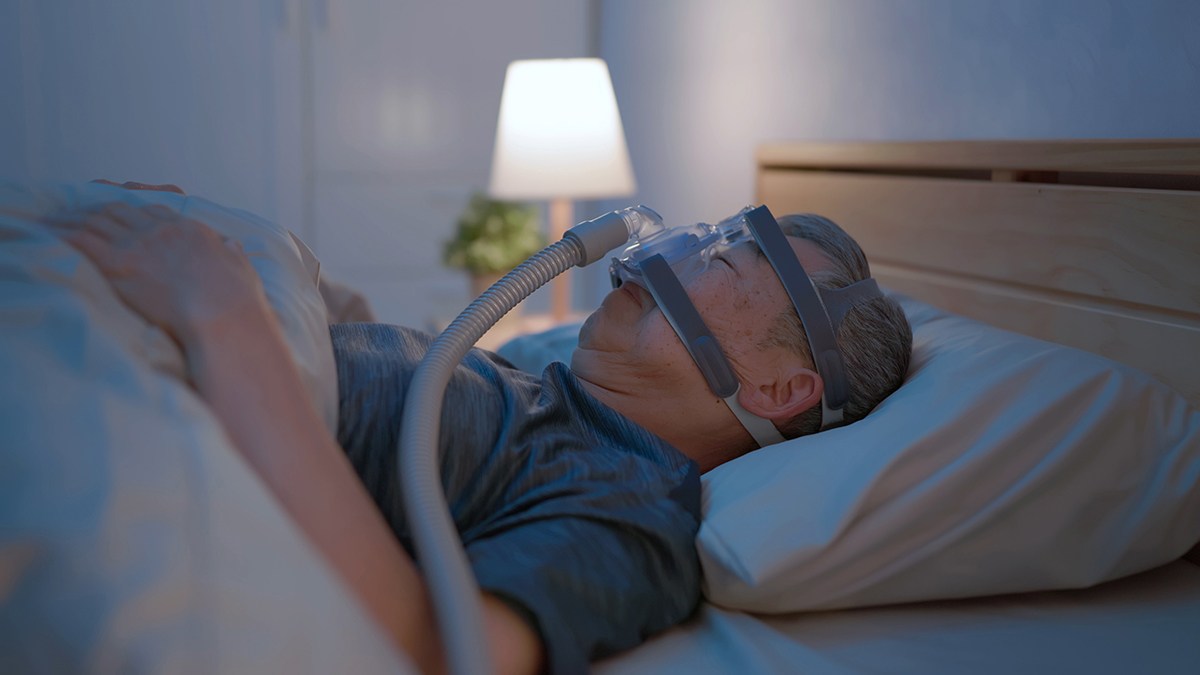
CPAP machine CPAP stands for continuous positive airway pressure and refers to a mask worn at night that delivers increased air pressure into the airway to keep it open. CPAP is thought to be the most effective and most common treatment for sleep apnoea.
Medicare doesn’t cover CPAP machines. However, state government-based schemes may contribute to costs, especially if you have a concession card. While public funding is limited, it is worth researching the situation in your state to see if you qualify for some support.
Usually CPAP machines are covered by extras policies, but a handful of funds cover them through their hospital policies
Private health insurance can help with the cost of a CPAP machine, but the type of policy you need depends on your fund. Usually CPAP machines are covered by extras policies, but a handful of funds cover them through their hospital policies. See below to find out how BUPA and Medibank cover CPAP.
Dental devices Dental devices that are used to help relieve snoring can also be effective in reducing the symptoms of sleep apnoea.
Some top extras policies will contribute towards dental devices that may help relieve the symptoms of sleep apnoea – check with your fund to find out if you’re covered
Positional devices These can be as simple as sewing a tennis ball to the back of your pyjama top to prevent you turning to lie on your back during sleep. There are also many different types of positional devices available from specialist retailers. Positional devices are generally not covered by Medicare or private health insurance.
Surgery
Upper airway surgery Upper airway surgery to create more space in the throat is usually a last resort if other treatments haven’t worked. This type of surgery is performed by an ear nose and throat surgeon and they can help work out whether this may be beneficial for you.
Such surgery is covered by both Medicare and all Bronze, Silver and Gold policies. Speak to your specialist for details about using the public or private system, and your health fund to see how your specific surgery is covered by your particular policy.
Removal of tonsils and adenoids Removal of tonsils and adenoids may be considered for children with large tonsils and adenoids that block the throat when sleeping and cause snoring.
This surgery is also are covered by all Bronze, Silver and Gold policies. Speak to your health fund to see how your specific surgery is covered by your particular policy. Going public is also an option, as these surgeries are also covered by Medicare, though wait lists may apply.
Weight loss surgery If you struggle to lose weight with lifestyle change, and are considering weight loss surgery, Medicare will cover bariatric surgery in a public hospital if you meet the criteria, but waitlists are long. If you want to be treated sooner in a private hospital, weight loss surgery is covered by Gold hospital policies, and a handful of Silver Plus policies.
We looked into how the most popular health insurance funds cover CPAP.
CPAP machines are usually covered as a device under extras policies. Bupa covers CPAP machines in this way, but only their top tier policies – Super Extras and Top Extras, and the cover does not pay for the entire cost. Once every two years, Bupa’s Super Extras will contribute 60% of the cost of a CPAP machine up to $300, while all the variations of Top Extras cover between 60% and 80% of the cost up to between $500 and $700 for CPAP machines. This is under a combined limit for health aids, appliances and blood glucose monitors.
Medibank and AHM cover CPAP machines under their hospital policies, rather than under an extras policy like Bupa and most other insurers.
Medibank covers CPAP machines on all of their Bronze Plus, Silver Plus and Gold policies, offering a $500 benefit every 5 years.
CPAP machines generally cost over $1000, but they can go up to about $6000, so it’s not worth buying private health insurance for this benefit alone – you’ll need to be getting value from the rest of your policy as well for private health insurance to be worth your while.
Jane Bardell is a Content producer in the Insurance and utilities team. She writes about home, car, pet and health insurance.
Previously at CHOICE, she checked facts, figures and statistics as a Verifier with the Editorial and investigations team.
Jane has a Bachelor of Science from the University of New South Wales. LinkedIn
Jane Bardell is a Content producer in the Insurance and utilities team. She writes about home, car, pet and health insurance.
Previously at CHOICE, she checked facts, figures and statistics as a Verifier with the Editorial and investigations team.
Jane has a Bachelor of Science from the University of New South Wales. LinkedIn
For more than 60 years, CHOICE has been fighting the good fight for Australian consumers.
In the past year alone we've uncovered systemic issues with sunscreens, investigated shonky supermarket pricing, fought for stronger scam protections and helped make complex energy pricing fairer and clearer.
CHOICE is here to provide unbiased advice and independent testing in our world-class labs. We buy the products we test, just like you do, and our expert reviews are influence free. We’re here to help you choose smarter. Hopefully you’ll also save some money along the way.
Thanks to CHOICE, you’ll never be alone when a business treats you unfairly. You can support our work by joining or donating to our cause.