The Victorian government has threatened to execute approximately 3117 imprisonment warrants, most of which are for unpaid fines to road toll operator Transurban dating back for years
Many of the affected people would be unaware that they have outstanding toll debts
Legal aid and community support groups are calling on the Victorian government to purge these ‘zombie warrants’ from the system
Thousands of low-income Victorian residents could soon be receiving an unexpected knock on the door from a state sheriff, or at least a bombshell of a debt collection notice in the mail.
They’re unlikely to know what’s coming. Despite an outcry from legal aid and community support groups, the state government has said it’s going to start trying to collect unpaid road toll fines dating back a decade or more. And it’s threatening to put people in prison if they don’t pay.
Most of these approximately 3117 unexecuted imprisonment warrants were written up against economically marginalised Victorians. The bulk of them are for unpaid fines to road toll operator Transurban, a global corporation that has a lucrative monopoly on Australia’s busiest commuting routes. (The Magistrates’ Court in Victoria can issue enforcement warrants for a sheriff to execute after a “notice of final demand” for outstanding fines goes unpaid.)
The unpaid financial penalties for a single warrant – mouldering for years in the state’s record books – could easily be in the tens of thousands of dollars, as steep administrative and late payments fees have added to the original toll amounts.
Many of the affected people would be unaware that they have outstanding toll debts, which generally balloon out of proportion with the accretion of late payment and administration fees
At the moment, there’s a moratorium on executing the warrants that came into effect in early 2024 after Victoria Legal Aid and other community support groups caught wind of what the government had in mind.
But moratoriums are temporary, and the lawyers and social support professionals CHOICE spoke to say the pause needs to become an outright ban on trying to collect this phantom revenue.
Many of the affected people would be unaware that they have outstanding toll debts, which generally balloon out of proportion with the accretion of late payment and administration fees. The knock on the door would come out of the blue.
Shifrah Blustein, a managing lawyer at Inner Melbourne Community Legal, says “it’s unusual and egregious that people are at serious risk of going to prison for not paying a toll fine, which arises from a debt to a private company”. It makes Victoria an outlier.
“No other debts to private companies, like not paying your phone or utility bill, can result in criminal charges, let alone imprisonment,” Blustein says.
Bronwyn Davis, a specialist family violence financial counsellor at Women’s Legal Service Victoria, points out that this would effectively be the state doing toll operator Transurban’s bidding, since it’s the toll operator who chooses which toll debts to refer to Victoria Police.
No other debts to private companies, like not paying your phone or utility bill, can result in criminal charges, let alone imprisonment
Shifrah Blustein, Inner Melbourne Community Legal
“Transurban can send toll fee notices to Victoria Police to pursue the criminal route and the rest sit with Transurban, which they try to collect without involving the police,” Davis says. “So affected people are getting pursued by both sides and then facing the threat of imprisonment.”
Davis wants policymakers to understand that the people they’re bent on extracting money from are already struggling to survive. And there’s often a darker story in the background.
“These are people who can’t afford to pay, and on top of that many have been experiencing family violence. And because of the nature of family violence, many actually don’t realise the extent of their fines and the risk that they’re facing.”
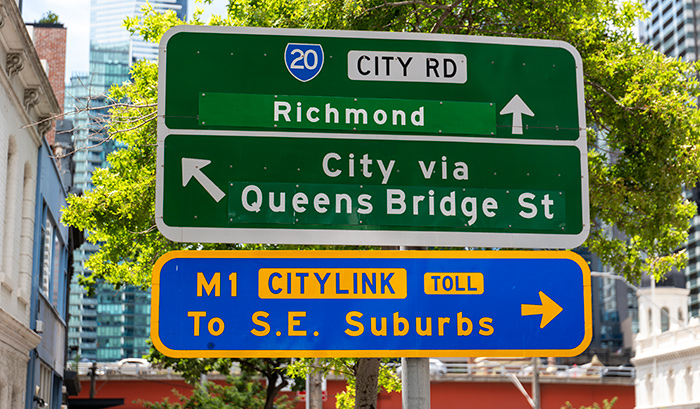
Toll operator Transurban has a lucrative monopoly on Australia’s busiest commuter routes.
Fines a significant part of financial counselling cases
The “zombie warrants” issue comes at a time when more and more people in Victoria are finding it hard to pay for basic necessities. According to a December 2025 update of the Mapping Poverty in Victoria project by the Victorian Council of Social Service, over 800,000 Victorians, including 216,000 children, live on the edge of poverty. This is around 13% of the state’s population.
Blustein says this includes a growing number of families with two working parents whose combined income just isn’t enough. They may have once been considered “middle class”, but the cost-of-living pressures in major population centres like Melbourne have blurred socioeconomic lines.
Blustein and Davis are co-convenors of an organisation focused on reducing the impact of Victoria’s convoluted fines system on people with very little discretionary income.
The Infringements Working Group (IWG) is made up of the Federation of Community Legal Centres (Victoria), Victoria Legal Aid and Financial Counselling Victoria.
In a December 2025 submission to the state government, the IWG called for reform “that moves away from a punishment and deterrence model and recognises that many fine recipients do not have the capacity or means to resolve their fines in a complex and traumatising fines system, particularly in a cost-of-living crisis”.
Unpaid fines come into play in around 12% of financial counselling cases in Victoria.
Are the fines actually enforceable?
Many of the unpaid road toll fines were issued before Victoria’s Fines Reform Act of 2017, which came about after the state parliament acknowledged that the previous legislation allowing imprisonment for unpaid fines disproportionately affected vulnerable Victorians.
“People are being punished under a regime that doesn’t exist anymore, but the warrants made back then still do,” Blustein says.
The punishment would also be for an infraction that was probably unintentional. For many Victorians, using a toll road is more of an unavoidable necessity than a conscious choice, she says.
“We hear lots of stories of parents driving kids with disabilities to appointments, or who are in a mental health crisis or fleeing family violence, all sorts of things interacting. So if they receive a toll notice, it’s not the top priority at the time. They’re juggling all sorts of other financial obligations.”
And then life goes on.
“One of the worst things about this system is that it doesn’t catch up with you for a long time, but when it does, it’s harsh. So people think, ‘okay, I can put that on the back burner and deal with my more urgent issues’.”
For Blustein and Davis, it’s a case of criminalising poverty, because many people simply can’t afford the high cost of road tolls. To take one example, residents in Melbourne’s more socio-economically disadvantaged outer suburbs rely heavily on the Transurban network because public transport isn’t really an option. They stand to pay the most in both tolls and late payment fees. Unless they can’t pay or forget they were supposed to.
“We suspect that a lot of affected people wouldn’t even know about the existence of these warrants. They’re from a decade or more ago,” says Blustein.
If the Victorian Government doesn’t actively close this loophole, imprisonment won’t be off the table for people who incur fines in the future
Bronwyn Davis, Women’s Legal Service Victoria
“They wouldn’t know that they’ve defaulted on a payment arrangement and now there’s an imprisonment warrant hanging over their head that the sheriff can execute at any time.”
In December last year, Victoria’s Attorney-General Sonya Kilkenny told The Age that warrants and imprisonment were “last resorts for outstanding fines and have nothing to do with the state’s financial position”.
But the heavy-handed last resort remains a distinct possibility. Bronwyn Davis says it’s time to put the unexecuted warrants and their legal ambiguity to bed forever.
“If the Victorian Government doesn’t actively close this loophole, imprisonment won’t be off the table for people who incur fines in the future.”
And that would include not just low-income Victorians, but everyone in the state who’s finding it hard to get by.
Andy Kollmorgen is the Investigations Editor at CHOICE. He reports on a wide range of issues in the consumer marketplace, with a focus on financial harm to vulnerable people at the hands of corporations and businesses. Prior to CHOICE, Andy worked at the Australian Securities and Investments Commission (ASIC) and at the Australian Financial Review along with a number of other news organisations. Andy is a former member of the NSW Fair Trading Advisory Council. He has a Bachelor of Arts in English from New York University. LinkedIn
Andy Kollmorgen is the Investigations Editor at CHOICE. He reports on a wide range of issues in the consumer marketplace, with a focus on financial harm to vulnerable people at the hands of corporations and businesses. Prior to CHOICE, Andy worked at the Australian Securities and Investments Commission (ASIC) and at the Australian Financial Review along with a number of other news organisations. Andy is a former member of the NSW Fair Trading Advisory Council. He has a Bachelor of Arts in English from New York University. LinkedIn
For more than 60 years, CHOICE has been fighting the good fight for Australian consumers.
In the past year alone we've uncovered systemic issues with sunscreens, investigated shonky supermarket pricing, fought for stronger scam protections and helped make complex energy pricing fairer and clearer.
CHOICE is here to provide unbiased advice and independent testing in our world-class labs. We buy the products we test, just like you do, and our expert reviews are influence free. We’re here to help you choose smarter. Hopefully you’ll also save some money along the way.
Thanks to CHOICE, you’ll never be alone when a business treats you unfairly. You can support our work by joining or donating to our cause.