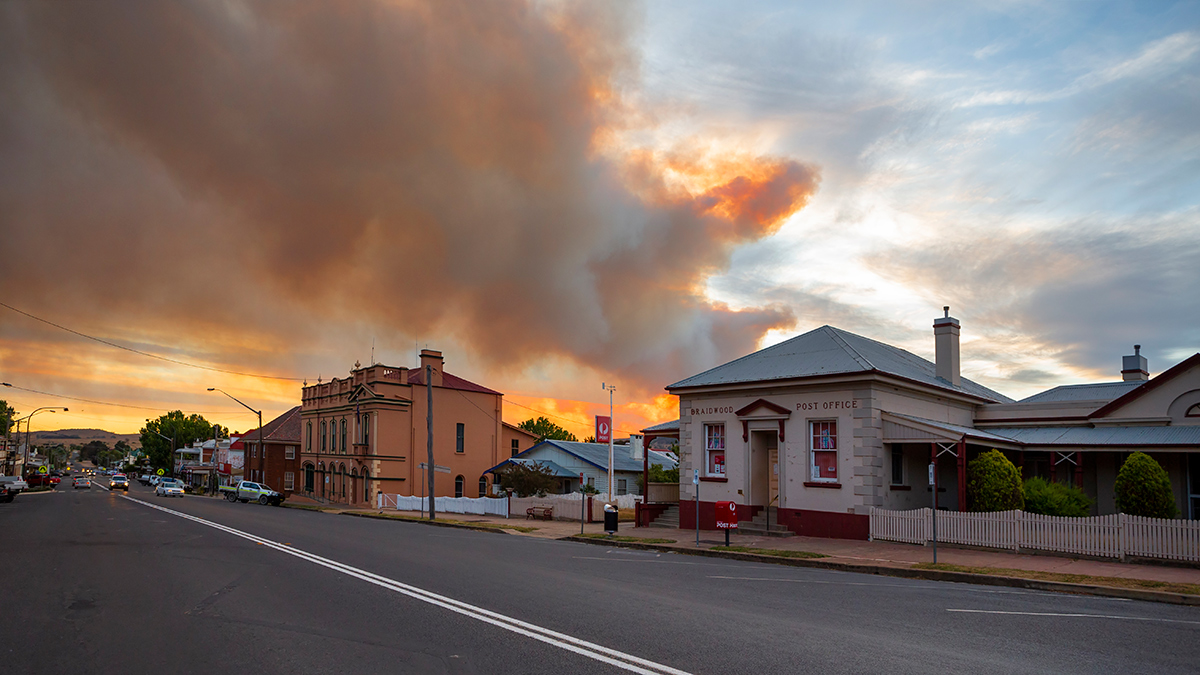
For Sean and his family in Coonabarabran in the Central West region of NSW, living with bushfire danger comes with the territory.
“We are on 100 acres and completely surrounded by scrub. When we inherited this house it was all good, but it wasn’t remotely ember-proof,” he says.
Over the last five years, Sean estimates he has spent $150,000 on improvements to the property to make it more fire resilient, including a new roof, new cladding, windows and fire screens. Despite lowering the risk of losing his house in a fire, his insurance premium hasn’t been reduced at all.
Changing how mitigation efforts are factored into premiums … could help incentivise more owners to act
“Our decision-making hasn’t been about reducing the premiums, but still, it would be nice to get some kind of financial recognition,” Sean says.
For Sean and thousands of other Australians around the country who live in high-risk disaster areas, the decision to make resilience improvements to their properties is a cost they mostly have to bear without assistance. Even when they do make improvements on their own, those efforts are very rarely, if ever, factored into their home insurance premiums, which have continued to rise nationally.
Changing how mitigation efforts are priced and factored into premiums is a simple change that advocates say could help incentivise more owners to act, potentially saving homes and saving customers and insurance companies money when disaster does strike.
Current insurance premium pricing a “wicked problem”
Julia Davis, principal of external relations and advocacy at Financial Rights Legal Centre, says the insurance industry currently has no standard approach when it comes to pricing individual mitigation efforts.
“Pricing systems currently are complex and they are opaque, there is little transparency and a homeowner has no idea exactly why they are priced the way they are,” she says.
“A lot of people out there want to make their homes safer. If the insurance industry said ‘you can do X, Y and Z and this is the discount you will receive’ as well as creating an incentive, it would also be a clear signal to people about what they should do,” Davis says.
The insurance industry currently has no standard approach when it comes to pricing individual mitigation efforts
Julia Davis, Financial Rights Legal Centre
Professor Paula Jarzabkowski from the University of Queensland is an expert on insurance markets. She says insurance premium pricing is a “wicked problem” and acknowledges that more transparency and information for customers is needed. But she disagrees that pricing individual mitigation efforts would necessarily work for insurance companies.
“Mitigation on an individual level isn’t a simple solution. If you don’t get community-wide results, you might not actually be lowering the risk (for insurers),” she says.
Premiums are leading to rising rates of uninsurance and underinsurance.
How to incentivise mitigation
The government’s Australian Reinsurance Pool Corporation provides a financial guarantee for cyclone insurance in certain geographic areas of northern Australia. The reinsurance pool also provides four individual mitigation actions households can take to receive a discount on their insurance premium.
Davis says this model is an example of how incentivising mitigation can work.
“We know much more about what relatively easy mitigation efforts are effective when it comes to cyclones, so it is easier to price them. Flood and fire become a more complicated picture, but that’s not to say it can’t be done,” Davis says.
The Resilient Building Council (RBC), which was formed in the wake of the 2009 Black Saturday bushfires in Victoria, is an innovative example of how a new approach could work.
There is momentum building in this space, even if it is a little slower than we would like
Kate Cotter, CEO and founder, Resilient Building Council
RBC CEO and founder Kate Cotter has spent over a decade convincing industry to take into account fire mitigation efforts. She’s also developed a bushfire resilience app to help homeowners know how to improve their protection and save money.
“It is happening, there is momentum building in this space, even if it is a little slower than we would like,” she says.
They have had some success. Both Suncorp and IAG have said customers who make certain improvements through the Bushfire Resilience Rating Home Self-Assessment App will receive discounts of up to 60% on the disaster peril component of their home insurance premiums.
Cotter says that for innovations like the app to scale up and have an impact nationally, government assistance and intervention will be necessary.
“Governments certainly have a role in helping support these programs in terms of scaling them up and backing them over the long term, but they’ve also got a really important coordination role in bringing industry and all the stakeholders together to accelerate these programs,” she says.
“We don’t need to reinvent the wheel. We see with rooftop solar that when you incentivise something, people will invest.”
Davis says that government intervention in this issue is needed and history shows the industry won’t fix this problem on their own.
Our entire financial system is reliant on home insurance working, and it isn’t working for too many people
Julia Davis, Financial Rights Legal Centre
“We’re seeing growing levels of underinsurance from both an affordability and an accessibility point of view. Our entire financial system is reliant on home insurance working, and it isn’t working for too many people right now,” she says.
The Insurance Council of Australia declined to be interviewed, but said in a statement that insurers use “a range of sophisticated data sources” to determine premiums.
“Individual property characteristics, including risk-reducing upgrades, can be factored into a premium, so homeowners who have made mitigation improvements should tell their insurer,” a spokesperson says.
“While individual mitigation efforts can make a difference, the answer is to tackle the risk itself. The most effective lever for reducing premiums at scale is investment in large-scale hard infrastructure, including levees, flood barriers and resilient community assets that reduce risk for entire neighbourhoods at once”.
Jarni Blakkarly is an award-winning Senior Investigative Journalist at CHOICE. Jarni has worked for news organisations such as SBS, Reuters, Al Jazeera English, ABC 730, Radio National, BBC World Service and Deutsche Welle.
Jarni won the Walkley Foundation's young journalist of the year student category award in 2016 and was the recipient of a Melbourne Press Club Michael Gordon fellowship in 2022. In 2023 he was a highly commended finalist in the Quill Awards and a winner at the 2024 Excellence in Civil Liberties journalism awards. In 2024 he was elected to serve on the Federal Council (National Media Section) of the MEAA. Jarni has a Bachelor of Communications (Journalism) from the Royal Melbourne Institute of Technology (RMIT).
Jarni Blakkarly is an award-winning Senior Investigative Journalist at CHOICE. Jarni has worked for news organisations such as SBS, Reuters, Al Jazeera English, ABC 730, Radio National, BBC World Service and Deutsche Welle.
Jarni won the Walkley Foundation's young journalist of the year student category award in 2016 and was the recipient of a Melbourne Press Club Michael Gordon fellowship in 2022. In 2023 he was a highly commended finalist in the Quill Awards and a winner at the 2024 Excellence in Civil Liberties journalism awards. In 2024 he was elected to serve on the Federal Council (National Media Section) of the MEAA. Jarni has a Bachelor of Communications (Journalism) from the Royal Melbourne Institute of Technology (RMIT).
For more than 60 years, CHOICE has been fighting the good fight for Australian consumers.
In the past year alone we've uncovered systemic issues with sunscreens, investigated shonky supermarket pricing, fought for stronger scam protections and helped make complex energy pricing fairer and clearer.
CHOICE is here to provide unbiased advice and independent testing in our world-class labs. We buy the products we test, just like you do, and our expert reviews are influence free. We’re here to help you choose smarter. Hopefully you’ll also save some money along the way.
Thanks to CHOICE, you’ll never be alone when a business treats you unfairly. You can support our work by joining or donating to our cause.