Is the Breville Eye Q Auto two-slice toaster worth it?
The latest Breville toaster uses optical sensors rather than a timer to get your preferred shade of bread. We look at whether it's worth splurging for high-tech toast.
It’s refreshing to see innovation in the toaster market, and clearly a lot of thought has gone into the Breville Eye Q’s sleek, timer-free design. But this era of high-tech toasting isn’t perfect, and we still ran into some of the same issues we find with regular toasters. Because the optical sensors only assess browning levels on one side of the toast and replicates this across slices, we experienced inconsistent, uneven results for our initial review, particularly with sourdough that varies in size and shape. Early adopters may love it, but it’s expensive. A cheap toaster could do the same job with a little experimentation with your preferred timer settings.
Toasters are a surprisingly controversial subject. Every time CHOICE publishes our toaster reviews, people proudly declare their preferred shade of toasted bread on our social platforms.
Many express shock at someone whose preference borders on charcoal, while others scoff at those who like it light and barely touched.
Then there are the types of breads. Sliced white bread is so 1980s. Today it’s all about sourdough, multigrain (or multigrain sourdough), artisanal bread, waffles… the list goes on. Having to juggle all these toast variables in a regular timer-based toaster can be a challenge.
What if there was a toaster that could sense what you toasted, and stopped toasting when it reached your favourite shade?
But what if there was a toaster that could sense what you toasted and stopped toasting when it reached your favourite shade, no matter how long that might take or what bread you used?
Enter the Breville boffins who say they’ve spent more than 10 years making this a reality. We tested the Breville Eye Q Auto toaster on a range of bread types to see if it worked, and got some interesting results. (Watch out for our full review later in the year, which will thoroughly compare its performance alongside other toasters.)
Read more:
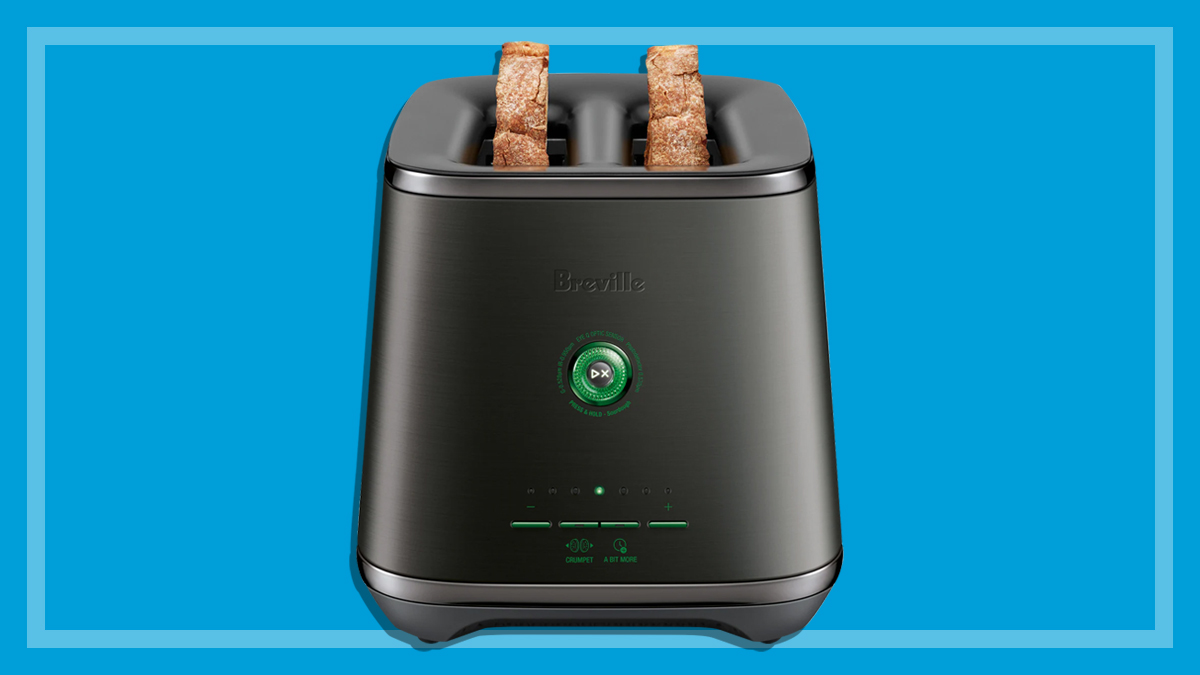
The new Breville Eye Q Auto toaster has a sleek look.
What’s special about the Breville Eye Q Auto toaster?
A conventional toaster uses a timer to determine how long to brown your toast. Toast times will vary depending on the toaster, and whether you’ve selected a higher (darker) or lower setting (lighter).
Generally, you’ll need to experiment to select the right level for you, and occasionally look and check to see how it’s going.
The Breville Eye Q Auto, on the other hand, dispenses with the idea of time (almost). After selecting your preferred brownness level, it gets to work using optical sensors to measure by colour. It “sees” how much darker your toast is before gently ejecting it when it’s done. Breville says that its sensors scan the toast ten times every second.
It ‘sees’ how much darker your toast is before gently ejecting it when it’s done
There’s also a mode for sourdough bread, a bread that is denser and more oddly shaped than a regular sliced loaf, and a crumpet mode that puts more heat on the dimpled side (this mode can also be used for bagels and English muffins).
The idea is that you don’t need to tweak the settings or check the bread mid-toast, and you can let the toaster do the watching for you, although there is a timer-based mode if you still need it.
For this review, we tried the Breville Eye Q on the usual white bread, but also expanded the test to include a range of foods it claims to work well with, including bagels, crumpets, sourdough and even Pop-Tarts.
First impressions
For this review, we tested the two-slice variation of the Eye Q, but it also comes in a four-slice mode ($629) with two lots of settings to accommodate a household’s different shade preferences.
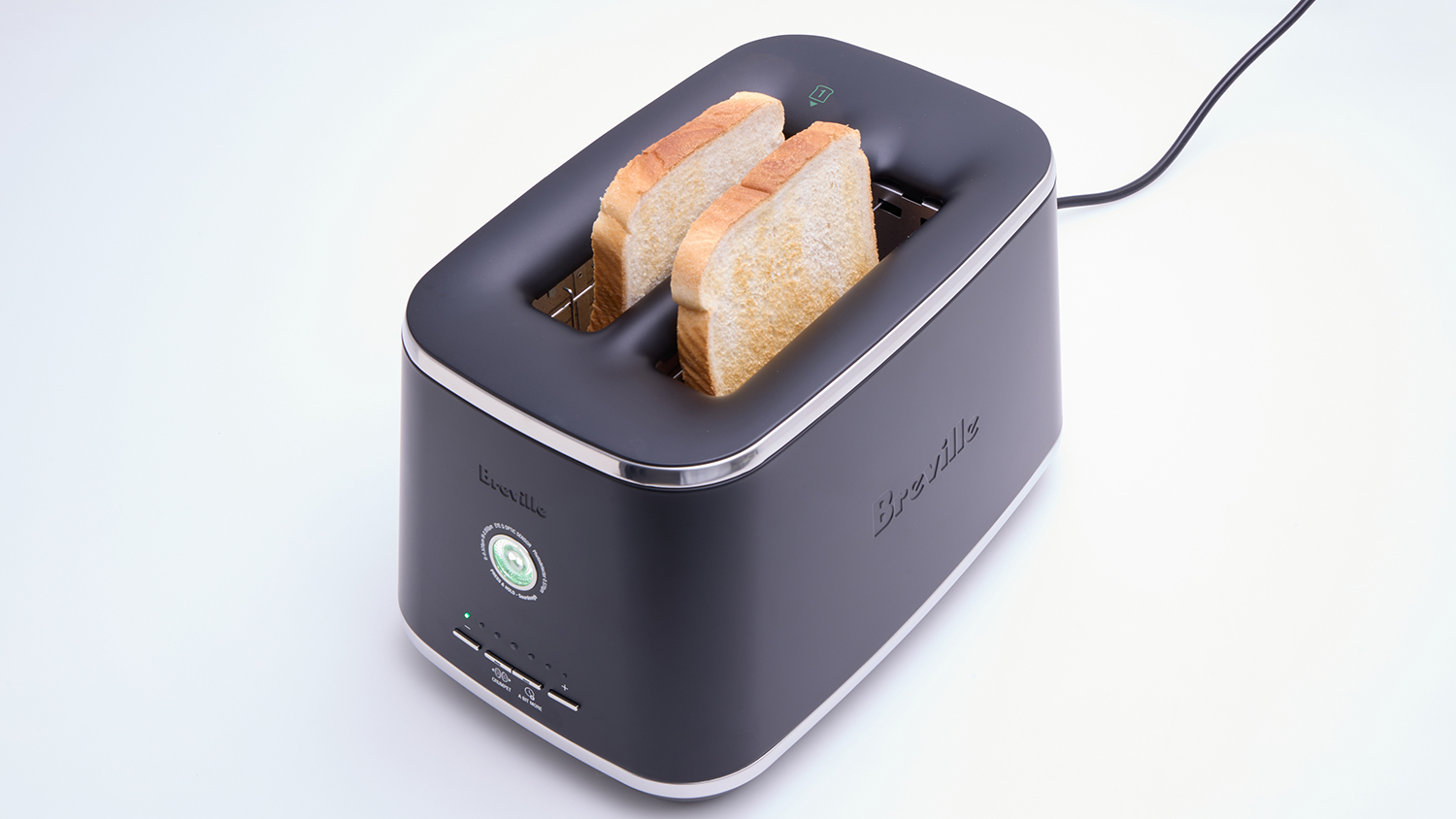
It’s a sleek-looking appliance, with an automatic mechanism that works smoothly to raise and lower your toast and no pesky levers to trap crumbs – though it may take some getting used to having your toast slowly creep up rather than spring up when it’s done.
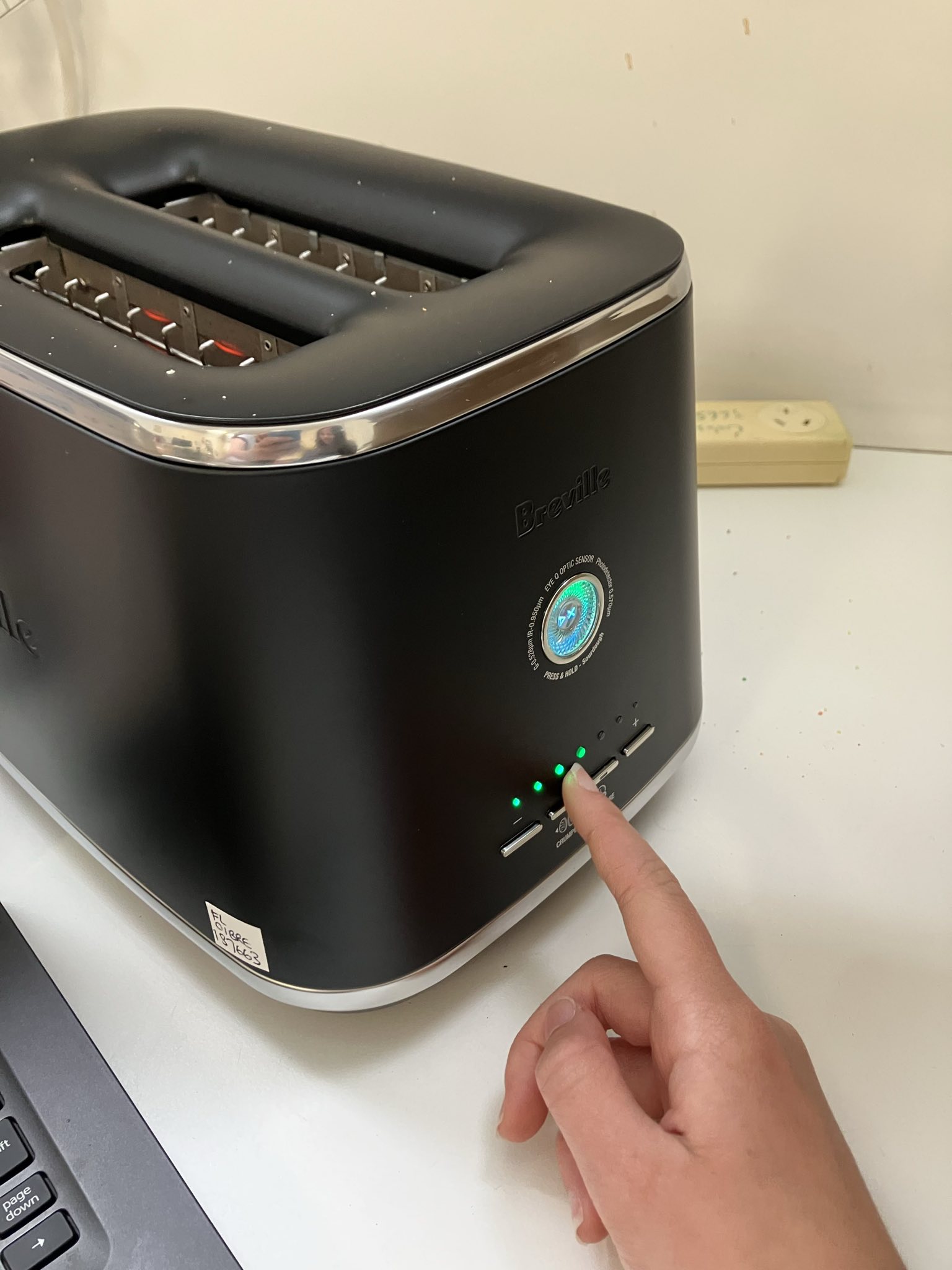
Settings at the side of the toaster include one central button to stop and start your toast. A long press of this button will activate sourdough mode. The plus and minus buttons underneath let you select one of seven shade levels, from low to high. There’s also a crumpet mode (which also works on bagels) and “a bit more” button if you need a little extra crunch.
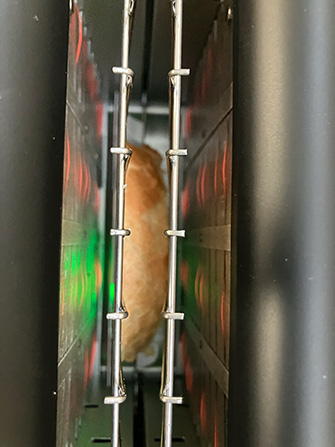
The sensors at work inside the toaster, which ‘scan’ the shade of your bread.
White bread
Whenever we test toasters in our labs, they usually need a little tweaking to get the right levels of toasting. We aim for a particular shade of toast that’s on the darker side – much to the horror of many toast aficionados, but it helps us see how well the toaster works.
After a few attempts with the Eye Q we found the shade we needed, but the results were fairly uneven, with some spots darker than others. The toast was still perfectly edible, but nothing a regular toaster couldn’t achieve.
How the sensors work
When in operation, peer down and you can see the optical sensors at work on one side of the toaster. This “scans” the shade of bread you start off with. The toasting will stop once the sensors see the colour change to your chosen level.
The sensors are only on one side of the toaster, as you’ll usually be putting the same type of bread in both slots (and having sensors on all sides would likely push the price up even more). So even though there is no timer, the toaster will still toast for a certain amount of time depending on the shade on one particular side.
If you’re only toasting one slide of bread, make sure you put it in the slot with the sensor, or it’ll think the toaster is empty.
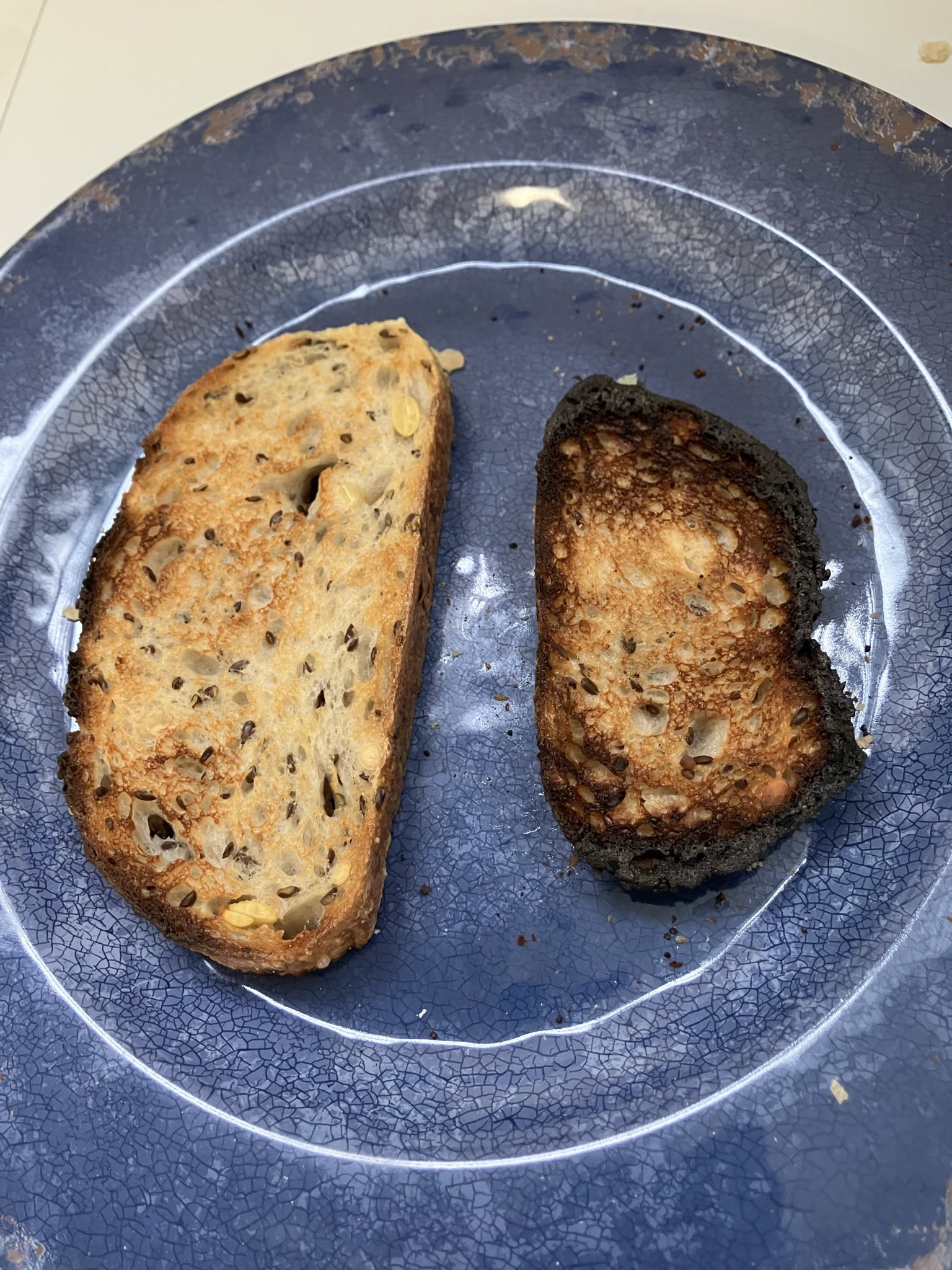
The toaster struggled with sourdough slices that were different sizes.
Sourdough
Sourdough is a difficult piece of bread to toast at the best of times. It’s dense so it takes longer, there’s a dry crust all around it, and the loaves are typically oddly-shaped, with small and large slices alike.
The sourdough mode is meant to tackle this style of toasting.
On the supermarket shelves you’ll see different types of sourdough too, so to make things even more difficult we chose a nice loaf of multigrain sourdough that had slices of the same thickness, but different sizes.
On the larger slices of bread, it worked well. We got a nice crunchy exterior with soft insides, and on the whole the crust was not too hard or dry.
But to increase the challenge, we put one of the smallest pieces of sourdough into the side without the optical sensor, and a larger piece into the side with the sensor.
Sourdough is a difficult piece of bread to toast at the best of times
Our theory proved correct: the larger piece that the sensor was detecting was browning at a slower rate than the small one in the other slot.
When the small piece of sourdough began to send smoke rising from the toaster, we immediately cancelled the operation and ended the process prematurely, afraid to repeat the embarrassing moment of 2018 when this author and the smouldering edges of her artisan toast set off the smoke alarm in the CHOICE building and led to an evacuation. Clearly, slices of huge variation in size definitely do not work.
Vienna bread
Next was the Vienna bread, which has a fluffy texture and thin crust. This bread had to be hand-cut, and it is a truth universally acknowledged that a left-handed person in possession of a serrated knife is going to slice that bread at a strange angle, because knives are usually designed for right-handed people.
Sounds obvious, but even this smart toaster can’t outsmart bread sliced by a left-hander
Breville’s “tips and tricks” video advises that “consistent slices will achieve consistent results”, and that a noticeably wonky slice creates an “uneven toasting canvas”. Not initially watching this video all the way through was our mistake.
As a result, the bread got burnt around the edges and produced considerable smoke to frantically fan away. Sounds obvious, but even this smart toaster can’t outsmart bread sliced by a left-hander.
CHOICE testing expert Adrian Lini regularly puts toasters to test in our small appliance lab, and has to toast quite a lot of bread in the process!
Crumpets and bagels
In crumpet mode, which can also be used for bagels, the toaster worked well, with the dense bagel still browning nicely on the cut side without losing the nice glow on the outside.
The middle level for crumpets was quite “well done”, and while this may be some people’s preference, it’s hard to imagine what the highest level might end up tasting like.
Timer mode
For certain foods that only require re-heating and not browning, such as a cold slice of toast or a jam-filled Pop-Tart, there’s a timer mode accessed by double-pressing the start button and choosing a level.
However, there’s no actual countdown timer like you find on some higher-end models. Breville’s tips video explains that the first button is approximately 1 minute and 5 seconds, with each subsequent button adding around 16 seconds to the toast.
We tried it with a Pop-Tart, where the instructions on the box say to toast it on the “lowest” setting – but this setting varies from toaster to toaster. The Breville Eye Q’s lowest setting runs 1 minute and 5 seconds, while another toaster we compared it with is 1 minute 40.
The Breville’s Pop-Tart was a bit cold according to our in-house Pop-Tart aficionado, so it probably needs a press of the “a bit more” function for that extra warmth and crunch.
Frozen bread
There’s no frozen bread or defrost setting on the Eye Q, because the toaster is designed to recognise change in shade no matter how cold the bread was to start with.
We tried this test and got the same sort of result as the initial white bread test: it turned out OK, albeit uneven in parts, and didn’t take all that long to toast, either.
How does the Breville Eye Q compare to a normal toaster?
We also compared the toasted white bread from the Eye Q to another regular toaster, operating them side-by-side. Results from both toasters were similar, with slight unevenness on each side.
Some of the crusts on the Eye Q bread that sat on the side without the sensor were looking a little more burnt than the results from the conventional toaster.
The toaster is fairly straightforward to use.
How easy is the Breville Eye Q to use?
Because the Breville Eye Q works differently to other toasters, there is a slight learning curve (for example, long-pressing for sourdough mode) but it’s still pretty straightforward.
Many features of modern toasters aren’t on this model by design. For example, there’s no option to “lift and check” your toast halfway through to see if it’s done; the toaster’s meant to do away with that necessity (though as we discovered, there were times when it would have been useful to see whether the crusts were burning).
Understandably, there’s also no countdown timer, though there is a flashing progress light that gives you an idea when the toast is going to emerge.
And the auto-lift mechanism is smooth and impressive, even though some observers declared it “creepy” to see the toast stealthily emerge from the slots instead of with the more familiar springing action.
Cleaning
We didn’t assess cleaning to our full ease-of-use method, but we noticed minimal cracks and crevices where crumbs might collect, and the large crumb tray is easy to remove and empty. The carriages are quite wide and crumbs are designed to fall straight through without getting caught into the carriage slots. The top of the toaster is ceramic-coated and easy to wipe down when needed.
Sustainability
We’ve tested expensive toasters before from longstanding European brands Milantoast and Dualit, but these are at the other design extreme and have mechanical, replaceable components. While we found them fiddly to use, their high emphasis on repairability means they should last many years (albeit with parts and labour costs) before being consigned to landfill.
The instructions have little information about spare parts or repair beyond the standard notices applicable to all Breville products
The Eye Q uses optical sensors that are usually found on products like smartphones and cameras, not toasters. Yet it only has a two-year warranty, in line with most of the mid-priced toasters we’ve tested. The instructions have little information about spare parts or repair beyond the standard notices applicable to all Breville products.
Supporting Aussie innovation is great and there are some things to like about this toaster. However, the price is not one of them, and the results for some breads weren’t earth-shatteringly impressive. A cheap model can do the job just fine once you get to know its quirks.
If you’re using a lot of different types of bread, then the Eye Q can take a lot of the guesswork out of how long to toast it for, but then again, so can a little mid-toast glance or a little extra toasting time.
We will, however, give the Breville Eye Q a chance to display its true colours with a full in-depth review later in the year.
The Eye Q can take a lot of the guesswork out of how long to toast for, but then again, so can a little mid-toast glance
We’re particularly interested to see its results for consistency of browning cycle after cycle. A lot of the heat retention in timer-based models means that a subsequent batch may turn out darker than intended. If the Eye Q does its job, it’ll know if the toast is already brown enough, and eject the toast at the right time.
Right now though, unless you’re splurging on absolutely everything in your new kitchen and want to show off some new tech, it’s not an absolute game-changer. But we know the Breville Eye Q will keep people talking about toasters!
Know the products to avoid before you shop. Get our free guide and buy smarter.
Kim Gilmour is a Senior project officer. She manages a range of product tests such as coffee machines, stick vacuums, bassinets, high chairs and ovens, which are all tested in our in-house labs.
Kim’s work gives people access to robust, independent advice and helps consumers make informed decisions about their purchases. Her work also helps to keep manufacturers in check, by regularly exposing product flaws which can result in better and safer products.
Prior to CHOICE, Kim spent 16 years working as a technology journalist in Sydney and London. With several years as a senior researcher/writer at our UK sister organisation, Which?
Kim has authored how-to technology books such as Spotify for Dummies and Digital Photography for the Older and Wiser.
Kim has a Bachelor of Arts in Communication (Journalism) from Charles Sturt University. LinkedIn
Kim Gilmour is a Senior project officer. She manages a range of product tests such as coffee machines, stick vacuums, bassinets, high chairs and ovens, which are all tested in our in-house labs.
Kim’s work gives people access to robust, independent advice and helps consumers make informed decisions about their purchases. Her work also helps to keep manufacturers in check, by regularly exposing product flaws which can result in better and safer products.
Prior to CHOICE, Kim spent 16 years working as a technology journalist in Sydney and London. With several years as a senior researcher/writer at our UK sister organisation, Which?
Kim has authored how-to technology books such as Spotify for Dummies and Digital Photography for the Older and Wiser.
Kim has a Bachelor of Arts in Communication (Journalism) from Charles Sturt University. LinkedIn
For more than 60 years, CHOICE has been fighting the good fight for Australian consumers.
In the past year alone we've uncovered systemic issues with sunscreens, investigated shonky supermarket pricing, fought for stronger scam protections and helped make complex energy pricing fairer and clearer.
CHOICE is here to provide unbiased advice and independent testing in our world-class labs. We buy the products we test, just like you do, and our expert reviews are influence free. We’re here to help you choose smarter. Hopefully you’ll also save some money along the way.
Thanks to CHOICE, you’ll never be alone when a business treats you unfairly. You can support our work by joining or donating to our cause.