The federal government’s current rebate – officially known as the Cheaper Home Batteries Program – has slashed the prices of installing a battery in your home or small business, with discounts of around 25% and in some cases, even more.
Not surprisingly, the rebate has been running red-hot since it launched last July, with the government reporting in March that 250,000 home batteries had already been installed across Australia.
The uptake expended much of the Program’s initial $2.3 billion budget way ahead of schedule, but thankfully the government upped the budget to a hefty $7.2 billion across the next four years.
To ensure the budget lasts through to its 2031 end date, the government recently implemented new changes to the rebate’s rates and conditions, which came in from 1 May 2026.
Find out how the rebate has changed and how it might impact your battery plans below.
We’ll get into the technical nuts and bolts of the changes below, but the top line is the revised rebate will now:
decrease every six months as opposed to yearly (to reflect falling battery prices over time)
change its ‘per kWh’ discount on batteries from a flat rate to a tiered system based on the size of the battery installed.
Change #1: Rebate rates decrease over time
As part of these new changes, the rebate’s value (measured in Small-scale Technology Certificates, aka STCs, which are the same ‘credits’ applied to solar panels) will now decrease every six months rather than annually, and at a faster rate than previously planned.
When the rebate launched last July, it paid $372 per kWh for a battery installation, and then $366 in January to April earlier this year. This is the new rate schedule below, as sourced from our friends at SolarQuotes.
Note: Expect to lose 10% of your rate to admin fees.
May–Dec 2026: $272 per kWh
Jan–Jun 2027: $228 per kWh
Jul–Dec 2027: $208 per kWh
Jan–Jun 2028: $184 per kWh
Jul–Dec 2028: $164 per kWh
Jan–Jun 2029: $144 per kWh
Jul–Dec 2029: $124 per kWh
Jan–Jun 2030: $104 per kWh
Jul–Dec 2030: $84 per kWh
If you want to see the exact specific STC Factor rates, view them in the following section.
Proposed STC Factor discount over time
The discount is determined by the STC Factor on the date the battery is installed.
Year
Time period
Old STC Factor
New STC Factor
2026
January–April
8.4
8.4
2026
May–December
8.4
6.8
2027
January–June
7.4
5.7
2027
July–December
7.4
5.2
2028
January–June
6.5
4.6
2028
July–December
6.5
4.1
2029
January–June
5.6
3.6
2029
July–December
5.6
3.1
2030
January–June
4.7
2.6
2030
July–December
4.7
2.1
Change #2: Rebate now depends on battery size
The rebate has now switched from its initial flat ‘per kWh’ discount to a tiered rate system according to battery size. The government says this will maintain a discount of around 25% across small, medium and large batteries.
Under the previous rules, some residents super-sized their battery systems because a 40–50kWh system could earn a bigger discount of 40–50%. Industry critics argued this drained rebate funds quicker and incentivised people to get systems bigger than they actually needed or could ever charge properly.
The STC Factor rate now depends on the battery capacity installed:
Small: 0–14kWh capacity: STC Factor applied at 100%.
Medium: 14–28kWh capacity: STC Factor applied at 60%.
Large: 28–50kWh capacity: STC Factor applied at 15%.
Video: The federal battery rebate explained
Battery rebate eligibility criteria
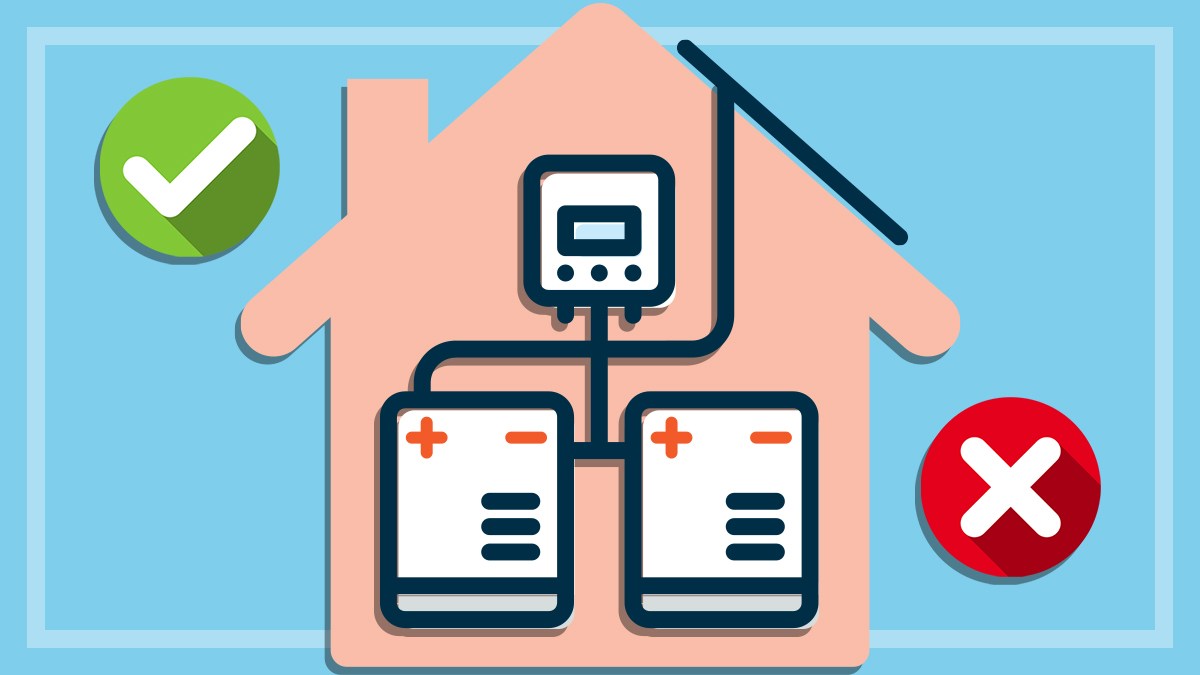
Currently to be eligible for the rebate, the battery must:
be installed after 1 July 2025
have a nominal capacity of 5–100kWh, but the rebate only applies to the first 50kWh of usable capacity
be installed alongside new or existing rooftop solar
be capable of joining a virtual power plant (VPP) if it’s an on-grid system (though actual participation is optional)
be claimed once per property – however, if you own multiple properties, you can get separate discounts for each.
Note: The federal government’s separate solar panel rebate only applies to the panels in the installed system, not the battery. However, you can apply for both discounts together, plus applicable state or territory incentives, to really supercharge your savings.
We've partnered with SolarQuotes to help you find and buy the right solar, battery, heat pump and EV charger. While we make money if you use SolarQuotes to find an installer, this doesn't influence our ratings. 100% of the money we make goes directly back into our nonprofit mission.
Battery costs after the rebate
Costs vary significantly for solar home batteries, but generally, the bigger the battery capacity, the more you can expect to pay.
Since the launch of the federal rebate, the ‘average’ size of batteries being installed has increased dramatically, with a battery exceeding 20kWh quickly becoming the new norm.
Here are approximate battery costs (after the current federal rebate) for common sizes, including basic installation. Prices are based on information from our solar partners, SolarQuotes.
10kWh storage: $7000–$11,000 installed
15kWh storage: $11,000–$15,000 installed.
20kWh storage: $14,000–$19,000 installed
30kWh storage: $18,000–$22,000 installed
50kWh storage: $24,000–$30,000 installed
Keep in mind, a more complex installation can increase costs considerably, given that architectural and technical factors can increase the time, work and components a job requires. See our guide to finding a good solar installer.
It’s a tricky question and one that depends on multiple factors including your solar/battery set-up, energy consumption and, most vitally, electricity costs and additional rebates in your state or territory, which can vary a lot.
For a long time, home batteries didn’t make complete economic sense. They were relatively expensive and the payback time was often longer than the battery’s warranty period, which is typically 10 years.
But with the new federal rebate promising a discount of more than 25%, the maths is looking a lot more attractive, depending on the aforementioned factors.
The federal rebate offers a discount of around 25% off an installed battery. Image: SolarQuotes.
Electricity savings and payback periods with rebate
Calculating your own possible payback period can be mind-boggling, but SolarQuotes have shared this helpful general guide comparing electricity savings and simple payback periods (with the rebate) by state and territory. You’ll notice payback times vary a lot depending on where you live. That’s due to your state and territory’s electricity prices, feed-in tariffs and weather.
For example, Adelaide’s payback period is the shortest because they have high electricity prices, while Hobart’s is the longest, thanks to relatively cheap electricity and high solar feed-in tariffs.
Payback times for $8500 installed cost:
Capital city
Annual electricity savings
Simple payback period
Adelaide
$1350
6.3 years
Brisbane
$1100
7.7 years
Canberra
$700
12.1 years
Darwin
$620
13.7 years
Hobart
$410
20.7 years
Melbourne
$610
13.9 years
Perth
$1120
7.6 years
Sydney
$1030
8.3 years
*Based on using only federal rebate, $8500 installed cost, and estimated overnight electricity use of 7kWh.
As well as the federal initiative, here are the current battery-focused rebates or loan schemes available by state and territory. These can be combined with the federal rebate for greater savings.
ACT: Sustainable Household Scheme
Canberra locals can access a low-interest loan (currently 3%) from $2000 to $15,000 for home energy improvements, including household batteries, electric heating and cooling systems, hot water heat pumps, EVs and more.
Over the scheme’s lifespan, you can install one product or several products from the list of eligible products – together, these can be valued at up to $15,000. Zero-interest loans are available to eligible concession card holders under the Home Energy Support Program.
NSW: Virtual power plant (VPP) Incentive
From 1 July 2025, the NSW government has increased the incentive to up to $1500 to encourage more households and small businesses to install a battery and connect to a virtual power plant. The incentive varies by the size of the battery and can be combined with the federal battery rebate.
Additional rebates may be available depending on your state.
Northern Territory: Home and Business Battery Scheme (closed)
NT homeowners, businesses and nonprofit organisations can apply for a grant to buy and install batteries and inverters. Grants can be used to buy solar panels too, but must be paired with a battery.
Eligible applicants can access a grant of $450 per kilowatt hour of usable battery system capacity, up to a maximum grant of $6000. Homeowners that own a business can apply for both their home and business.
Note that the funding cap for this scheme has been reached and it is closed for new grants. Stay tuned for updates in case this changes.
South Australia: Home Battery Scheme (closed)
Offering up to $6000 off a battery, South Australia’s HBS was one of the earliest and most successful battery programs, but sadly ceased in 2022. Instead, the state government has focused on its emPowering SA program, which employs 18 much-larger community batteries to lower residents’ electricity bills.
Queensland and Tasmania: None
Tasmania and Queensland don’t currently have their own dedicated battery rebate schemes. However, households can still claim the new federal rebate and benefit from VPP programs offered through energy retailers like Reposit, Amber and others.
Victoria: Solar Homes Program
This program is currently not taking applications, but keep an eye on it to see if more become available in future. Previously, it offered interest-free loans to purchase home batteries.
If you’re considering installing solar panels, rebates of up to $1400 plus interest-free loans for the same amount are still available.
Western Australia: Residential Battery Scheme
This incentive allows residents to get a rebate and no-interest loan to purchase and install a home battery.
On a 10kWh battery, applicants are eligible for a combined rebate of $5000 for Synergy customers and $7500 for Horizon Power customers. This is in addition to the federal rebate.
No-interest loans of up to $10,000 are also available to households with a combined annual income of less than $210,000. Loan repayment periods will be up to 10 years.
To receive a battery rebate and/or no-interest loan through the scheme, eligibility requirements apply, including participation in a virtual power plant.
A virtual power plant (VPP) is a network of solar and battery systems owned by homes and small businesses, centrally controlled by a VPP company.
When you join, your battery is linked to this network through smart software and the internet.
To maximise revenue, the company charges your battery during the day (when electricity is cheapest) through solar or top-ups from the grid. Then when wholesale electricity prices rise during peak times (such as at night), they sell it to the grid for a higher price.
In return, you get a financial benefit, which might be bill credits, higher tariff rates or a cut of profits on electricity sold (depending on your VPP plan).
In a wider sense, VPPs also reduce demand on the grid, which makes the state’s energy supply more stable and less prone to outages, and it reduces the price of electricity for everyone (it’s also better for the environment).
For a deeper dive into VPPs, including their pros and cons, check out our handy guide for newcomers, or our comprehensive breakdown of different virtual power plants on offer.
Jason is a Content Editor and journalist at CHOICE. He writes about a diverse range of subjects, from solar to robot vacuums to why Easter eggs are a rip-off. He's previously written for Sydney Morning Herald, Rolling Stone and many other publications.
Jason is a Content Editor and journalist at CHOICE. He writes about a diverse range of subjects, from solar to robot vacuums to why Easter eggs are a rip-off. He's previously written for Sydney Morning Herald, Rolling Stone and many other publications.
For more than 60 years, CHOICE has been fighting the good fight for Australian consumers.
In the past year alone we've uncovered systemic issues with sunscreens, investigated shonky supermarket pricing, fought for stronger scam protections and helped make complex energy pricing fairer and clearer.
CHOICE is here to provide unbiased advice and independent testing in our world-class labs. We buy the products we test, just like you do, and our expert reviews are influence free. We’re here to help you choose smarter. Hopefully you’ll also save some money along the way.
Thanks to CHOICE, you’ll never be alone when a business treats you unfairly. You can support our work by joining or donating to our cause.