But now a more subtle phenomenon is rearing its head.
‘Skimpflation’ is when, instead of making less of a product in order to save money, manufacturers change what they make the product with to achieve the same objective.
Skimpflating businesses will reduce expensive ingredients or components in favour of cheaper ones to produce a product that is the same size and retails for the same price, but is cheaper to make.
This shift to cheaper ingredients can affect the item’s nutritional value, resulting in an inferior or less healthy product
In the case of food, this shift to cheaper ingredients can affect the item’s nutritional value, resulting in an inferior or less healthy product.
Skimpflation is hard to spot, but the prospect of paying the same for an inferior product has motivated CHOICE members and supporters to share their own examples of products they suspect have undergone skimpflation.
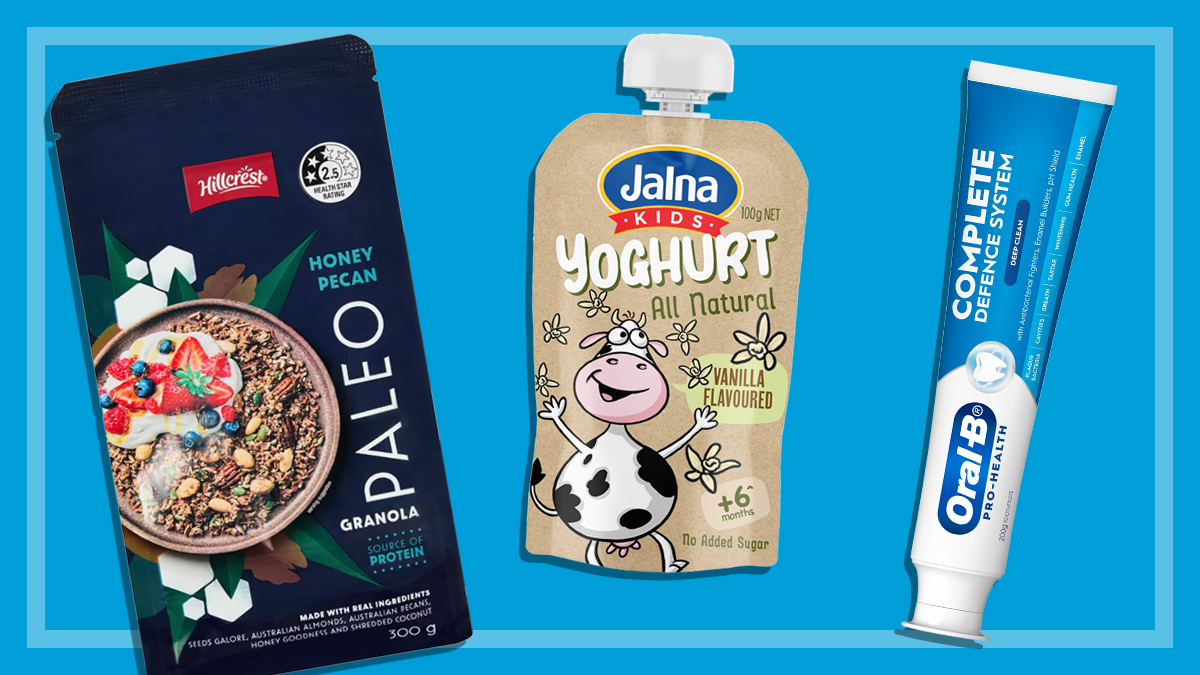
Consumers have come forward with granolas, yoghurts and toothpastes that have stayed the same price, but changed their ingredients.
Buyers of some of these items have expressed frustration that manufacturers changed their favourite products without informing them, leaving them paying the same price for products they say aren’t as good as they used to be.
Cereal offender
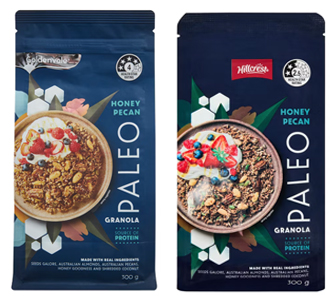
Aldi’s Goldenvale granola (left) appears to have been replaced with a new, less healthy variety (right). Image: Aldi
One product brought to our attention is a honey pecan granola sold by Aldi.
As recently as July this year, the supermarket was selling this version of the popular breakfast snack under its Goldenvale brand for $6.99 in 300g packets.
According to Aldi’s website, that specific product is no longer available.
It appears to have been replaced with another granola, which comes in almost identical packaging, in the same size and for the same price, but branded under Hillcrest, another of Aldi’s many home-brand labels.
These cosmetic alterations mask some significant ingredient changes.
The product has gone from having seeds as its main ingredient to dried coconut. The Hillcrest version still claims to be “seeds galore,” despite being only 33% seeds compared to Goldenvale’s 52%.
This honey pecan granola has also recorded a small drop in how much honey and pecan nuts it contains.
Capping off these changes, the product has also dropped one and a half stars from its health rating and ended up with a lower proportion of Australian ingredients.
The Hillcrest version isn’t impressing some Aldi shoppers, with several taking to Aldi groups on Facebook to complain the product tastes worse than the Goldenvale variety.
Before and after: Jalna recently changed the type of milk in these yoghurt pouches and stopped claiming they were organic. Image: Jalna
Another food item whose ingredient changes haven’t been missed by eagle-eyed shoppers and influencers on social media is Jalna’s line of kids yoghurt pouches.
In April this year, Jalna was making these strawberry, vanilla and blueberry flavoured products with full-cream milk and each carried a prominent “Organic” certification.
Six months later, the pouches were still the same size and retailing for the same price at major supermarkets, but had swapped full-cream milk for skim.
Jalna also no longer describes the products as organic, swapping the claim for an “All natural” promise.
Changing toothpastes
It’s not just foods whose changing inputs are being picked up on by consumers.
One longtime Oral B customer says some of the brand’s toothpastes taste worse following changes to ingredients and manufacturing.
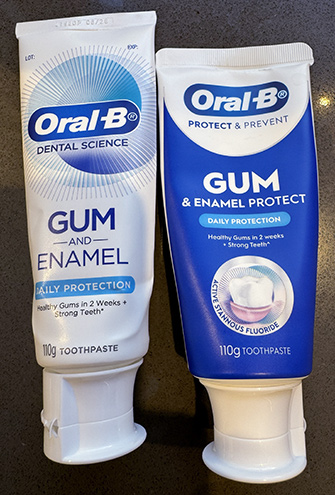
One longtime user of Oral B products recently drew our attention to a range of alterations to the ingredients of two types of toothpaste.
A close look at the back of tubes of the Gum & Enamel Protect Daily Protection and Complete Defence System Deep Clean varieties reveals parent company Procter & Gamble recently shifted production of these products from Germany to China.
Information provided there also shows the new Chinese-made versions of the products have fewer and different ingredients than those made in Germany.
The new toothpastes still come in 110g tubes, but have recently attracted negative feedback in online reviews.
The longtime user who contacted us about the products said their prices have stayed the same, but argued the new versions were “lower quality”, with the new ingredients leading to unwanted changes in taste and texture.
In response to questions from CHOICE, the manufacturers of these products said they had changed their ingredients for the benefit of customers.
Aldi said it will return its Goldenvale granola to stores following questions from CHOICE.
Aldi said it tries to bring shoppers “new and exciting flavours” and introduced the Hillcrest granola to “see what customers think”.
The company also told us the original Goldenvale granola will be back in its stores next year.
Jalna parent company Lactalis Australia said it switched to skim milk to better control the fat content of its yoghurt pouches. It said it dropped the organic certification of these products because, while some shoppers valued it, “for many it wasn’t a key factor in them choosing Jalna yoghurt.”
Neither did Procter & Gamble miss an opportunity to trumpet its services to consumers.
It said “the core motivation” of the changes to its toothpastes was “product performance and consumer benefit”, in particular to improve “foaming [and] brushing experience”.
Are they doing it to save money?
Manufacturers have often cited cost pressures when asked to explain other subtle product changes, such as shrinkflation.
After all, the costs of manufacturing inputs have seen some big increases in recent years, according to the Australian Bureau of Statistics.
In September, agricultural lender Rabobank warned some food producers were using skimpflation along with shrinkflation to protect profit margins without losing consumers.
The bank said this is especially the case for makers of foods with ingredients whose prices have been volatile (such as chocolate), and that these manufacturers are embedding shrinkage and skimping into their long-term strategies.
The manufacturers we spoke to for this article either denied product changes were made to save money or declined to comment, but Aldi did say that it always considers cost when developing a new product.
Do the reasons manufacturers gave us for these product changes add up?
In the case of Oral B’s toothpaste, Associate Professor and dental health expert at Melbourne University Matt Hopcraft backed up Procter & Gamble’s explanation.
Following a review of the ingredient changes of both products, he said he suspected they were made based on customer feedback and to improve the user experience.
The changes to Aldi’s granola, however, drew the concern of Damian Maganja from the Food Policy Division of the George Institute for Global Health. Noting how the newer Hillcrest variety had double the saturated fat due to the influx of coconut and more sugars, he’s concerned longtime purchasers of the Goldenvale product could now be getting a worse-quality product without realising.
If it’s a product you’re buying all the time, you’re probably not going to be checking the nutritional information
Damian Maganja, George Institute for Global Health
“The products look almost exactly identical in every way. If it’s a product you’re buying all the time, you’re probably not going to be checking the nutritional information … people are going to be getting this extra whack of unhealthy nutrients,” he says.
Maganja says he isn’t sure whether Aldi’s changes make the product cheaper to produce, but says Jalna may have saved some money by no longer certifying its yogurt pouches as organic.
CHOICE is keen to hear of any instances of suspected skimpflation.
“Consumers are bombarded by a range of tricks and traps at the supermarket that make it hard to get the best value for money,” says Andy Kelly, director of campaigns and communications at CHOICE.
“Skimpflation can lead consumers to unknowingly pay more for a worse-quality product and it can be even more difficult to detect than other tricks, like shrinking the size of the product while keeping the price the same.”
Skimpflation can lead consumers to unknowingly pay more for a worse-quality product
Andy Kelly, director of campaigns and communications at CHOICE
The government has recently been considering how to make grocery retailers display notices when a product has shrunk in size or volume, but stayed the same price. Kelly says this is a good idea, but is concerned manufacturers may be switching from this tactic – shrinkflating – to skimpflating their products instead, in order to preserve profit margins.
“The rules need to be designed to prevent companies gaming the system,” he says. “They shouldn’t be allowed to avoid detection by artificially decreasing, inflating or delaying price increases when a product reduces in size, or by slightly altering the ingredients or the name of the product to avoid detection.”
Liam Kennedy is a Journalist with the Editorial and investigations team. He answers consumers' most burning questions, from which scams to be aware of and how to save money, to whether new services and products are worth using and how the latest developments in consumer news could affect them.
Prior to CHOICE, Liam worked in production in daily news radio and podcasting.
Liam has a Bachelor of Communication (Journalism) and a Bachelor of Arts in International Studies from the University of Technology Sydney. LinkedIn
Liam Kennedy is a Journalist with the Editorial and investigations team. He answers consumers' most burning questions, from which scams to be aware of and how to save money, to whether new services and products are worth using and how the latest developments in consumer news could affect them.
Prior to CHOICE, Liam worked in production in daily news radio and podcasting.
Liam has a Bachelor of Communication (Journalism) and a Bachelor of Arts in International Studies from the University of Technology Sydney. LinkedIn
For more than 60 years, CHOICE has been fighting the good fight for Australian consumers.
In the past year alone we've uncovered systemic issues with sunscreens, investigated shonky supermarket pricing, fought for stronger scam protections and helped make complex energy pricing fairer and clearer.
CHOICE is here to provide unbiased advice and independent testing in our world-class labs. We buy the products we test, just like you do, and our expert reviews are influence free. We’re here to help you choose smarter. Hopefully you’ll also save some money along the way.
Thanks to CHOICE, you’ll never be alone when a business treats you unfairly. You can support our work by joining or donating to our cause.