The federal government has introduced a register to make it harder for scam texts to impersonate businesses.
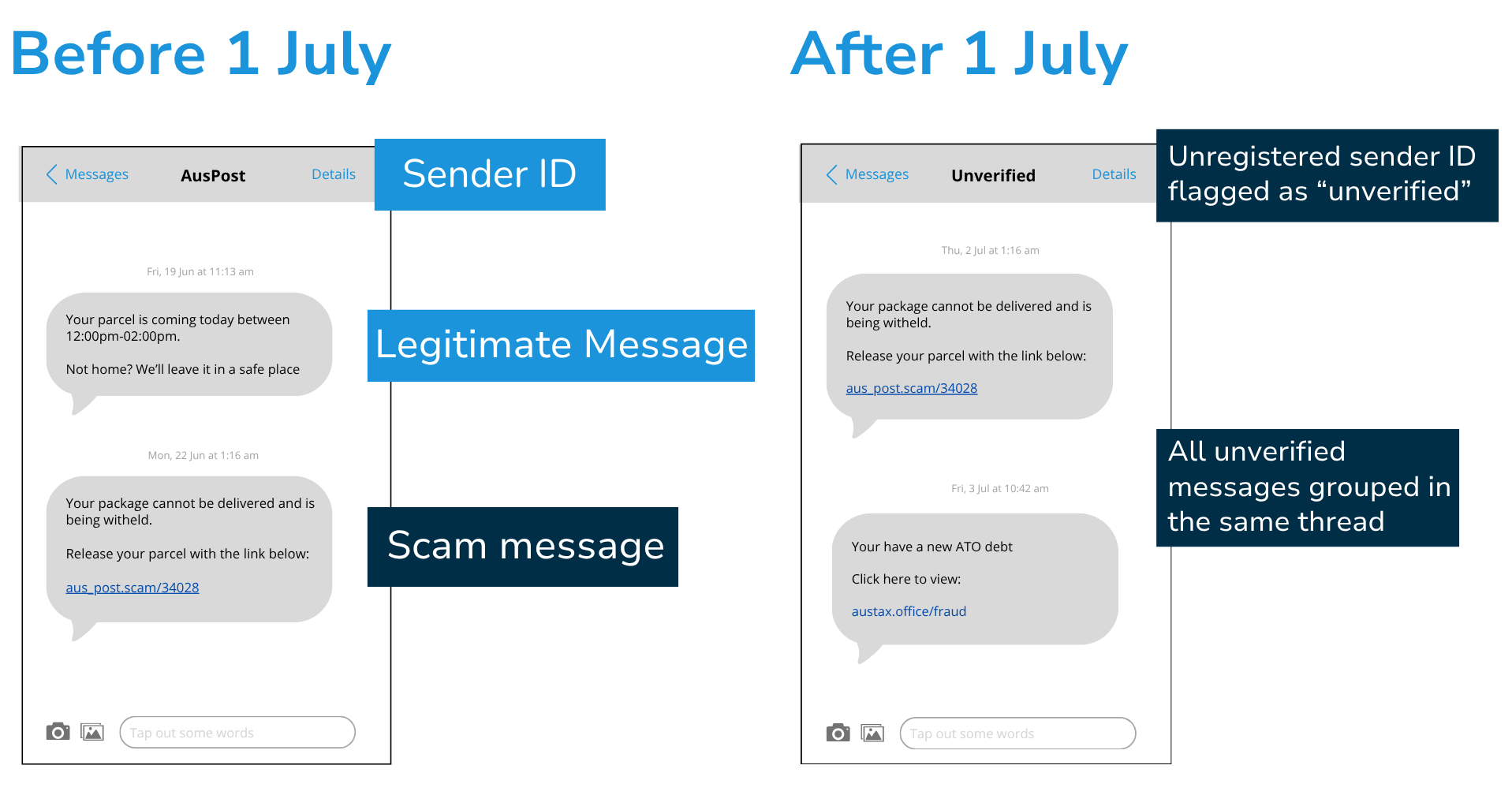
Previously, fraudsters have been able to imitate companies or government bodies by mimicking their sender ID, making scam texts seem as though they are coming from trusted organisations like the ATO or Australia Post.
Fake texts have even appeared in the same text chain as real messages, making them seem more legitimate.
Since 1 July 2026, however, only businesses that have registered their sender ID with telcos can continue to use them, with all unregistered messages being labelled as “unverified” and placed in the same thread as other unverified texts.
From 1 July, all texts from businesses, government bodies and organisations that have not registered their sender ID will be marked as “unverified”.
‘Unverified’ messages expected to save Australians millions
Australians lost nearly $18 million to text scams last year, according to telco regulator the Australia Communications and Media Authority (ACMA). Modelling from Deloitte suggests the sender ID register will have a net benefit of $96.2 million to both consumers and businesses over the next 10 years.
Chair of ACMA Nerida O’Loughlin says if a message is marked as “unverified”, it should be treated with extra caution.
“It may be from a legitimate business or organisation that has not yet registered its sender ID, or it may be a scam message impersonating a trusted brand,” O’Loughlin says.
“Either way, the message is simple: stop and think before you click a link or provide information to the sender.”
Not a silver bullet
Australia has followed the example of Singapore, which introduced an SMS ID register in March 2022. According to the Singaporean government, this led to a 64% decrease in SMS scams compared to six months prior.
Either way, the message is simple: stop and think before you click a link or provide information to the sender
Nerida O’Loughlin, Australian Communications and Media Authority (ACMA)
Advocacy body Australian Communications and Consumer Action Network (ACCAN) CEO Carol Bennett says the register is an important measure in preventing scam activity, but is not going to stop every scam. She also notes that many businesses are still unaware of it.
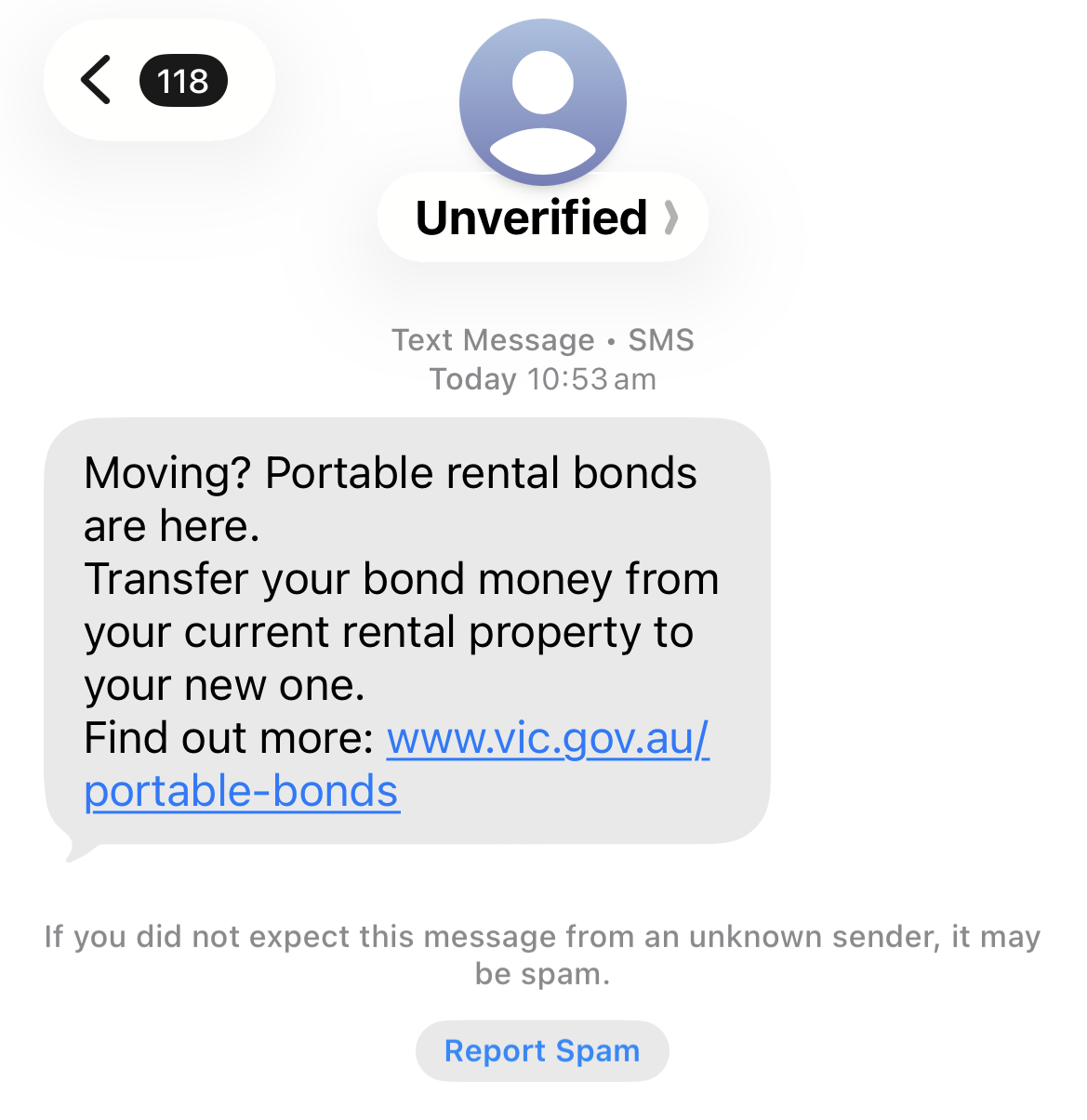
A text CHOICE has confirmed was sent from the Victorian Department of Government Services was tagged as “unverified”.
Even some government agencies appear to have not yet registered their ID, with a CHOICE employee recently receiving a text labelled “unverified” from Victoria’s Department of Government Services which has since been verified as a legitimate text from the government agency.
“The other part, as always, is that enforcement action needs to be firm and robust,” Bennett says.
It is up to telcos to implement the new register and label unverified messages, and they will face up to $250,000 in fines if they do not comply with their new obligations.
The register only applies to branded MMS and SMS messages, meaning the verification check does not cover texts sent from phone numbers or messaging apps, which scammers may continue to exploit.
Carol Bennett says while the register is a welcome protection, more needs to be done, considering how useful phone networks are to fraudsters.
“Telcos are a frontline scam pathway. Telecommunications and digital platforms sit alongside each other as the key vehicle for connecting those scammers to consumers,” Bennett says.
The sender ID register comes ahead of the federal government’s delayed Scam Prevention Framework, which will place obligations on banks, digital platforms and telcos to protect Australians from scams.
Despite being passed by Parliament in early 2025, the government announced in May its implementation will be postponed until March 2027.
Australian families continue to be robbed and bear the financial burden in the midst of a cost-of-living crisis
Stephanie Tonkin, Consumer Action Law Centre (CALC)
Consumer Action Law Centre (CALC) CEO Stephanie Tonkin says this delay will cause “unacceptable harm”, with CALC estimating that Australians will lose a further $2 billion to scams while they wait for the delayed laws to kick in.
“For the most part, industry has done its best to drag out the consultation, limiting their liability and ensuring the path to implementation is painfully slow,” Tonkin says.
“All while Australian families continue to be robbed and bear the financial burden in the midst of a cost-of-living crisis.”
Beyond concerns about the delay in implementing the Framework, ACCAN’s Bennett says it could be strengthened to offer better protection to consumers.
She says the proposed $3000 minimum reimbursement for scam victims is too low, and in its current form, the Scam Prevention Framework places an unfair burden on those trying to access compensation.
[Telcos] should be held to account when it comes to protecting consumers, when their platforms are responsible for creating harm
Carol Bennett, Australian Communications and Consumer Action Network (ACCAN)
“Consumers are hit with the double whammy of being scammed, then having to prove they’ve been scammed, which is particularly difficult for the most vulnerable people,” she says.
Bennett says she wants to see the Framework stand up to industries who are pushing back on obligations to prevent and respond to scams.
“They have the privilege of running these platforms that enable them to generate significant profits. They should be held to account when it comes to protecting consumers, when their platforms are responsible for creating harm.”
James is a journalist with CHOICE's editorial and investigations team, decoding complicated consumer issues and reporting on how corporations and businesses affect the lives of Australians.
He has previously created podcast series for We Are Explorers and Protect Our Winters Australia, and has published in Cosmos and The Citizen. James has a particular interest reporting on science, environmental and social issues, and was a recipient of a JEERA Ossie Award for his journalism.
James has a Master of Journalism and Bachelor of Science in Physiology from the University of Melbourne. LinkedIn
James is a journalist with CHOICE's editorial and investigations team, decoding complicated consumer issues and reporting on how corporations and businesses affect the lives of Australians.
He has previously created podcast series for We Are Explorers and Protect Our Winters Australia, and has published in Cosmos and The Citizen. James has a particular interest reporting on science, environmental and social issues, and was a recipient of a JEERA Ossie Award for his journalism.
James has a Master of Journalism and Bachelor of Science in Physiology from the University of Melbourne. LinkedIn
For more than 60 years, CHOICE has been fighting the good fight for Australian consumers.
In the past year alone we've uncovered systemic issues with sunscreens, investigated shonky supermarket pricing, fought for stronger scam protections and helped make complex energy pricing fairer and clearer.
CHOICE is here to provide unbiased advice and independent testing in our world-class labs. We buy the products we test, just like you do, and our expert reviews are influence free. We’re here to help you choose smarter. Hopefully you’ll also save some money along the way.
Thanks to CHOICE, you’ll never be alone when a business treats you unfairly. You can support our work by joining or donating to our cause.