Fuel costs can change suddenly, but there are ways you can save when prices are high
Making changes to how you drive and the way you use and care for your car can help you spend less at the pump
So can shopping around for the lowest prices, paying attention to cost cycles and considering a more efficient vehicle
Even before Australia’s latest petrol price panic, the cost of filling up our cars was driving a lot of financial stress.
In a Consumer Pulse survey of households we conducted last June, 76% said they were concerned about the cost of fuel.
Now, prices have jumped above normal levels as turmoil in the Middle East threatens supply and Aussie motorists rush to fill up.
Motoring groups have accused some fuel retailers of profiteering, saying their prices are much higher than they should be and have urged consumers to shop around, noting some outlets are still keeping prices competitive.
But filling up at a fair price is only part of the equation – you can put off your next servo stop a bit longer and save even more money by considering how you drive and caring for your car.
Are you guilty of being a little heavy-footed on the accelerator? Easing back on the pedal is just one of a range of practices you can adopt to save on fuel.
“Changing your driving style is one of the most effective ways to improve your car’s fuel economy,” says Alex Forrest, vehicles and fuels manager at Western Australia’s Royal Automobile Club.
“Think of the accelerator as a tap – the more you press it down, the more fuel you’ll send to the engine to be burnt,” he adds.
“Relax a bit as you drive,” advises Dr Ian Jeffreys, principal economic and affordability specialist at the Royal Automobile Club of Queensland (RACQ).
“Smooth out the drive [and] drive steadily, avoiding any harsh acceleration or hard braking.”
Modern cars don’t need to be ‘warmed up’, it just wastes fuel
James Williams, RACV
It also pays to avoid driving at times when traffic is congested: cars tend to use more fuel when moving in a stop-start fashion, such as in bumper-to-bumper traffic.
Once you’ve reached your destination, it’s a good idea to shut the engine off, even if you’re only stopping for a short time.
“Modern cars don’t need to be ‘warmed up’, it just wastes fuel,” says James Williams, head of policy at the Royal Automobile Club of Victoria (RACV).
“By having the engine switched off, even for a short period, you will save more fuel than is lost in restarting the engine and the increased wear and tear from this is negligible.”
Changing your driving style is a quick way to start saving on fuel.
There’s also a careful (but beneficial) balance you can strike between running the air conditioning and rolling down windows that could leave more in your wallet.
Running a car’s air con causes it to work harder and use more fuel, so if you want to cool off, it’s usually better to crack a window instead.
But when a car is travelling at 80km/h or more, the aerodynamic drag caused by an open window will cause more stress on the engine than running the air conditioning, leading to less juice in the tank.
Read more:
Do manual cars use less fuel?
When we asked CHOICE members for tips to save on fuel, some recommended driving a manual, suggesting automatic cars were less economical.
“This is true of older vehicles, such as those from the 1980s, ’90s and early 2000s, which had less advanced automatic transmissions that sapped more of the engine’s power,” says Alex Forrest.
“The availability [now] of more modern auto transmission designs, such as dual clutch and continuously variable transmissions, have helped automatic vehicles become much more efficient.”
Ian Jeffreys agrees manual cars don’t automatically take the title of the most economical vehicles, but argues it can be easier to drive more efficiently with your hand on the gear stick.
“In a manual car, it’s very clear which gear you’re in and you are in control,” he says. “You want to be getting into as high a gear as possible [to save fuel].”
On top of general maintenance, there are several specific tips that can pay dividends at the bowser.
Taking unnecessary heavy items out of your car will help it use less fuel.
One is to unload unnecessary items from your car. The NRMA found loading a vehicle to its maximum-rated weight will lead to it using 24% more fuel.
“If you’re a golfer or scuba diver, get your gear out of the boot, put it in the garage,” advises Peter Khoury, a spokesperson for the NSW-based motorist group.
The NRMA also found keeping your car’s tyres inflated at the right pressure will reduce rolling resistance and fuel consumption by around two percent.
You can usually find the recommended pressure for your tyres written on the driver’s door jamb or in your owner’s manual.
Ian Jeffreys says removing any car add-ons when you don’t need them will also reduce resistance.
“If you don’t need the roof racks, take them off,” he advises. “[These sorts] of things will increase drag and increase your fuel use.”
Text-only accessible version
5 ways to save on fuel Drive differently, pay attention to your car, keep an eye on prices and consider other vehicles
1. Think about how you drive
Avoid sharp accelerating or braking and driving in heavy traffic. Don’t leave your engine running when not driving.
2. Care for your car
Take out unnecessary heavy items and keep tyres properly inflated. Remove roof racks when you don’t need them.
3. Pay attention to prices
Use an app or website to compare prices and find the cheapest service station near you.
4. Get to know your price cycle
If your city has a petrol price cycle, keep track of local rates and fill up when prices are at their lowest.
5. Consider a more efficient vehicle
Think about switching to a car with better fuel economy or even an electric vehicle.
3. Compare prices via apps and websites
Browsing your local bowsers before filling up is a great way to avoid spending more than you have to, as prices can vary hugely even between outlets in the same town or suburb.
Using the NSW FuelCheck platform this week, CHOICE found a difference of over 20 cents per litre in the cost of unleaded 91 petrol on the same day between two Sydney service stations, seven minutes’ drive apart.
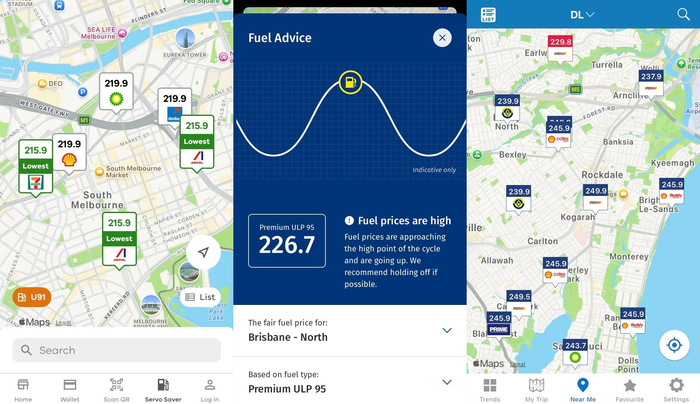
Luckily, you too can shop around and find the cheapest deal thanks to the various apps and websites that let you compare prices at retailers near you.
CHOICE tip: Independent service stations tend to be cheaper than major chains, although this advice may not apply in times of unusual price volatility and supply concerns.
What fuel comparison tools are available?
There are over 40 free fuel price apps and websites operating in Australia, with different platforms servicing different parts of the country.
So, wherever you are, there should be an app or website that will let you compare the going rates for different fuel types near you.
In most states and territories, these comparison services draw their prices from a government database that retailers are required to report to. We’ve previously found these services to be the most accurate.
Some states and territories with databases also have their own government-run apps or websites. Others have a list of third-party apps or websites that receive data from their respective fuel reporting schemes.
Some other non-government apps use crowd-sourced data, meaning you’re relying on other motorists to update the price information being displayed.
Various apps allow you to compare fuel rates and monitor price cycles in each state and territory.
How to compare fuel prices in each state and territory
NSW: Has a government-run database and app and website (FuelCheck). Third-party services are also available.
ACT: Most service stations are included on NSW’s FuelCheck app and website, but third-party services are also available.
You should know that, outside of times of unusual price volatility, petrol prices go up and down in a relatively predictable pattern in Australia’s largest cities: Sydney, Melbourne, Brisbane, Adelaide and Perth. Similar sequences have also been observed in some neighbouring regional areas.
This is the “petrol price cycle” (diesel prices don’t move in this way) and it can make a big difference to how much you pay at the pump.
If you’re in one of the five largest capitals, you can observe your city’s cycle by checking the ACCC’s petrol price cycle page.
The consumer regulator updates this resource three times a week, telling you where your city’s cycle is up to and providing buying advice.
“[The petrol price cycle] can either help you save money on fuel or leave you absolutely exposed if you fill up at the wrong point,” explains Peter Khoury from the NRMA.
You can sign up for alerts to let you know when it’s a good time to buy fuel via most price apps and websites
If you live in a city with a petrol price cycle, you can save by filling up towards the end of the cheap (or lower) part of the cycle. Ian Jeffreys says this is the time to be comparing local prices.
“It’s in the cheap phase, moving into the price hike phase, where the best deals can be found,” he says. “You really want to be watching the cycle in your city and making sure that when you’re moving into the price hike phase, you’ve got a full tank of fuel.”
You can sign up for alerts to let you know when it’s a good time in your area to buy fuel via most price apps and websites.
When in operation, the petrol price cycle doesn’t mirror changes in wholesale costs, but is driven by retailer strategies in bigger cities.
Price cycles are caused by competitive tactics among petrol stations.
Retailers seem to adopt these practices in districts where they’re competing against lots of other service stations and want to get a competitive edge.
In these areas, the price you pay at the bowser at the bottom of the cycle tends to be close to the wholesale price, and can even be below the average costs borne by the retailers to supply the petrol.
This means the price cycle can deliver good deals to consumers buying at the right time, especially compared to regional areas, where petrol prices are usually higher and more heavily influenced by international factors.
But it also means retailers’ margins get squeezed, so they’ll start to raise the price after a period of time.
This increase happens more slowly in the areas with the most retailers, where businesses are cautious about raising prices too quickly and being undercut by the rest of the market.
Prices will rise to a certain point, until some retailers start cutting them again to gain an edge on the competition and attract more customers.
Desire to compete leads other retailers to follow suit, until the bowser prices fall back closer to the wholesale rate (back to the beginning of the cycle), where they will stay until retailers start looking for higher margins again.
While petrol price cycles in Perth and Adelaide are shorter (one and two weeks, respectively), it usually takes around five weeks for prices in Sydney, Melbourne and Brisbane to go from their low point to a high and back again.
Switching to a vehicle with better fuel economy is an obvious way to spend less on refills, but going all the way to an electric or hybrid car can cut down on these costs substantially, if not completely.
The RACV recommends this not just as a solution to fuel-induced hits to your hip pocket, but also other ongoing outlays, as EVs typically have lower maintenance costs than petrol or diesel vehicles.
For info on how to choose the best electric, hybrid or just more fuel-efficient vehicle, check out our eco-friendly car buying guide.
It talks through the available options and explains whether purchasing an EV or hybrid car will actually save you money.
If you do decide an EV is for you, compare models with our electric vehicle review and see which are the quickest to charge, have the longest range and are the cheapest to run.
Once you’re running on battery power, you can employ the same tips for saving fuel from the beginning of this article, such as careful driving and removing unnecessary items from your car, to conserve your new vehicle’s battery.
Liam Kennedy is a Journalist with the Editorial and investigations team. He answers consumers' most burning questions, from which scams to be aware of and how to save money, to whether new services and products are worth using and how the latest developments in consumer news could affect them.
Prior to CHOICE, Liam worked in production in daily news radio and podcasting.
Liam has a Bachelor of Communication (Journalism) and a Bachelor of Arts in International Studies from the University of Technology Sydney. LinkedIn
Liam Kennedy is a Journalist with the Editorial and investigations team. He answers consumers' most burning questions, from which scams to be aware of and how to save money, to whether new services and products are worth using and how the latest developments in consumer news could affect them.
Prior to CHOICE, Liam worked in production in daily news radio and podcasting.
Liam has a Bachelor of Communication (Journalism) and a Bachelor of Arts in International Studies from the University of Technology Sydney. LinkedIn
For more than 60 years, CHOICE has been fighting the good fight for Australian consumers.
In the past year alone we've uncovered systemic issues with sunscreens, investigated shonky supermarket pricing, fought for stronger scam protections and helped make complex energy pricing fairer and clearer.
CHOICE is here to provide unbiased advice and independent testing in our world-class labs. We buy the products we test, just like you do, and our expert reviews are influence free. We’re here to help you choose smarter. Hopefully you’ll also save some money along the way.
Thanks to CHOICE, you’ll never be alone when a business treats you unfairly. You can support our work by joining or donating to our cause.