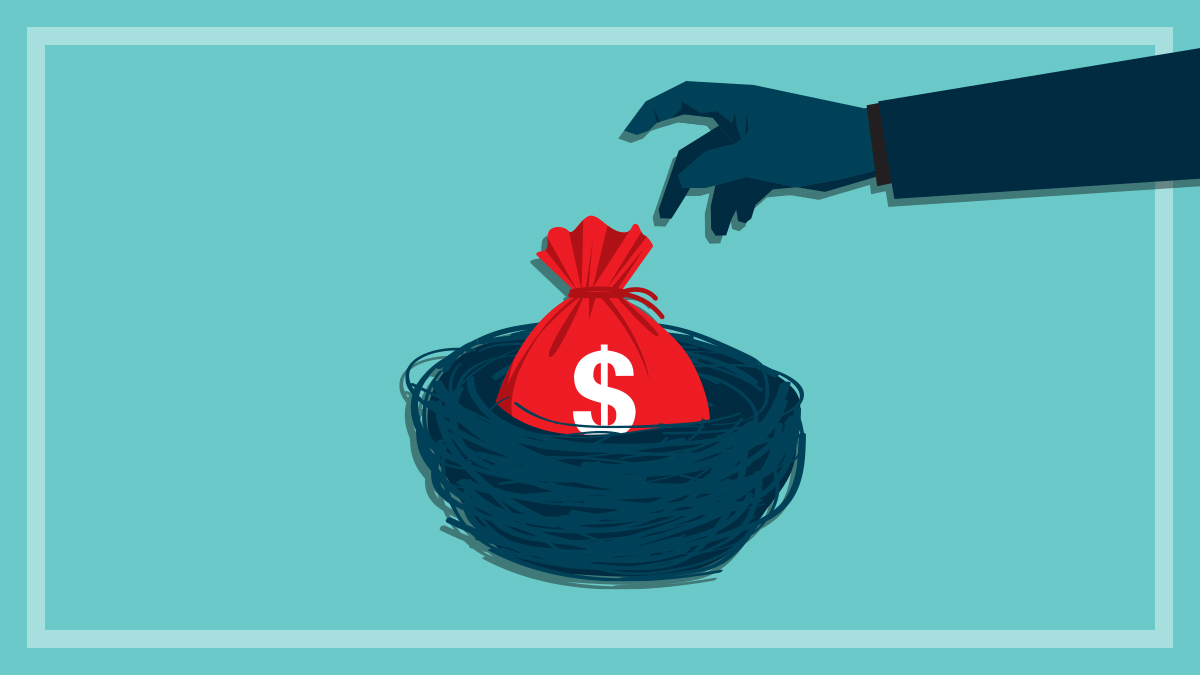
Australians can expect an increase in scams in the lead-up to the new financial year
Most tax-time scams involve criminals impersonating tax office or government officials in attempts to get your money or information
There are five types of scams worth looking out for this year, each with their own red flags
Tax time is a prime season for scammers.
It’s a period where we’re often rushing to get our affairs in order or waiting to hear from the government about refunds we’ll receive or debts we’ll have to pay.
Criminals often tap into this anxiety, using technology to pose as tax officials or government agents promising returns or demanding debts.
The Australian Tax Office received 7500 reports of impersonation scams last July alone
The Australian Tax Office (ATO) often sees more attempts to impersonate its staff around the new financial year, receiving 7500 reports of impersonation scams last July alone.
Using official-looking emails, calls, SMS messages and social media posts, criminals will try to force you to hand over money or sensitive personal information, which they can then sell online or use to commit fraud in your name or steal your tax refund or superannuation.
With many tax scams becoming harder to spot, we’ve trawled through the most common types to bring you an outline of the five slippery schemes scammers are likely to deploy in the coming months.
A new tax scam rearing its head sees criminals taking advantage of the fact that the ATO will sometimes request money from you.
Earlier this year, the tax office warned of emails appearing to come from it or online government service hub myGov.
The emails claim that you own cryptocurrency that has to be “declared immediately” and urge you to call a number at the bottom of the message to avoid being prosecuted.
They might claim that a warrant will be issued for your arrest
Such threats are a twist on a classic tax scam technique, often conducted via phone or SMS, where criminals accuse you of not paying enough tax and demand you pay them immediately to cover the shortfall.
To get you to act quickly, they might claim that a warrant will be issued for your arrest unless you pay right away.
Alternatively, they might claim your Tax File Number (TFN) has been suspended due to illegal activity and that you’ll need to make a payment to avoid being arrested or to protect your TFN.
How to spot them
The ATO may contact you by phone, email, SMS or post, but will never threaten you with arrest or to cancel your TFN.
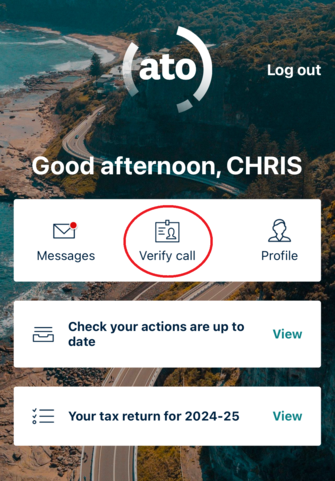
You can use the ATO app to make sure a call claiming to come from the tax office is genuine.
If you’re unsure about a message appearing to come from the ATO, call them on 1800 008 540 and not on any phone numbers included in the suspicious message.
While people do sometimes have to send money to the government to settle tax debts, it should never be via gift cards, cryptocurrency or personal or offshore bank accounts.
New phone app feature fights fraud
If you download the ATO app and register your device, you can use the new “verify call” feature to make sure you’re really talking to the tax office.
Open the app while you’re on a call with someone claiming to be from the ATO, select “verify call” and you’ll receive a notification within 30 seconds if the contact is genuine.
Another new take on a perennial scam starts with an email advising you of an urgent document you need to sign in order to finalise your tax arrangements.
The email invites you to review the form using DocuSign, but when you click to do this, you’re taken instead to a copy of the myGov website.
Here, you’re asked to provide information about you that could be valuable to criminals, including your myGov sign-in credentials, name, date of birth and driver licence details.
This is just the latest in a succession of emails scammers have sent out over the last year that look like they come from the tax office or myGov – all contain links to malicious clones of the myGov website designed to steal information.
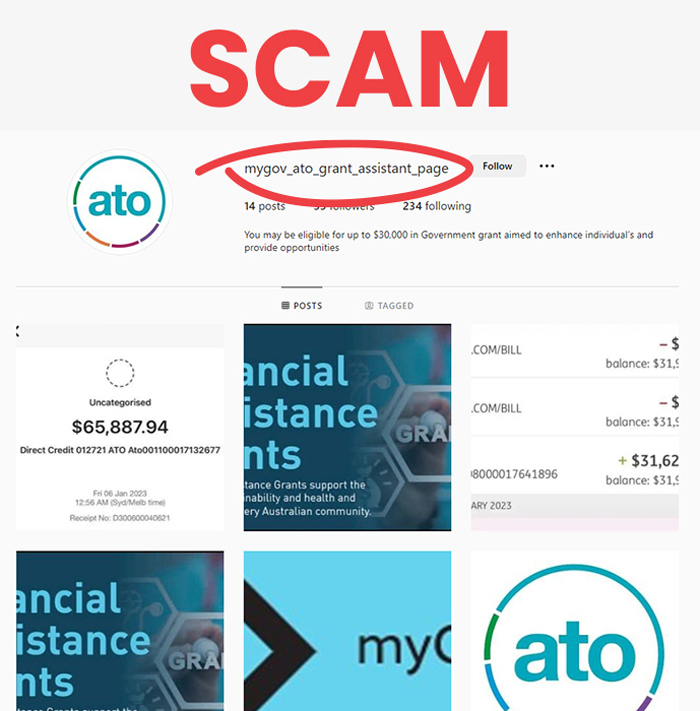
Criminals have also been known to include these sorts of appeals for personal details via fake ATO or myGov accounts on social media.
Fake ATO accounts on social media may contact you and ask for sensitive personal details. Source: ATO
How to spot them
DocuSign is a legitimate platform, but the ATO doesn’t use it to finalise tax returns.
Furthermore, emails might appear to come from the ATO or myGov, but when you look closely at the actual email address of the sender, you might see the account has no obvious connection with these agencies.
In any case, neither the ATO or myGov will ever send you an unsolicited email or social media message with a link to use to log into their services.
They’ll also never ask you to provide sensitive personal information via these channels.
Don’t get ripped off. Our expert tips can help you spot and avoid the latest scams.
These sorts of phishing scams also often exploit our yearning for an EOFY refund on the tax we’ve paid over the year.
A classic tax refund scam sees you receive a message claiming to be from the ATO urging you to click on a link to secure your well-deserved reimbursement.
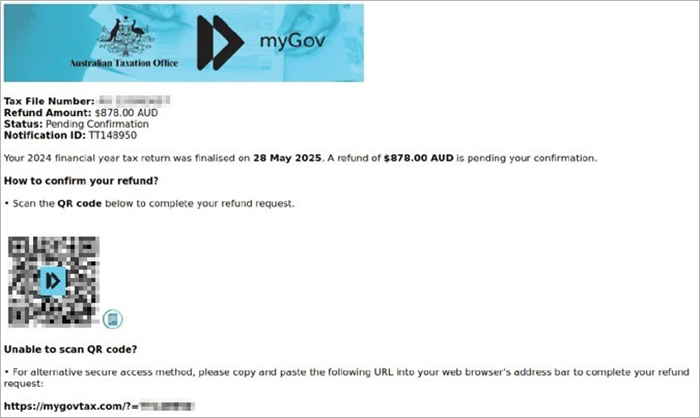
More elaborate attempts we’ve seen have involved government-branded emails, QR codes and promises of almost $900 – all you have to do is hand over your card details.
Clicking on these links or scanning the accompanying codes will probably deliver you to the same place – an official-looking clone site designed to steal your bank card and other details.
Scammers pretending to be the ATO often use promises of a tax refund to get victims to scan dangerous QR codes. Image: MailGuard
How to spot them
QR codes might be common in other parts of daily life, but neither the ATO nor myGov will ever send you one to log in to their online services.
They’ll also never send you unsolicited links to click on via SMS or email.
The tax office is warning Australians not to get sucked in by dubious financial advice this EOFY, in particular, questionable hacks that purportedly lead to a bigger refund.
It’s seen a rise in tax tips and other financial content online and says we should think twice before acting on such leads, which often come from AI or “finfluencers” (finance influencers).
Some previous viral schemes have, at their core, been tax avoidance operations that are illegal and could land you in serious trouble.
Previous viral schemes have been tax avoidance operations that are illegal and could land you in serious trouble
Also beware of getting tax advice from AI chatbots such as ChatGPT. This advice can be inaccurate due to the models behind these platforms drawing information from a broad and inconsistent range of sources.
The ATO is reminding Aussie taxpayers that we’re responsible for making sure the information we or our tax agents provide as part of our tax return is accurate.
How to spot them
Heard about a tax scheme that sounds too good to be true? The ATO recommends seeking advice on any arrangements from a registered tax practitioner.
Check if a practitioner is registered by using the Tax Practitioners Board’s public register.
You can report illegal tax schemes to the ATO via its online tip-off form. Steer clear of investment schemes promising unbelievable returns, urging you to get involved quickly or promoting themselves via ads on social media with photos or videos of well-known celebrities (often fake).
Scammers passing themselves off as working for the tax office or another official agency may also offer services (for a price) which are actually available from the government for free.
For example, ads offering to help you get a TFN for a fee have been known to circulate on social media. In reality, these posts direct victims to websites built to steal money or personal information.
If you’re applying for one through a tax agent, check that they’re registered with the Tax Practitioners Board.
When looking for other official documents that you have to get from a state or federal government website, make sure the page has “.gov.au” in the web address.
Text-only accessible version
5 types of tax scam to watch out for 1. Demanding debts 2. Requests for information 3. Promising refunds 4. Dodgy money-making opportunities 5. Fees for free services
How to report a tax scam
If you receive suspicious communication from the ATO, don’t give away any information, click any links, scan any codes, download software or open any attachments.
Call the ATO directly on 1800 008 540 to double-check what you’re being told.
If you’ve encountered a scam, report it to the ATO by emailing screenshots of social media posts and accounts or SMS messages to [email protected]. You can also forward suspicious emails to the same address.
If you’ve given money or personal information to a scammer, contact the ATO on 1800 008 540. Also report these incidents to your financial institution, IDCare and to police via ReportCyber.
If you’ve encountered a myGov-related scam, you can report it via the Services Australia website.
Liam Kennedy is a Journalist with the Editorial and investigations team. He answers consumers' most burning questions, from which scams to be aware of and how to save money, to whether new services and products are worth using and how the latest developments in consumer news could affect them.
Prior to CHOICE, Liam worked in production in daily news radio and podcasting.
Liam has a Bachelor of Communication (Journalism) and a Bachelor of Arts in International Studies from the University of Technology Sydney. LinkedIn
Liam Kennedy is a Journalist with the Editorial and investigations team. He answers consumers' most burning questions, from which scams to be aware of and how to save money, to whether new services and products are worth using and how the latest developments in consumer news could affect them.
Prior to CHOICE, Liam worked in production in daily news radio and podcasting.
Liam has a Bachelor of Communication (Journalism) and a Bachelor of Arts in International Studies from the University of Technology Sydney. LinkedIn
For more than 60 years, CHOICE has been fighting the good fight for Australian consumers.
In the past year alone we've uncovered systemic issues with sunscreens, investigated shonky supermarket pricing, fought for stronger scam protections and helped make complex energy pricing fairer and clearer.
CHOICE is here to provide unbiased advice and independent testing in our world-class labs. We buy the products we test, just like you do, and our expert reviews are influence free. We’re here to help you choose smarter. Hopefully you’ll also save some money along the way.
Thanks to CHOICE, you’ll never be alone when a business treats you unfairly. You can support our work by joining or donating to our cause.