When Betty* took a close look at her superannuation savings in 2024, she grew seriously concerned. Despite already being over 65 years old, the teacher, who lives in regional Victoria, was worried there wouldn’t be enough money to get her through retirement if she stopped working.
Around this time she saw a Facebook ad for an investment opportunity. The timing seemed perfect; this was her chance to grow her nest egg.
The problem was that the so-called investment opportunity was actually a set-up for a scam. At the insistence of the scammer, who groomed her over a period of weeks, Betty withdrew $5000 from her superannuation account every day for over a month and fed the money into cryptocurrency. Betty hadn’t heard of cryptocurrency, and had never traded in crypto before the scam.
For people who are retired, it’s just far too easy to get your money out of your retirement fund and move it to a complete scam
Meg Dalling, Consumer Action Law Centre
In the end, she lost a total of $140,000 to the scam. Nobody from her superannuation fund spoke to her or raised concerns about the suspicious transaction pattern.
Meg Dalling, assistant director of policy and campaigns at Consumer Action Law Centre, which provided support to Betty, says her case “goes to the heart” of a major gap in superannuation.
“For people who are retired, it’s just far too easy to get your money out of your retirement fund and move it to a complete scam,” Dalling says.
“We’ve seen the banks step up their efforts to prevent scams, but super funds are really far behind. I think one of the issues with the super funds is there’s typically not a lot of engagement with customers.”
Advocates say the new scam prevention plan doesn’t include what’s needed to make sure superannuation is safe in retirement
Experts are warning of a giant “honey pot” for scammers to target over the coming years, with Australia’s aging population and trillions of dollars moving into the retirement phase of superannuation, where funds are much easier to access.
While the federal government has released a new scam prevention plan, advocates say it doesn’t include what’s needed to make sure superannuation is safe in retirement. In fact, obligations on super funds to protect their members from scams are not included in the government’s plan at all.
Australians over 65 reported the highest level of scam losses of any age demographic to the Australian Competition and Consumer Commission’s (ACCC) ScamWatch service in 2025, losing $89 million.
They were the most likely to lose money to investment scams, romance scams and other major scam types.
That age category is particularly relevant for superannuation, because when someone is over 65 they can move their funds into the retirement phase, giving them far greater capacity to make withdrawals with minimal restrictions. While this allows flexibility, it also means far fewer checks and queries.
Superannuation scams are costing people of retirement age.
‘Significant gaps’ exposed in anti-scam protections
In February, the Australian Securities and Investments Commission (ASIC) sounded the alarm and called for immediate action from superannuation trustees to strengthen anti-scam protections.
The call came after an ASIC review of scam- and fraud-related information and support on 47 super funds websites, which the regulator compared against website content from the big four banks. ASIC found “significant gaps” in communications and member support from super funds.
“Super funds often lacked clarity, accessibility, and support for scam victims. When benchmarked against other industries, super funds fell short for victims,” ASIC Commissioner Simone Constant says.
“Super funds have a clear and unavoidable responsibility to oversee risk and ensure these emerging threats are identified and managed actively.”
No government department or regulatory body, including the National Anti-Scam Centre, collects data on how much money is lost to scammers each year that originated from superannuation accounts.
Because money is transferred from superannuation into a person’s bank account first before it’s taken by scammers, it’s not being captured as a superannuation scam.
The “Report a Scam” form to ScamWatch doesn’t even include a superannuation option or any way for someone to indicate that superannuation was lost in the scam either directly or indirectly.
Super is the honey pot, but it’s currently the weakest link in the financial services system when it comes to scams
Lily Jiang, Super Consumers Australia
The ACCC says it undertakes “comprehensive searches of multiple Scamwatch data fields to determine when such reports relate to superannuation schemes”. However, this relies on an individual proactively sharing this information in the details of their report.
Lily Jiang, director of advocacy at Super Consumers Australia, says that because there is no national reporting, nobody knows how big this issue is, adding that it’s likely to only get bigger.
“Over the next 10 years, we’ve basically got the biggest ever number of people retiring in Australia, about 2.5 million Australians. They will have the highest superannuation balances going into retirement that we’ve ever seen, we are talking about $1.5 trillion,” she says.
“However, super funds remain asleep at the wheel. Super is the honey pot, but it’s currently the weakest link in the financial services system when it comes to scams and a system is only as strong as its weakest link,” Jiang says.
Minister Daniel Mulino says the Scams Prevention Framework will make a difference.
Scam Prevention Framework doesn’t cover super funds
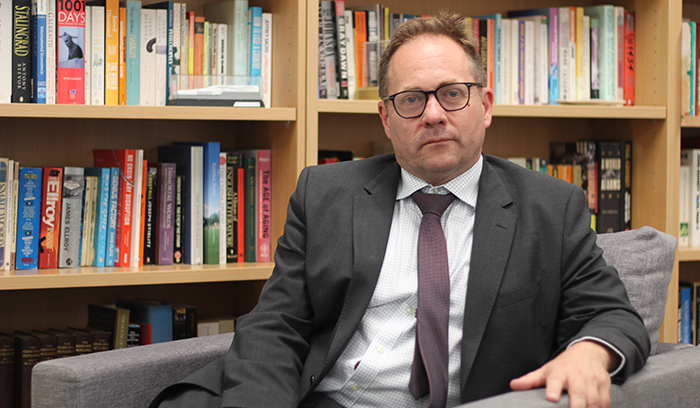
Sitting down with CHOICE and Super Consumers Australia at his office in the western suburbs of Melbourne, federal Assistant Treasurer and Minister for Financial Services Daniel Mulino highlights the government’s Scam Prevention Framework and the increased obligations that will be brought on businesses to comply with scam protections.
The bill, which passed parliament February 2025, gives the government powers to designate sectors of the economy that have to comply with sector codes and increased efforts to monitor and prevent scams.
So far the government has announced plans to designate social media platforms, telecommunications companies and banks. Superannuation is not on the list.
“This is not going to be straightforward work, it’s actually work which is cutting edge and is a world leading framework,” Mulino says.
So far the government has announced plans to designate social media platforms, telecommunications companies and banks
When asked why the decision was made not to designate superannuation under the framework, Mulino says designating three sectors at the same time was already going to be “quite complex”.
“We’ll continue to look at whether or not the scams framework needs to expand,” he adds.
Mulino’s ministerial predecessor Stephen Jones had said in November 2024 that the superannuation industry was “on notice that they will be fast followers” when it came to designation under the framework.
We sent follow-up questions to Minister Mulino’s office about whether that position had changed; the reply was that there “isn’t any change” from the former Minister’s position.
Kathryn McKenzie, director of operations at the NSW Ageing and Disability Commission, says the agency often works with banks that proactively bring them cases of older scam victims seeking support.
She cites the case of a man with signs of dementia who successfully withdrew $150,000 from his super and was about to lose it all to scammers when his bank stepped in and blocked the transaction.
“They are proactively looking for warning signs and acting on them before money is lost,” she says of the banks.
Patricia Sparrow, chief executive officer of Council on the Ageing, says super funds should be made to meet the same accountability standards as other financial institutions.
“Super funds also need to play their part in the broader scam prevention system, including taking steps to identify scams where legitimate transfers from super to a member’s bank account are later used for fraud,” she says.
Mulino also pointed out that in most instances the superannuation withdrawal will go to the member’s own bank account before being lost to a scammer, providing the banks, who are regulated by the prevention framework, an opportunity to catch, query and potentially prevent the suspicious transaction.
But Jiang from Super Consumers Australia says a “multi-layed approach” would be far more effective.
“The issue with that approach is that we are funneling all the risks and responsibilities into one part of the system (the banks), as opposed to trying to improve every part of the system where the money is being moved from point A to point B,” she says.
It’s the super funds who need to understand how their customers engage with the retirement system and use their retirement accounts
Lily Jiang, Super Consumers Australia
“The banks are good at understanding their customers in a banking environment, but it’s the super funds who need to understand how their customers engage with the retirement system and use their retirement accounts,” says Jiang. “The banks have zero visibility of this information, it all sits with the super fund – they should be responsible for catching it from the start.”
A spokesperson for the Super Members Council says funds are taking positive steps to proactively strengthen scam prevention measures.
“The next critical step is to promote greater consistency across the sector, ensuring that members receive a comparable level of protection, friction, and escalation regardless of their fund. This is particularly important for high-risk transactions and for members identified as experiencing vulnerability,” the spokesperson says.
Jiang adds it will take time for super funds to properly invest in stronger anti-scam protections and member support, but it’s vital that the government sends clear signals to industry now that firmer compliance obligations are coming soon.
Jarni Blakkarly is an award-winning Senior Investigative Journalist at CHOICE. Jarni has worked for news organisations such as SBS, Reuters, Al Jazeera English, ABC 730, Radio National, BBC World Service and Deutsche Welle.
Jarni won the Walkley Foundation's young journalist of the year student category award in 2016 and was the recipient of a Melbourne Press Club Michael Gordon fellowship in 2022. In 2023 he was a highly commended finalist in the Quill Awards and a winner at the 2024 Excellence in Civil Liberties journalism awards. In 2024 he was elected to serve on the Federal Council (National Media Section) of the MEAA. Jarni has a Bachelor of Communications (Journalism) from the Royal Melbourne Institute of Technology (RMIT).
Jarni Blakkarly is an award-winning Senior Investigative Journalist at CHOICE. Jarni has worked for news organisations such as SBS, Reuters, Al Jazeera English, ABC 730, Radio National, BBC World Service and Deutsche Welle.
Jarni won the Walkley Foundation's young journalist of the year student category award in 2016 and was the recipient of a Melbourne Press Club Michael Gordon fellowship in 2022. In 2023 he was a highly commended finalist in the Quill Awards and a winner at the 2024 Excellence in Civil Liberties journalism awards. In 2024 he was elected to serve on the Federal Council (National Media Section) of the MEAA. Jarni has a Bachelor of Communications (Journalism) from the Royal Melbourne Institute of Technology (RMIT).
For more than 60 years, CHOICE has been fighting the good fight for Australian consumers.
In the past year alone we've uncovered systemic issues with sunscreens, investigated shonky supermarket pricing, fought for stronger scam protections and helped make complex energy pricing fairer and clearer.
CHOICE is here to provide unbiased advice and independent testing in our world-class labs. We buy the products we test, just like you do, and our expert reviews are influence free. We’re here to help you choose smarter. Hopefully you’ll also save some money along the way.
Thanks to CHOICE, you’ll never be alone when a business treats you unfairly. You can support our work by joining or donating to our cause.