In her retirement, Carolyn Bond has taken up an unusual hobby.
Since 2022, the former consumer advocate has been spending part of her time trawling the web for dodgy superannuation advertisements, plugging in her details and then taking note of what happens next.
“I was getting so many phone calls it got to the point where I thought ‘I better get another phone’. So I have another phone, another name, another email. I have a spreadsheet where I track it all, but it’s a bit messy now,” she says.
One man assures Carolyn she can be $200,000 better off if she switches super funds, without taking on any extra risk
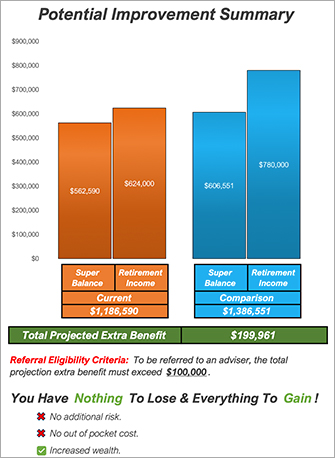
The people on the other end of the phone make Carolyn all kinds of promises. One man assures her she can be $200,000 better off in retirement if she switches super funds, without taking on any extra risk.
“You have nothing to lose and everything to gain,” trumpets a pitch document that was sent to Carolyn.
The promises roll in despite the fact that these types of callers are not legally allowed to provide financial advice or sell a financial product. They are what the industry calls “lead generators”, and recent financial scandals have experts calling for them to be banned altogether.
What are lead generators?
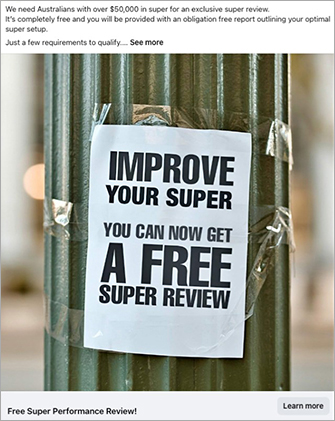
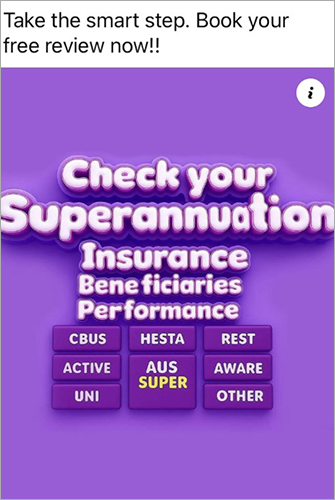
An example of a lead generator ad seen on Facebook.
Lead generators gather your information – sometimes without your consent – from various interactions you may have had online. Perhaps web forms you’ve filled out, social media surveys you’ve responded to, or a competition you’ve entered.
They might set up web pages that offer customers a “free super health check” or similar services, and promote them heavily on social media, through ads or partnerships with financial influencers.
Angel Zhong, deputy dean of the department of economics, finance and marketing at RMIT University, says ‘finfluencers’ often push the boundaries of what constitutes financial advice, and nudge people towards lead generators for a “kickback” or commission.
“There is no such thing as a free lunch,” says Zhong. “That’s especially true in the world of online marketing.”
Once the lead generators have your details, they’ll then call you on the phone to get you interested in a product.
In the world of superannuation, they are usually trying to convince you to switch your superannuation to a financial product with higher fees and higher risks.
A pitch document sent to Carolyn Bond, in an attempt to convince her to move her super.
While the lead generator can’t legally sell you the financial product or service themselves without a licence, they will often get you interested in switching your super fund without mentioning the name of the product they’re trying to get you to invest in.
Once the cold lead is sufficiently “warmed up”, they will forward you on to a financial adviser, who is licensed and allowed to sell a financial product.
It’s a way around the legal protections and so-called anti-hawking provisions designed to prevent the cold-call selling of financial products.
Xavier O’Halloran, CEO of Super Consumers Australia, says it’s the simplicity of the premise that hooks people in.
“People are being sold on the idea that they might be in a poor-performing superannuation fund and they can click a button and find out if they are, and then find a better one.
“But what typically follows from sharing their details is a series of high-pressure sales tactics, very carefully crafted to get people to switch superannuation funds for very, very high fees and higher risk,” he says.
Alyssa Jackson has no idea how the lead generators got her phone number. The Gold Coast woman, who says she has always taken an interest in superannuation and regularly checks her balance, was in the local Woolworths supermarket in 2023 when she got a call offering her a comparison for free.
“I thought, what can it hurt?” she says.
Alyssa says she was passed through multiple people over the phone, who she describes as “very smooth”, before being convinced to roll over most of her superannuation into a new platform called First Guardian.
By 2025, the First Guardian Master Fund had infamously collapsed. Along with the demise of another investment scheme, Shield Master Fund, it left more than 11,000 Australians with little hope of ever seeing their retirement savings again.
Alyssa lost around $60,000 in the collapse – a terrible outcome for her, but a small amount compared to many other victims.
Alyssa lost around $60,000 – a terrible outcome, but a small amount compared to many other victims
The corporate regulator, the Australian Securities and Investments Commission (ASIC), is still working through several ongoing court cases relating to the twin collapses, and liquidators are still trying to recover assets, but in total about $1.1 billion dollars of people’s retirement savings may have been lost in the scandal.
Appearing before a parliamentary committee in May this year, ASIC confirmed that First Guardian and related funds had paid more than $100 million to lead generators to drum up business.
Stephanie Tonkin, CEO of Consumer Action Law Centre, says given the evidence of the harm that has been caused by lead generation, it is time for an outright ban.
Lead generator ads may seem innocent, but advocates say these businesses are ‘a significant source of consumer harm’.
“Getting to the bottom of the extent and harm of lead generation is difficult because it is such a hidden problem, it is lurking in the background,” she says.
But there is no doubt, she says, that lead generation has become “a significant source of consumer harm”.
O’Halloran from Super Consumers Australia agrees that it’s time the practice was banned, as does ASIC Commissioner Alan Kirkland.
Kirkland also argues against any kind of licensing of lead generators as a potential remedy, which some in the industry have called for.
“We don’t see any benefit from licensing lead generators. Based on what we’ve seen in our work over time in this area, a clear ban on lead generation activities in relation to super would be more likely to protect consumers into the future,” Kirkland says.
“The people on the other end of the line can seem quite knowledgeable … we really do encourage people to be on the lookout for anybody that’s encouraging them to move their super,” he says.
We don’t see any benefit from licensing lead generators
ASIC Commissioner Alan Kirkland
Super Members Council, the peak body representing industry super funds, also wants a ban on lead generation.
“When you look at those searing case studies and witness and victim testimonials from these terrible collapses [Shield and First Guardian], this wasn’t driven in the main by individual consumers articulating that they were looking actively for a switch. It has often started with that clickbait activity,” Council CEO Misha Schubert says.
Super funds need to ‘step up’
Super Consumers’ O’Halloran says that big industry funds also have a role to play, and says they’ve been “asleep at the wheel” when it comes to combatting harmful lead generation practices.
“They saw these outflows from their fund and did little to question or prevent it, they failed to engage with their members, and the lead generators preyed and took advantage of that,” he says.
Schubert, from the Super Members Council, maintains that superannuation funds are providing consumers with warnings about dangerous products.
Where is that call to understand why I am leaving? I think [super funds] could do a lot to warn people at that point
Super Consumers Australia CEO Xavier O’Halloran
But O’Halloran argues that every part of the super system must step up and take part in stamping out these predatory practices.
“I have a harder time trying to leave my internet provider, my electricity provider or my health insurance than my super fund,” says O’Halloran. “Where is that call to understand why I am leaving? I think they could do a lot to warn people at that point.”
Treasury is currently considering consultation feedback on ways to curb harmful lead generation activity and is expected to hand its recommendations to the government in the coming months.
Jarni Blakkarly is an award-winning Senior Investigative Journalist at CHOICE. Jarni has worked for news organisations such as SBS, Reuters, Al Jazeera English, ABC 730, Radio National, BBC World Service and Deutsche Welle.
Jarni won the Walkley Foundation's young journalist of the year student category award in 2016 and was the recipient of a Melbourne Press Club Michael Gordon fellowship in 2022. In 2023 he was a highly commended finalist in the Quill Awards and a winner at the 2024 Excellence in Civil Liberties journalism awards. In 2024 he was elected to serve on the Federal Council (National Media Section) of the MEAA. Jarni has a Bachelor of Communications (Journalism) from the Royal Melbourne Institute of Technology (RMIT).
Jarni Blakkarly is an award-winning Senior Investigative Journalist at CHOICE. Jarni has worked for news organisations such as SBS, Reuters, Al Jazeera English, ABC 730, Radio National, BBC World Service and Deutsche Welle.
Jarni won the Walkley Foundation's young journalist of the year student category award in 2016 and was the recipient of a Melbourne Press Club Michael Gordon fellowship in 2022. In 2023 he was a highly commended finalist in the Quill Awards and a winner at the 2024 Excellence in Civil Liberties journalism awards. In 2024 he was elected to serve on the Federal Council (National Media Section) of the MEAA. Jarni has a Bachelor of Communications (Journalism) from the Royal Melbourne Institute of Technology (RMIT).
For more than 60 years, CHOICE has been fighting the good fight for Australian consumers.
In the past year alone we've uncovered systemic issues with sunscreens, investigated shonky supermarket pricing, fought for stronger scam protections and helped make complex energy pricing fairer and clearer.
CHOICE is here to provide unbiased advice and independent testing in our world-class labs. We buy the products we test, just like you do, and our expert reviews are influence free. We’re here to help you choose smarter. Hopefully you’ll also save some money along the way.
Thanks to CHOICE, you’ll never be alone when a business treats you unfairly. You can support our work by joining or donating to our cause.