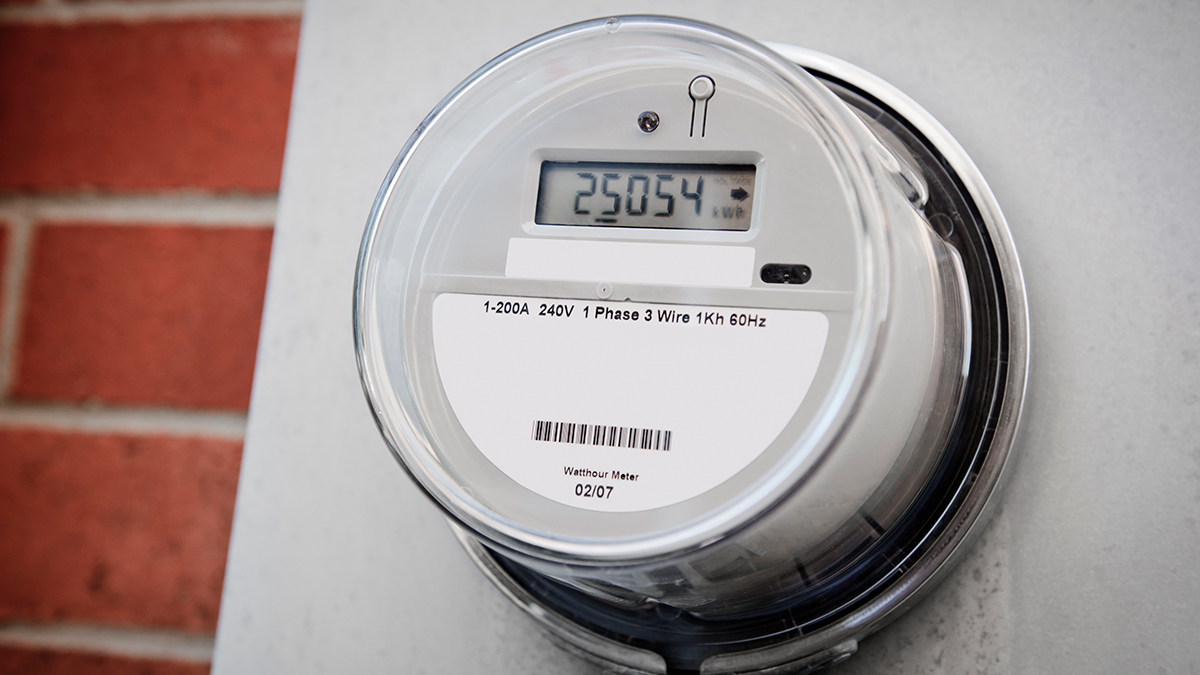
A new breed of smart meters will start being installed for free across Australia as part of the mandatory rollout from November 2028
These new meters will have the capacity to wirelessly communicate real-time data, which customers can access for free
But approximately 85% of households are expected to be stuck with older smart meters
Energy smart meters are supposed to give us the information we need to better understand and control our power usage. The theory is that this will help us find ways to reduce our ever-increasing bills. Smart meters are also critical when it comes to monitoring the performance of solar devices.
But unless you can access real-time smart meter data – information that tells you how much energy you’re using at a given time – fine-tuning your energy consumption from day to day will involve a lot of guesswork.
At the moment, energy customers have access to daily usage data, but they have to request real-time, second-by-second data from their retailers, and they’re under no obligation to provide it. And if they do give it to you, they can charge you for it.
But change is in the wind. As of 30 November 2028, a new breed of smart meters will start being installed across Australia as part of the mandatory rollout, which is being implemented under the authority of the Australian Energy Market Commission (AEMC) and applies across the National Energy Market (Queensland, NSW, the ACT, Victoria, South Australia and Tasmania).
If your household already has an older-style smart meter installed, you won’t get a new one
These new meters will have the capacity to wirelessly communicate real-time data, and customers can ask their retailer to provide access to this data for free.
It’s an important step forward in a rapidly evolving energy market, but there’s a major caveat: if your household already has an older-style smart meter installed, you won’t get a new one.
That means approximately 85% of households are expected to be stuck with older smart meters by the projected end of the rollout in 2030 and won’t benefit from this reform at all. If they want to upgrade their meter to one with real-time data capabilities, they’ll have to pay for it.
If they want to upgrade their meter to one with real-time data capabilities, they’ll have to pay for it. (Under the mandatory rollout, energy retailers are initially installing smart meters at no cost to customers.)
So it seems the best move would be to wait until late 2028 to have a smart meter installed, except that’s not really an option. The timing of your smart meter installation is generally controlled by your energy retailer. In Victoria and Tasmania, the rollout is finished or close to it.
Nevertheless, the advocacy group Energy Consumers Australia (ECA), which called for speeding up access to real-time data, welcomes the ruling – especially given that the AEMC’s original implementation date was a lot farther off. ECA argued that it be moved forward in a submission to the AEMC.
“The initial direction would have meant retailers could charge consumers for access to real-time data until 2040,” says ECA general manager of policy and advocacy, Brian Spak.
“Our research has found that consumers want information that could be provided via access to real-time data, which can help them better understand their energy use and identify easy ways to save on their bills,” Spak says.
Providing consumers access to their real-time data will help also build trust in the smart meter rollout, Spak adds.
Our research has found that consumers want information that could be provided via access to real-time data, which can help them better understand their energy use and identify easy ways to save on their bills
ECA general manager of policy and advocacy Brian Spak
But for customers who received the older style of smart meter, having to pay to upgrade to a real-time data meter leaves them at the mercy of energy retailers, who will have no incentive to make sure the metering companies they hire offer the best value for money, since the cost will be passed on to customers.
ECA has called on the AEMC to set a regulated price for the many customers who may want to upgrade, rather than having retailers set prices. But this wasn’t included in the final AEMC ruling. Instead, retailers have been instructed to charge ‘reasonable’ prices.
The AEMC is relying on market competition to keep prices reasonable, but it’s the energy retailer, not the customer, that’s comparing smart meter providers, as the ECA pointed out in its submission.
Retailers “have no market incentive to gain the best value from metering service providers as they are not the customer, and simply pass on these costs to them,” ECA wrote.
Pace will be set by industry
Smart meters are supposed to help save on energy costs, but they’ve had the opposite effect for many.
AEMC chair Anna Collyer tells CHOICE that making real-time smart meter data available to households sooner would have placed a heavy financial burden on households, since retailers’ costs are passed along to customers.
“By 2045, most consumers will have free access as their smart meters are replaced through natural replacement cycles. The pace depends on metering coordinator decisions about which meters to install – the sooner industry adopts real-time capable meters, the faster customers gain access,” Collyer says.
The AEMC stressed the point that waiting until the later stages of the rollout to introduce real-time data smart meters will significantly reduce the cost of adding this technology to energy customers.
By 2045, most consumers will have free access as their smart meters are replaced through natural replacement cycles
AEMC chair Anna Collyer
Households that don’t get a new real-time data meter from November 2028 can pay to upgrade early or use alternative real-time data tracking devices, Collyer adds.
There is a number of commercially available devices that connect to energy meters or power cables that claim to track real-time usage data. The AEMC points out that these monitoring devices cost as little as $50.
Though smart meters are meant to help lower bills, the mandatory rollout has had the opposite effect for many customers. Some energy retailers have used it as an opportunity to add unexpected new charges, in particular demand charges.
These are based on the highest amount of electricity used for one 30-minute block over the monthly billing cycle. This level of usage then determines how much customers pay in the demand period set by the retailer for the entire billing cycle.
CHOICE has heard from a number of energy customers who were taken by surprise by the jump in their bills following a smart meter installation and the application of demand charges.
The good news is that the era of retailers being able to add new charges officially came to an end as of December last year. Since then, energy retailers have been prohibited by an earlier AEMC ruling from adding charges without the customer’s consent for two years after a smart meter is installed.
CHOICE has heard from a number of energy customers who were taken by surprise by the jump in their bills following a smart meter installation and the application of demand charges
But households who’ve had a smart meter installed before December 2025 won’t have this protection, just as households with meters installed before 30 November 2028 won’t have free access to real-time data. In November 2024 – more than a year before the two-year moratorium on adding new charges took effect – the AEMC reported that around 7.3 million meters had already been installed, covering 57% of households.
Collyer says customers who had smart meters installed before December 2025 have the option of switching to a different offer from their retailer or to a different retailer altogether if they’re facing higher costs, adding that Queensland, South Australia and NSW offer flat rate plans for households with smart meters following an AEMC recommendation.
If households are hit with new charges following the installation of a smart meter after December 2025, Collyer recommends customers first contact their retailer, then, if necessary, the energy ombudsman in their state or territory.
In many jurisdictions there’s an unresolved question about who has oversight over metering companies. We recently heard from an energy customer named Brendan who was convinced his energy smart meter wasn’t working properly and that he was the victim of excessive demand charges.
“My meter reported that I used 4000 watts an hour continuously for two hours, which is absurd and impossible,” Brendan says. “I don’t run air con, I don’t have a pool heater or anything like that – 8000 watts over two hours is just insane.”
Brendan says his power usage is limited to a computer, a TV, a fridge and a modem. “Before this faulty meter was installed two years ago, my bills were around $250 per quarter. Now they’re between $350 and $500.”
My meter reported that I used 4000 watts an hour continuously for two hours, which is absurd and impossible
Energy customer Brendan
When he contacted his energy retailer he was told there was nothing wrong with the meter. Yet energy retailers and metering companies are generally two separate entities that have no obligation to work together, so the retailer likely wouldn’t be in a position to know whether there was a problem.
Smart meters are handled by an array of different businesses in NSW, for instance. Metering coordinators have overall responsibility for providing metering services, and they generally hire other businesses to install and maintain the equipment at people’s homes. Different businesses keep track of the meter data.
The NSW Electricity and Water Ombudsman (EWON) has no jurisdiction over any of these players and they have no obligation to comply with requests for metering data. EWON has lodged several submissions to regulators, including the AEMC, calling for oversight of metering businesses, but that has yet to happen.
Metering companies also operate independently in Queensland. In Victoria, energy distributors are responsible for providing meters.
So while the relative few households that get access to free real-time smart meter data in 2028 will be in a better position to reduce energy costs and monitor solar devices, the national smart meter rollout as a whole – while critical to the evolution of Australia’s retail energy infrastructure – continues to bring with it some unwelcome surprises for many households.
Andy Kollmorgen is the Investigations Editor at CHOICE. He reports on a wide range of issues in the consumer marketplace, with a focus on financial harm to vulnerable people at the hands of corporations and businesses. Prior to CHOICE, Andy worked at the Australian Securities and Investments Commission (ASIC) and at the Australian Financial Review along with a number of other news organisations. Andy is a former member of the NSW Fair Trading Advisory Council. He has a Bachelor of Arts in English from New York University. LinkedIn
Andy Kollmorgen is the Investigations Editor at CHOICE. He reports on a wide range of issues in the consumer marketplace, with a focus on financial harm to vulnerable people at the hands of corporations and businesses. Prior to CHOICE, Andy worked at the Australian Securities and Investments Commission (ASIC) and at the Australian Financial Review along with a number of other news organisations. Andy is a former member of the NSW Fair Trading Advisory Council. He has a Bachelor of Arts in English from New York University. LinkedIn
For more than 60 years, CHOICE has been fighting the good fight for Australian consumers.
In the past year alone we've uncovered systemic issues with sunscreens, investigated shonky supermarket pricing, fought for stronger scam protections and helped make complex energy pricing fairer and clearer.
CHOICE is here to provide unbiased advice and independent testing in our world-class labs. We buy the products we test, just like you do, and our expert reviews are influence free. We’re here to help you choose smarter. Hopefully you’ll also save some money along the way.
Thanks to CHOICE, you’ll never be alone when a business treats you unfairly. You can support our work by joining or donating to our cause.