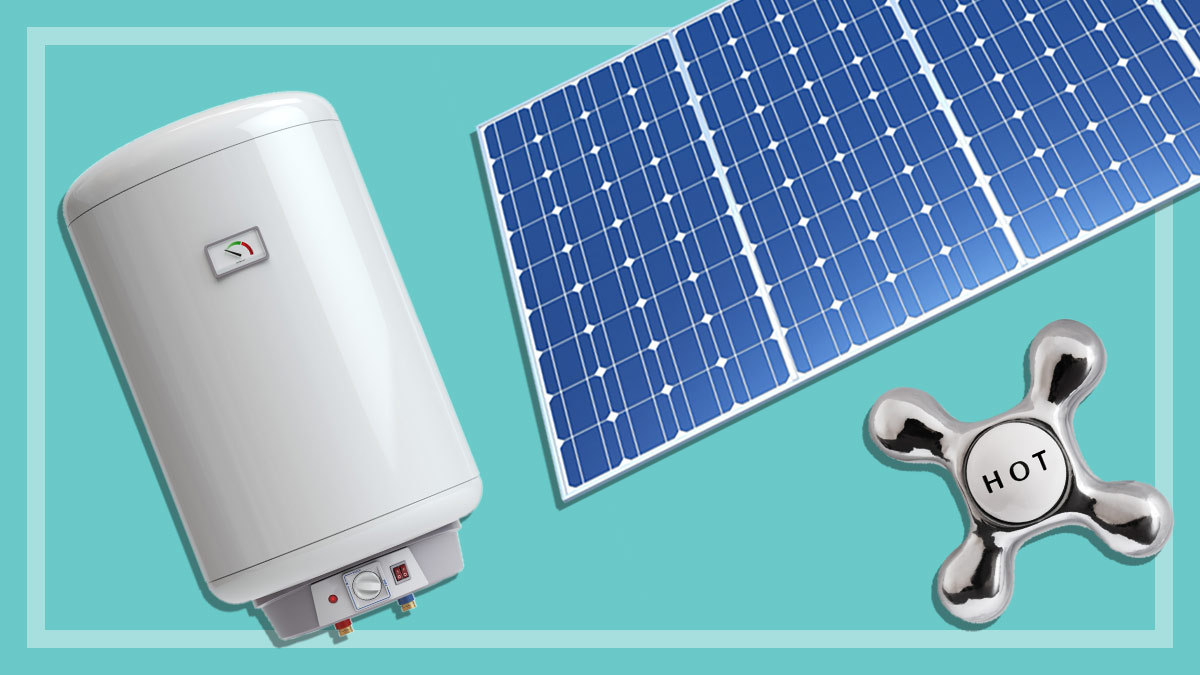
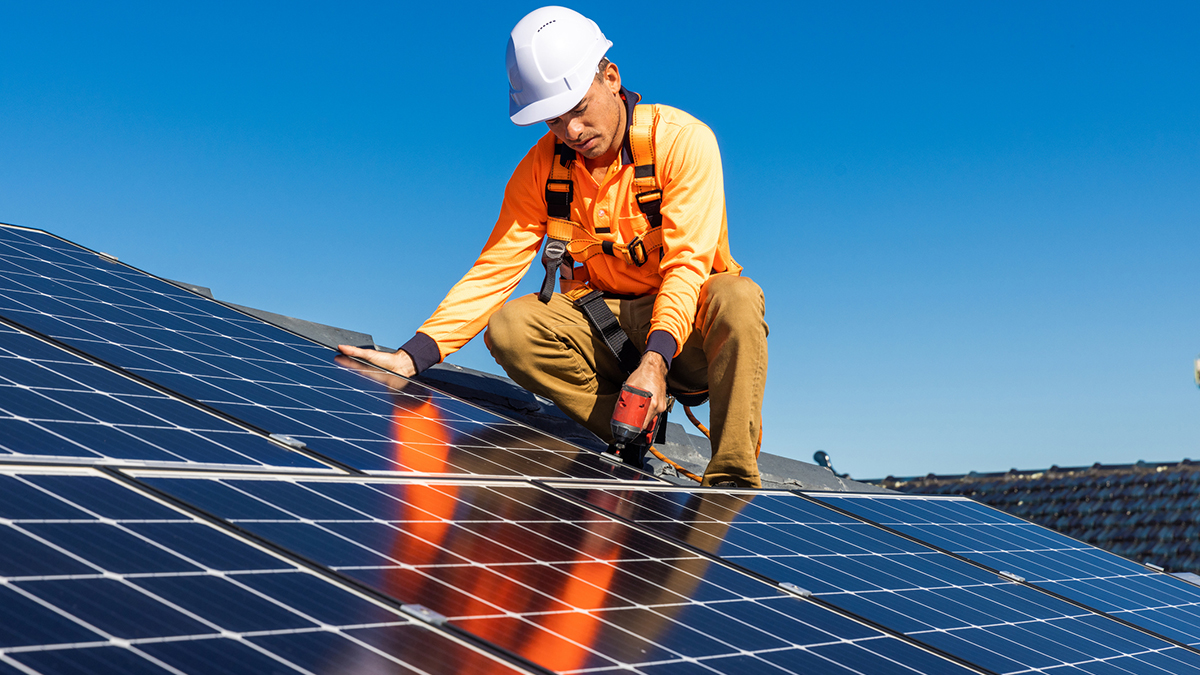
With gas and electricity prices continuing to rise, many Australians are turning toward the sun to heat their hot water and reduce power bills.
Water heating typically makes up around 25% of a household’s energy bill, second only behind heating and cooling costs, so it makes sense to soak up free sunshine to bring your costs down.
Whether you’re considering a solar thermal heater on your roof or a heat pump powered by your solar array, both systems are significantly cheaper to run than conventional electric or gas heaters and can reduce costs by 70–80%. That’s great for your bank account and for the planet.
Solar hot water systems are significantly cheaper to run and can reduce costs by 70–80%
Solar water heaters and heat pumps do come with hefty upfront costs though, so you’ll need to do some research and maths to ensure they’re suitable for your home and budget.
To give you a head start, this guide shines the light on the different sun-powered heating options, their various pros and cons, rebates and more.
We've partnered with SolarQuotes to help you find and buy the right solar, battery, heat pump and EV charger. While we make money if you use SolarQuotes to find an installer, this doesn't influence our ratings. 100% of the money we make goes directly back into our nonprofit mission.
Solar heating types: Prices, pros and cons
Traditionally, ‘solar hot water’ referred to a roof-mounted thermal hot water system (see option 1), but these days people use it to describe other types of sun-powered setups, like using solar panels or a battery to power a heat pump unit or electric heater, so keep this in mind when shopping around.
Let’s dive into the different options now:
1. Thermal solar hot water
Not to be confused with solar panels that generate electricity (as they do look similar), these heater systems consist of a storage tank and roof-mounted thermal collectors, which absorb heat from the sun to warm circulated water.
Collectors usually come in two forms:
Flat plates: Glass panel boxes absorb sunlight and heat a network of copper water pipes inside.
Flat plate panels heat the water inside and store it in the tank.
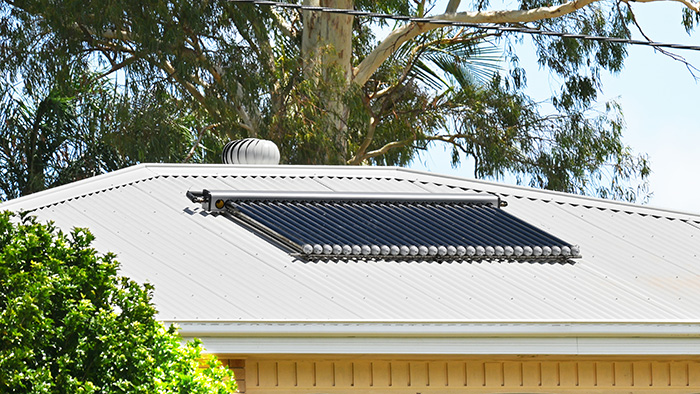
Evacuated tubes: Vacuum-sealed glass tubes trap sunlight inside to heat the water (or a separate heat transfer fluid). They’re more insulated so they’re better suited to colder climates, but they are more expensive and fragile.
A solar tube system sighted in the wild, with the tank mounted on the ground.
These systems can mount the water storage tank on the roof or on the ground. The former is called a thermosiphon system, which bolts the tank and collectors on the roof, while a pumped split-system has collectors on the roof and the tank on the ground.
The best option for you will depend on your water needs, the design of your home and of course, roof strength.
The tank usually has an electric or gas booster element to keep the water hot on days with less sunshine.
Price range: $4000–$8000 fully installed. Systems with a roof-mounted tank are usually cheaper than split systems, and electric-boosted systems are cheaper than gas-boosted ones.
Tank size for 4-person household: 300–360L (plus ~4sqm of solar collector area on roof)
Pros:
Very energy efficient
Low running costs (virtually free if powering with solar energy)
Simple sturdy design means systems can last decades (if well maintained)
Cons:
Quite expensive and time-consuming to install
Requires dedicated roof space, which may be limited if you have (or plan to install) solar panels
Please note: With solar panels dropping in price, it’s now commonly advised that you’ll get better long-term value by skipping a solar thermal heater and using the roof space for extra solar panels, which can power a heat pump (see option 2 below) or a conventional electric heater (option 3).
Using the same heat pump principle as a fridge or air conditioner, this is a very efficient electric storage tank system that extracts heat from surrounding air and uses it to heat water.
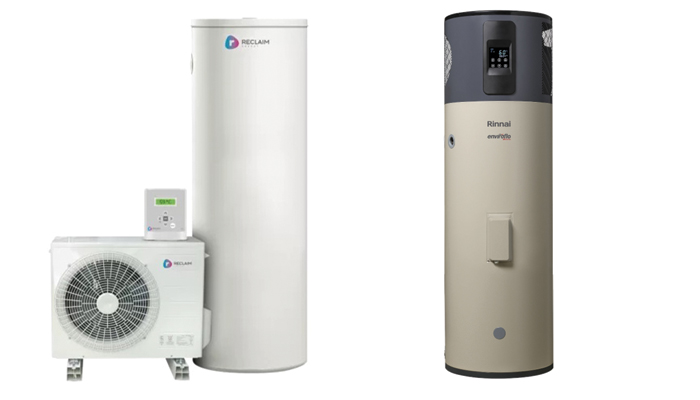
Units are usually integrated (tank and compressor together) but can also be split (separate tank and compressor). They need to be installed in a well-ventilated area, usually outdoors, and the unit compressor can be noisy, like an outdoor air con unit.
An example of a split-system heat pump (left) and an integrated unit (right).
Heat pumps tend to work best in warm and temperate regions, but most are able to run effectively in cold weather, and some are specifically designed for cold climates. Most systems have a booster element for days of cold weather or high demand.
Most systems have an integrated timer, so that you can set it to run at optimal times, i.e. during the day when ambient air is warmest and your solar panels (if you have them) produce cheap electricity.
Price range: $3000–$7000 fully installed. More expensive units are typically more efficient, quieter and can heat water faster.
Tank size for 4-person household: Approximately 270–315L tank. Tank sizes generally range from 125–400L.
Pros:
Very energy efficient
Low running costs (virtually free if powering with solar energy)
Easier to install than thermal solar hot water systems
Cons:
Cheaper units can be noisy so don’t install too close to your neighbours
Fairly expensive (can be double the price of a standard electric system)
3. Conventional electric hot water and solar PV diverters
If you’re after an option with smaller upfront costs, you might consider a conventional (resistive) electric heater and use your solar-generated power to run it.
These older-school heaters are definitely not as efficient as a heat pump, but if you’re generating ample solar, that might not matter as much to you. Of course, doing so leaves less spare electricity for other uses, so it depends on your priorities and budget.
To optimise efficiency, you can set your electric heater to a timer so it only operates during the day when solar is generating (or if your retailer offers free day-time electricity as some have started to do).
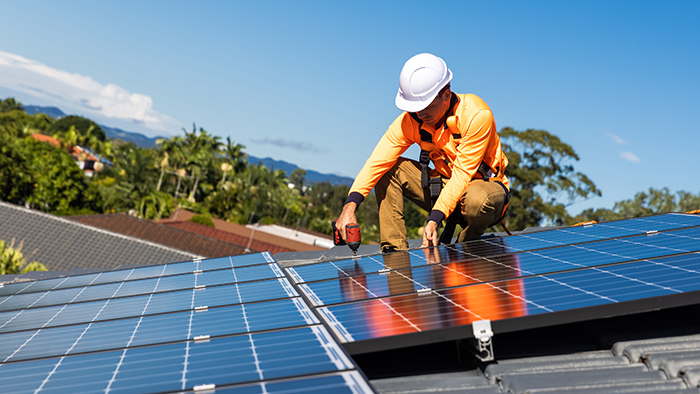
Using solar to heat your water can greatly reduce your power bills.
Another option here is to use a solar diverter, which directs excess electricity generated from your photovoltaic (PV) solar panels to your hot water system.
Usually this surplus power is exported to the grid, and you’re paid a feed-in tariff (FiT) for it. However, with FiTs rapidly dropping over time, it may be more cost-effective to use some of the excess power in your hot water system.
Note that this method assumes there’s enough excess solar power to run the hot water system as well as your household appliances.
Price range: $2000–$3000 fully installed (plus $1000–$2000 for a diverter)
Tank size for 4-person household: 160L–250L (250–315L if choosing to use off-peak electricity).
Pros:
Cheaper to buy and install
Can run on off-peak electricity if you don’t have solar
Cons:
Less energy-efficient so higher power bills (unless running on solar)
Note: With home battery uptake increasing thanks to the federal government rebate, diverters are becoming less common these days, as residents choose to store surplus solar power in batteries instead. Consider this during your research and see if a diverter still works best for your home.
Using solar-generated electricity is a great way to cut water heating costs.
Payback times for solar hot water
Most households switching from a gas or electric tank system to a thermal solar or heat pump setup should find that their hot water costs drop by approximately 70–80%.
But exact payback times can vary a lot, because they depend on your individual home, the system you’re replacing and (of course) the size and price of the new solar or heat pump hot water system.
Your water usage too is obviously critical to the equation. The more hot water you use, the more you benefit from cheaper hot water, so payback time is reduced.
For example, if you’re a big household that takes lots of long showers or baths, your system could be paid off in as little as three years. However, if you’re a two-person household that takes brief showers, it could take 10+ years.
That said, here’s a rough guide if you’re changing over from electricity or gas.
Replacing an electric hot water system
Running an electric storage tank hot water system can make up a quarter of your electricity bill.
If you replace an electric hot water system with a solar or heat pump hot water system, the new system’s cost savings will probably pay for itself in about five years or less (for a four-person home that uses a fair bit of hot water – payback may take longer for homes that use smaller amounts of hot water).
Replacing a gas hot water system
Changing from a gas system to a solar or heat pump hot water system usually takes longer to pay itself off, because gas is actually quite an efficient way to heat water.
For small households with relatively low hot water consumption, a continuous flow (instantaneous) gas hot water system is often relatively cheap to install and run.
Of course there are other considerations around gas hot water systems; you might be aiming to get your home completely off gas for environmental and long-term cost reasons.
Unfortunately it can be a bit more complicated to replace a gas system with an electric heat pump one. For example, new electrical circuits or connections may be needed as part of the installation.
Unfortunately it can be a bit more complicated to replace a gas system with an electric heat pump one
Likewise, an instantaneous gas hot water system might not be easily replaceable by an instantaneous electric or a heat pump system (an equivalent instant electric system might need three-phase power, and a heat pump system needs space for the tank and compressor).
You can estimate the cost savings for replacing your gas hot water system by looking at your gas bills. A solar hot water system will probably reduce them by about 60% or more, depending on how much of the gas bill is due to hot water (if you have ducted gas heating in your home, for example, that may be a much bigger factor in your gas bill than the hot water).
The payback time for gas hot water systems is generally 5–10 years.
While federal discounts for solar panels and home batteries are well publicised, you might not know that you can also get them for solar or heat pump hot water systems. Note: technically speaking, these discounts aren’t rebates, but they are commonly called this by installers and the public.
Some state and territory governments also offer their own incentives, which can be combined with the federal ones. Some have limited numbers though, so do your research.
Operating under the wider Small-scale Renewable Energy Scheme (you can see why people just call it a “rebate”), STCs offer a financial incentive with a dollar value you can ‘earn back’ as a discount.
The number of STCs you can get for your solar or heat pump system depends on a number of factors: your location, the specific model and its efficiency, and the projected energy savings.
In most cases, the easiest way to use STCs is to sell them to the company supplying your new hot water system – they usually ‘pay’ you by discounting the system you’re buying.
The federal heat pump rebate can save you $600–$1000 on installation.
The discount is usually included in the quoted price, but make sure their quote is clear about that. You can also trade the STCs yourself, but it’s trickier and might not be worth the effort.
The market price for STCs is currently around $35–$40, so you can get around $600–$1000 back at the moment depending on the above factors.
Different suppliers may quote different amounts for STCs, which is another reason to get multiple quotes.
State government incentives
In addition to federal STCs, some state governments operate energy-efficiency incentive schemes that can make your hot water system cheaper.
To find incentives and rebates for hot water systems, visit the federal government energy website. Select the state you live in and select ‘hot water’ as your area of interest. Or, just contact your state government.
Some manufacturers and suppliers also have rebate calculators on their websites.
Installing a solar thermal hot water system can be more complex and time-consuming than a conventional electric or gas system, so if your old heater has just carked it, it’s probably not a viable option unless you’re OK with taking cold showers for weeks while your new system is installed.
A heat pump hot water system is easier to install, as it’s often situated and plumbed in just like other outdoor electric tank systems.
Solar hot water panels need a section of roof with good access to sunlight, preferably facing north for maximum exposure. With a thermosiphon system, the roof might need reinforcing as it has to bear the load of the water tank. And if the roof is difficult to access, the supplier might charge more for installation.
Check with your local council about building regulations. Councils probably won’t object to you installing a solar hot water system or heat pump, but there may be restrictions.
For example, noise regulations cover the noise from a heat pump hot water system. The installer should know the relevant regulations but it’s still worth checking with them – you don’t want to end up in a dispute with your neighbour over a noisy heat pump.
Maintenance
Solar and heat pump hot water systems should run without problems for years, and in most cases they should not need significantly more maintenance than a regular hot water system. An inspection every five years is worthwhile (just as it is for a regular hot water system).
The cost for inspecting and maintaining a solar hot water system may be a little higher, as the tradesperson will need to get onto the roof to check and clean the solar collectors and connections.
Just as with any hot water system, there are parts such as pressure valves and sacrificial anodes in the tanks that may need occasional replacement. A full service will likely cost $300–500 depending on parts and labour.
Suppliers usually need about 30 minutes to visit and assess your home. Retail suppliers are often connected with just one or two brands, but most brands have a wide range of products, so suppliers should be able to quote on a range of different types and models.
As always, get quotes from at least three suppliers to ensure you get the best service. That might sound like a chore, but it’s worth it to get a range of prices and recommendations on the best way to install the system.
Questions the supplier should ask you:
How many people live in the house? How much showering and hot clothes washing do you do each day, and what time of day do you do it?
What sort of hot water system do you currently have?
Is gas connected to the property?
Questions you should ask the supplier:
Is installation included in the quote?
How long will it take from placing the order to completion?
How many STCs does the system qualify for? Is STC buyback included, and at what price for the STCs?
Can they help you with other government rebates?
Is it better to get an integrated heat pump or a split-system?
How loud will it be and where can it be installed so as to not annoy neighbours?
Chris Barnes is a Senior Project Officer. He manages the product reviews that are done outside of CHOICE with external labs or data sources. This includes solar panels, electric heaters, air purifiers and detergents. Chris also manages our testing services through our commercial arm, Test Research, and he is CHOICE's NATA authorised representative for our lab's formal accreditations. Chris is involved with the standards committee for air conditioners. And he works with government and industry in areas such as product safety and regulation. In over 20 years at CHOICE, Chris has managed lab teams for a wide range of products, including children's products, kitchen appliances, laundry appliances, garden power tools and more. Chris has a Science degree from the University of Sydney. LinkedIn
Chris Barnes is a Senior Project Officer. He manages the product reviews that are done outside of CHOICE with external labs or data sources. This includes solar panels, electric heaters, air purifiers and detergents. Chris also manages our testing services through our commercial arm, Test Research, and he is CHOICE's NATA authorised representative for our lab's formal accreditations. Chris is involved with the standards committee for air conditioners. And he works with government and industry in areas such as product safety and regulation. In over 20 years at CHOICE, Chris has managed lab teams for a wide range of products, including children's products, kitchen appliances, laundry appliances, garden power tools and more. Chris has a Science degree from the University of Sydney. LinkedIn
For more than 60 years, CHOICE has been fighting the good fight for Australian consumers.
In the past year alone we've uncovered systemic issues with sunscreens, investigated shonky supermarket pricing, fought for stronger scam protections and helped make complex energy pricing fairer and clearer.
CHOICE is here to provide unbiased advice and independent testing in our world-class labs. We buy the products we test, just like you do, and our expert reviews are influence free. We’re here to help you choose smarter. Hopefully you’ll also save some money along the way.
Thanks to CHOICE, you’ll never be alone when a business treats you unfairly. You can support our work by joining or donating to our cause.