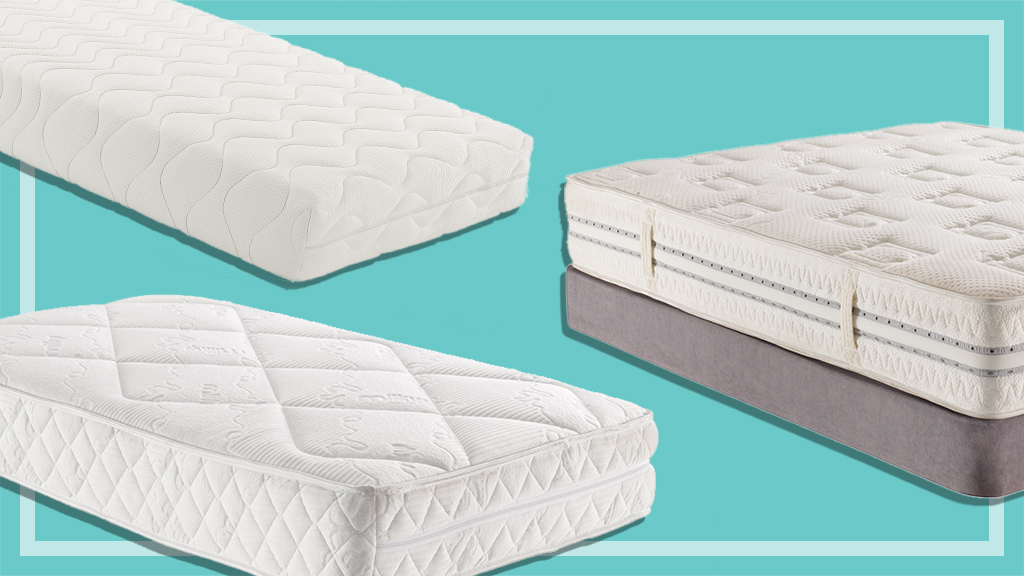
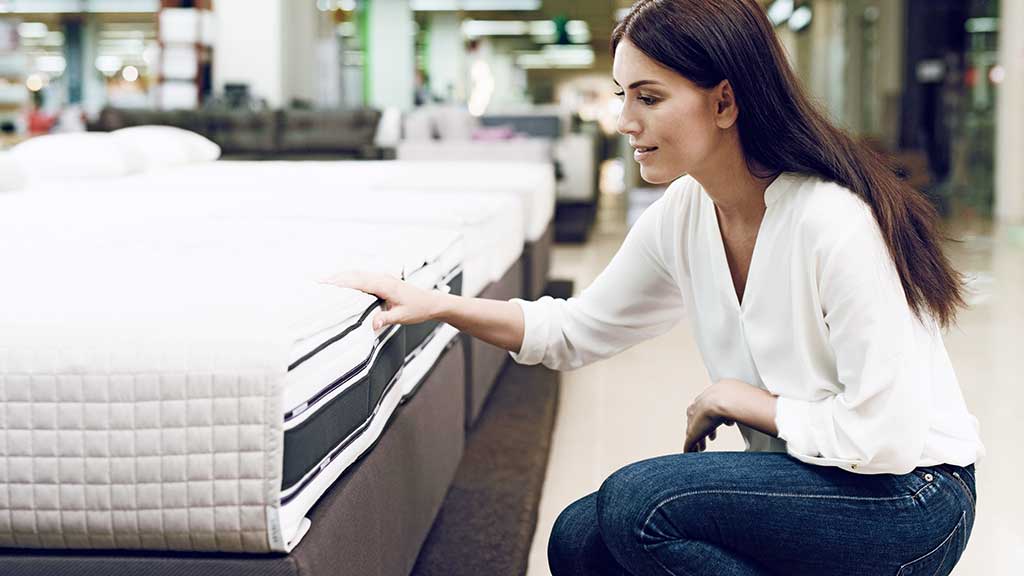
Five minutes of feeling things out on a bustling show floor won’t help you figure out which brands and models are comfortable and long lasting.
We can help you work out what type and size of mattress is best for you, and even how you can save 50% or more on your next purchase.
Choosing a mattress to suit your sleeping position
Comfort is subjective, but understanding mattress firmness and different mattress types will help you narrow the field when it comes to testing a mattress instore.
How firm should a mattress be? It all comes down to your preferred sleeping position.
If you sleep on your stomach… a firm mattress will keep your spine aligned.
If you sleep on your back… a medium mattress will provide support for your spine, back and neck while keeping you comfortable.
If you sleep on your side… a soft mattress will support and contour your body’s curves.
Adjustable firmness explained
Some mattress-in-a-box models also offer adjustable firmness. This means that you can configure the feel of the mattress at home with minimal effort most of the time.
The way it works depends on the brand, but they tend to use one of three techniques. The most common design is a flippable mattress topper with a firmness option on each side (usually soft and medium or firm). It sits between the cover and the mattress so you can pull it out and turn it over.
The second approach is similar, but each side of the mattress has a different feel. So instead of removing and turning a topper you need to flip the whole mattress which is a lot more work.
Finally, there’s ‘layered firmness’. Here, the manufacturer supplies two or more foam layers of varying densities, which you add or remove until the mattress feels right. For example, one layer will make it feel soft, two will give a medium feel and so on. Like a topper, they sit between the mattress and the cover.
A few brands take this one step further by adding firmness zones for double, queen and king-size mattresses. These let you adjust the firmness for the left and right side of the bed, so the two people using it can set their preferred firmness.
If you’re a side sleeper, a soft mattress will support your body’s curves.
Which type of mattress is best?
It really depends on your personal preference. For example, you may find a spring mattress supports your spine while a foam finish feels a bit too solid.
We explain the pros and cons, and price range, of different mattress types to help you make an informed decision.
Coil (aka spring) mattresses
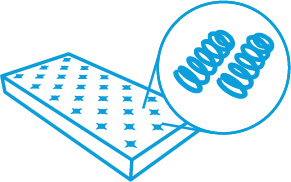
There are five types of coil mattresses.
Bonnell: the classic hourglass spring design with a closed/wired off end. All the coils are interconnected and designed to work as a single unit to provide a broad, continuous level of support.
Continuous: springs are made from a single piece of interconnected wire to improve stability and extend durability, but at the expense of comfort.
Light spring: a similar design to Bonnell, however the end of each spring is left open.
Offset (aka left-facing knot): another hourglass coil spring design, but with a flat top and bottom that’s held together with coiled wires. This claims to improve support and stability and reduce sagging thanks to better contouring around your body.
Pocket: the most common spring type to come through our labs. Each one is wrapped in material (pocketed), often contains smaller coils and is designed to operate independently for improved support and contouring.
Price
Between $200 and $10,000*.
Pros
They’re typically cheaper.
Good air circulation, which helps the mattress feel less stuffy and can improve comfort.).
Good support by distributing your body weight evenly.
They can support two people of two different body weights well if the springs are separate (e.g. pocket springs).
Cons
They can wear out quickly.
Because some springs move as one unit the mattress is less responsive to your body.
Any tossing and turning is likely to disturb a partner.
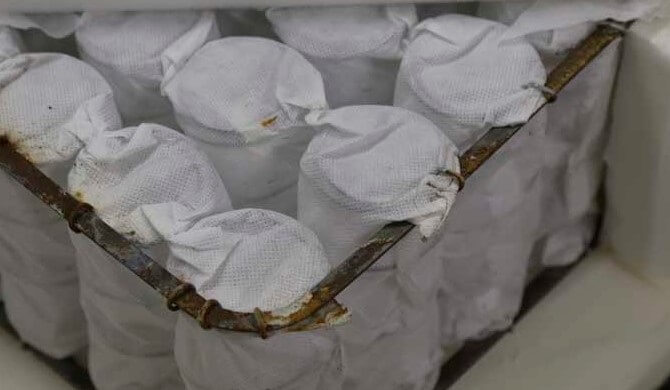
The springs can rust.
* Typical retail price for a queen-size mattress.
Foam mattresses
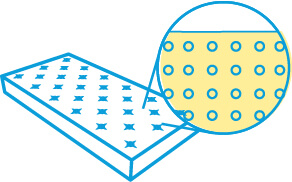
Made of various layers of polyurethane foams of varying grades.
Price
Between $300 and $6500*.
Pros
They absorb your weight as you sink in, taking pressure off your joints and increasing circulation.
They can mould to the shape of your body.
No risk of rust (if foam only).
Usually lighter than spring or latex.
Cons
They can make you feel ‘encased’.
They can feel too solid and dense (not springy), which isn’t likely to please someone wanting a softer, more cushioned night’s sleep.
They can get warm easily due to limited air circulation, which can make the bed feel stuffy and less comfortable, particularly in hot climates.
They tend to absorb more sweat and other bodily fluids compared to spring, which can cause damage and odour buildup over time.
* Typical retail price for a queen-size mattress.
Latex foam mattresses
Natural or synthetic latex that moulds to body shape. Some models use a combination of both.
Price
Between $1000 and $4900*.
Pros
Durable and breathable.
Better for people with allergies.
They don’t gather dust mites.
Cons
They have a solid feel, so they’re not likely to please someone wanting a softer, more cushioned night’s sleep.
They can be cumbersome to move due to their weight and heft.
Cheaper versions can get lumpy after a time.
They tend to absorb more sweat and other bodily fluids compared to spring, which can cause damage and odour buildup over time.
* Typical retail price for a queen-size mattress.
Hybrid mattresses
These combine elements of memory foam and spring mattresses, and as such have the same pros and cons.
This type of mattress was first brought to market in recent years in response to the often eye-watering mark-ups made on mattresses sold in bricks-and-mortar stores.
Mattress-in-a-box (also known as bed-in-a-box) is an online-only mattress industry. Manufacturers cut out the middleman by selling directly to the consumer, and they deliver compressed mattresses to your door. The mattresses are deoxygenated and enclosed in vacuum-sealed packaging, making it possible to be transported in a box, which earns them their nickname. Once open, the mattresses slowly expand to their full size.
Through our testing we’ve found that a mattress that costs $1000 can be just as comfortable as one priced at $6000
A mattress-in-a-box is generally cheaper than a conventional mattress, costing around a thousand dollars for a queen-size model (compared to many thousands for a regular instore mattress). Through our testing we’ve found that a mattress that costs $1000 can be just as comfortable and perform just as well over its lifetime as one priced at $6000.
To contend with the uncertainty many people might feel buying a mattress online without being able to physically try it out, mattress-in-a-box brands offer trial periods that can extend up to 120 days along with warranties up to 15 years. If you don’t like the mattress, you can often return it easily at no extra cost.
Brands that have had success in this market, and whose products we’ve tested, include Sleeping Duck, Koala, Ecosa and Sleep Republic.
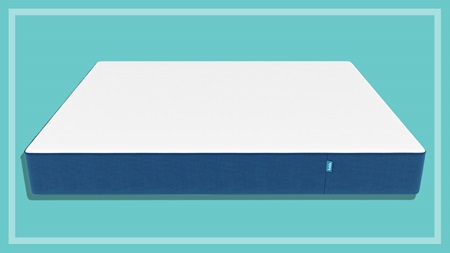
Mattress-in-a-box beds are usually made of foam or foam-like materials. Pictured: Koala mattress.
What size mattress do you need?
Retailers and manufacturers recommend buying the largest bed your room can accommodate, and the length of the mattress should be at least 10–15cm longer than the tallest person sleeping on it.
Mattress size
Measurements (width x length)
Single
92 x 187cm
Long single
92 x 203cm
King single
106 x 203cm
Double
137 x 187cm
Queen
153 x 203cm
King
183 x 203cm
Testing a mattress instore
Traditional mattress retailers like Forty Winks, Snooze and Harvey Norman sell mattresses from a variety of third-party manufacturers along with their own brands. Most have a spring core, with some foam and hybrid options available. Here’s how you can make the most of your time instore.
Take your time
Most people need seven to nine hours of sleep a night. A couple of minutes on your back won’t come close to replicating this experience. Lie down for as long as you need (though you probably shouldn’t spend the night…)
Move about
Roll over, sit up, get in and out of the bed. Ease of movement contributes to comfort. It will take more effort if the mattress is too soft, and will feel uncomfortable on your hips and shoulders if it’s too firm.
Sleep on slats (or a base)
Make sure the bed base in the shop is similar to the one you have at home. If you have fixed slats or a hard surface, a soft mattress will feel very different on top of that, rather than the ensemble base it’s resting on in the shop.
Bring your partner
If you share a bed with someone regularly or every night, bring them along and ask them to lie in the bed and move around. Be aware of how the bed moves on your side when your partner moves.
Ask the salesperson to leave
While they may be friendly and helpful, few of us are able to really relax when someone is hovering around.
Ask questions about the display model
The mattress you test instore could have been on display for two days, two weeks or even two months, with hundreds of customers potentially trying them out over that period. This will affect sag, firmness, support and more.
Ask if there’s a comfort guarantee
Most manufacturers don’t offer a guarantee on comfort, so you probably can’t return it if it doesn’t feel right. That said, there are a few brands that do, so it always pays to ask. Jump to ‘Can you return a mattress?’ for more info.
Lift it up
Lift up the display model to gauge the weight. Some mattresses are quite heavy which can make it difficult to fit sheets, transport, flip and roate, especially if you’re doing it alone.
Take your time when buying a mattress instore, and don’t be afraid to ask the salesperson to leave you to it.
5 tips for getting the best deal on a mattress
Retailers leave a significant amount of wiggle room in the listed price. In fact, you’re getting ripped off if you settle for the RRP.
We shaved at least half and even two-thirds off the asking price while shopping for most of the mattresses in our tests by using these five tricks.
1. Wait for a sale
They take place regularly and can bring the price down by as much as 50%.
2. Head instore
Deals are generally better instore than online.
3. Haggle
Mattress mark-ups are so high we rarely encountered a salesperson who wasn’t willing to shave a few hundred dollars off the asking price, even during a sale. It may seem daunting, but it can be as simple as asking, “What’s the best you can do?” after a little back-and-forth with the salesperson.
4. Buy in bulk
Our discounts improved when we bought at least two beds at once, which may be handy if you’re refurnishing a house.
5. Consider exclusive ranges
Retailers such as Snooze, Forty Winks and Fantastic stock exclusive brands. We found that salespeople are much more inclined to sell these over third-party brands. Snooze, for example, offered us a much better discount on their exclusive Madison range when we expressed interest in buying a Sealy.
Should you buy a mattress-in-a-box or go to a store?
There are some advantages to buying your mattress-in-a-box online. They can be cheaper cheaper and online shopping with home delivery is much more convenient.
Plus almost all brands let you assess the mattress after purchasing. If you don’t like it you can return it for a refund making the purchase more or less risk free, and there’s no pressure to buy.
Stores, meanwhile, involve a lot more pressure. Salespeople hover, so you’re unlikely to get more than five minutes on the bed before they come back to bother you. You can’t change your mind once it’s used, for example, as there’s generally no trial period.
Retailers leave a significant amount of wiggle room in the price. In fact, you’re getting ripped off if you settle for RRP
That said, you can only try before you buy instore. Sure, mattress-in-a-box brands have a trial period but sending one back can be a big hassle. Also, stores offer a much larger range from multiple brands under one roof which makes direct comparison much easier, and they typically stock multiple materials and builds such as spring, memory foam and latex. You have a clearly defined point of return if something is faulty and, most importantly, you can haggle.
Online-only mattress-in-a-box brands require a lot of consumer faith. You have to hope the product lives up to its claims and there’s no way to try it without laying down your hard-earned cash. Plus, most mattress-in-a-box models are made of foam, with very few spring or hybrid options around. If foam isn’t your thing, then your options are limited.
Mattress manufacturing changes
Mattress manufacturers sometimes make minor to moderate design tweaks to their products while continuing to sell them under the same name. It’s why we retest some mattresses, with the release year noted in our test results.
Keep this in mind if you’re buying a new mattress based on previous experiences. It’s always worth checking our mattress test results to see if updates have occurred and if so, how these changes have affected performance.
How long should a mattress last?
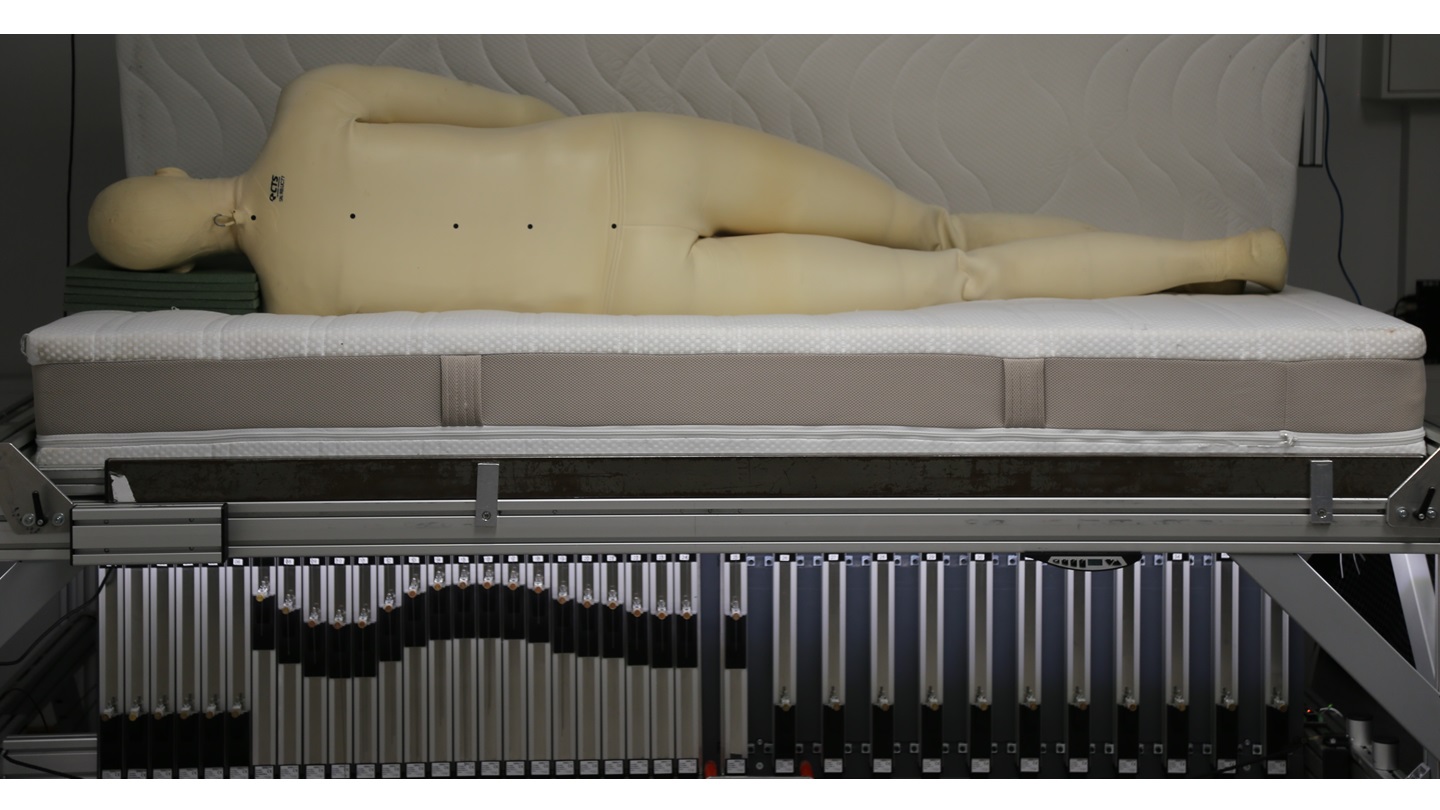
You should replace your mattress every eight years regardless of the build and material. That’s why our support measurement tests simulate eight years of use. That said, there are other indicators you should consider on top of manufacturer guidelines.
It mostly comes down to comfort and feel. If your mattress has significant sagging, signs of lumps or it just doesn’t feel supportive anymore then it’s probably time to replace it. Aches and pains after a night’s sleep can be a good indicator.
Also, give it a whiff every now and then. Humans shed all sorts of things including hair and skin, and we sweat everywhere and gather grit, grime and dirt during everyday activities. If the mattress is starting to stink or there are permanent stains and general indications of wear and tear, get a new one. An occasional vacuum probably wouldn’t hurt either.
Is a mattress protector worth it?
A mattress protector is essentially a fitted sheet designed to help protect the bed to keep it feeling ‘fresh’ for longer. It can prevent damage and stains from things like dirt, skin flakes and hair from being absorbed into the mattress, and most also have material to stop sweat and spills from seeping through. Some claim to stop dust mites and allergens as well.
Mattress protectors are generally a worthwhile investment as they can help extend the life of your mattress. They can keep body gunk, grime and fluids off the mattress, and they’re much easier to clean than the mattress itself. The extra layer can also help with warranty claims. Mattress warranties don’t cover stains, and this is often used as an excuse to void the warranty for unrelated issues. A mattress protector can show that you took extra steps to protect your purchase.
You can also use a mattress protector with an electric blanket. Almost all manufacturers agree that putting the protector over the electric blanket is the safest thing to do.
This can be tricky, because arguments regarding comfort, faults and more can be considered subjective, or part of ‘normal wear and tear’. And while most mattresses have a 10-year warranty period, the fine print is often overflowing with restrictions and conditions.
Most mattresses have a 10-year warranty period, but the fine print is often overflowing with restrictions and conditions
Take Sealy for example. While the warranty covers manufacturing faults, it won’t protect against “normal body indentations (less than 32mm), issues relating to comfort choice and issues relating to heat. These are just some of the terms, but they illustrate the grey areas consumers can find themselves in.
Returning a mattress you bought instore
The onus largely falls on you, the buyer, to make the right purchase if you’re buying from a traditional retailer, even when the industry practices are questionable. Because mattresses are used in the same manner as clothes and headphones, getting a refund under general consumer protections can be difficult.
These generally only cover the mattress being unfit for purpose, which is unlikely to include:
One of the mattresses we bought from our test arrived with rust around the frame. This is reasonable grounds for a return.
Returning a mattress-in-a-box
Almost all bed-in-a-box brands offer a free trial period, and you can return the mattress for a refund within this time if you don’t like it. Returned beds are typically donated to charity.
But to do this, you must adhere to these general terms to be eligible.
Duration: Make sure you apply for a refund/return within the allocated period.
Minimum use period: Many brands also specify a minimum usage period before you’re eligible for a return, so you can take time to properly assess the mattress. This is usually 30 – 100 nights
Damage: You won’t be able to return a mattress if it’s damaged, sunk, stained or torn. It’s worth treating your mattress like fine china, keeping it well away from food and drink, and making sure you’re clean as a whistle when it’s time for bed.
Protection: Almost all brands specify that you must use a mattress protector during the free trial period. Check the ‘free trial’ page on the company’s website to find the specific terms. The so-called free trial period may incur a return fee depending on where you live, and how the manufacturer handles returns.
Returns based on your location: Major cities and urban centres are eligible for free returns in many cases but regional collections often require you to do some of the leg work (e.g. take it to a collection partner) or pay a fee. Some brands are flat out ambiguous so always check the returns policy before buying and contact customer service if your location isn’t specifically covered.
Service dependent: Companies will either send their own crew, a courier, or a representative from the charity they’ve partnered with to collect the mattress. You may have to organise your own courier if the brand can’t make it to your location, which will result in additional costs. This is usually determined during the return process.
Occasionally you’ll encounter brands that charge an exchange fee on top of the pickup costs.
We’ve identified the best mattress brand based on our test results and feedback from our members. With almost 50 years of testing experience behind us, we can confidently tell you which ones are comfortable, stable, long-lasting and nice and cool for warm sleepers.
Feedback from our members helps us understand how mattresses perform in the real world. Comfort is subjective and this feedback is a valuable addition to the technical tests we perform in our labs.
Best mattress brand for 2025: Ecosa
Ecosa is the best mattress brand for the past 12 months. Many of their mattresses have performed well in our tests and Ecosa owners are very satisfied according to our CHOICE Product Reliability Survey.
To find out which specific mattresses we recommend, click on the ‘Recommended’ box in the filters section of our mattress reviews. We also reveal which ones won’t give you a good night’s sleep.
Best mattress brand 2025 scores
Ecosa 76%
Koala 75%
Ikea 69%
A.H. Beard 66%
Sealy 64%
SleepMaker 62%
It’s important to note that the performance of specific product models may vary quite significantly, so don’t assume that one brand’s products are the best across the many different features, functions and price points.
What are CHOICE Best Brand recommendations?
The Best Brand recommendation for mattresses is based on our test results for models tested from 2017 to 2025, as well as customer satisfaction and reliability information submitted by CHOICE members about their experience with the brand.
The recommendation is given to companies with a clear lead over their competitors during the test period, and no more than two recommendations are given during each period.
Best Brand eligibility is tough – to be considered, we must have tested a minimum of five models, and a brand must have received a minimum of 50 responses to the CHOICE member survey. Additionally, brands must be above the average score for their products’ CHOICE Expert Rating, and the brand’s overall reliability and satisfaction for consideration.
How we calculate the best mattress brand
How we calculate the best mattress brand
The following criteria determines the Best Brand recommendation.
Average test score – 40%
Brand reliability – 30%
Customer satisfaction – 20%
Recommended ratio – 10%
Average test score
This is an average of the CHOICE Expert Rating (our overall score) for all the brand’s models that we tested. The CHOICE Expert rating covers:
comfort score when the mattress is brand new (male and female average)
comfort retention score after eight years
stabilisation
sagging
sweat repellent
usage wear/damage
Brand reliability
Our CHOICE customer insights team surveyed over 1700 people about whether they’ve run into any problems with their mattresses in the past 12 months.
Customer satisfaction
Our survey also asks how satisfied members are with their mattress, including the repair/return process. So, even if a mattress has a fault after six months, it’s still possible for it to have a high satisfaction score – perhaps the company has customer service that goes beyond expectations, or the product is simply too good, despite some performance quirks.
Recommended ratio
We calculate the percentage of mattresses that we recommend for each brand. The greater the number of models that earn a recommendation, the higher the recommended ratio score.
Number of models tested: Ecosa 5. Koala 7. Ikea 16. A.H. Beard 15. Sealy 22. SleepMaker 11.
Number of recommended models: Ecosa 2. Koala 2. Ikea 3. A.H. Beard 3. Sealy 0. SleepMaker 0.
How to throw away an old mattress
Replacing a mattress also means that you need to throw the old one away. You can take it to the tip or hire a rubbish removal company to collect it. However, these can be expensive options as tips typically charge a flat rate to dump a mattress.
Many councils will collect mattresses for free under household cleanups (aka council cleanups). But if you live in an area with scheduled collections rather than collections upon request, then you’ll need to put up with an old mattress hanging around for a couple of months.
Landfill may be the only option depending on your location, but did you know that you can recycle your mattress as well? These services operate across the country and offer a much more sustainable approach to putting your old bed to rest.
Soft Landing is a national social enterprise with the goal of keeping mattress waste out of landfill. They’ve partnered with a number of well-known mattress manufacturers to achieve this, and they’re endorsed by state and territory governments.
You can take your mattress to one of several drop-off points or organise a collection in many areas of New South Wales, Victoria, Western Australia and the ACT. Fees typically start at $50 for one mattress, then $35 for each one after that.
According to their website, up to 75% of the materials are recycled and repurposed for other uses. For example, foam can be turned into carpet underlay, springs become roof sheeting, material is used in acoustic panelling and timber is turned into mulch, kindling and animal bedding.
If you live in Queensland, South Australia, Tasmania or the Northern Territory, then head to the Recycling Near You mattress database. This is a one-stop shop for recycling information run by Planet Ark. Just pop in your postcode and the website will list all mattress recycling options in your area.
If Recycling Near You doesn’t return any results, contact your local council to make sure as the database may not be up to date.
Peter Zaluzny is a Content producer in the Digital home team. He covers everything from home entertainment and personal safety devices to tech for your car and mattresses.
Peter enjoys cutting through the nonsense to help people understand the products they’re considering to buy. He helps consumers make educated, informed decisions.
Peter has a Bachelor's degree in Journalism and a Bachelor of Arts from the University of Wollongong.
Peter Zaluzny is a Content producer in the Digital home team. He covers everything from home entertainment and personal safety devices to tech for your car and mattresses.
Peter enjoys cutting through the nonsense to help people understand the products they’re considering to buy. He helps consumers make educated, informed decisions.
Peter has a Bachelor's degree in Journalism and a Bachelor of Arts from the University of Wollongong.
For more than 60 years, CHOICE has been fighting the good fight for Australian consumers.
In the past year alone we've uncovered systemic issues with sunscreens, investigated shonky supermarket pricing, fought for stronger scam protections and helped make complex energy pricing fairer and clearer.
CHOICE is here to provide unbiased advice and independent testing in our world-class labs. We buy the products we test, just like you do, and our expert reviews are influence free. We’re here to help you choose smarter. Hopefully you’ll also save some money along the way.
Thanks to CHOICE, you’ll never be alone when a business treats you unfairly. You can support our work by joining or donating to our cause.