Do you have a system for stacking your fridge, or do you just jam food in wherever it fits? A well-organised fridge can have a big impact on your energy bills, how long your food lasts and even how it tastes, so it’s worth considering your method next time you’re putting away the shopping.
Even the best fridge will have warmer and colder sections, but different types of food do best at slightly different temperatures so, with some planning, your food will not only be easier to find, but you can make it last longer.
Eggs
The plastic egg holders that came with your fridge are not all they’re cracked up to be. Eggs should be stored in their original carton: it keeps them safe, slows moisture loss, stops them absorbing food odours (egg shells are porous enough to do that) and helps you keep track of the use-by date.
Keep eggs refrigerated until you’re ready to use them. Fresh eggs should keep well for about a month in your fridge.
Cooked eggs
You may be able to put cooked eggs in the fridge, but it depends on how they were cooked. You can refrigerate fried eggs for a while, but they won’t be very nice. Scrambled eggs will fare a little better, but you’ll have the best luck with boiled eggs.
Hard-boiled eggs will keep for up to a week in your fridge. You should refrigerate them as soon as they’re cool, and definitely within two hours of cooking. Eggs that have been at room temperature for between two and four hours are safe to eat immediately, but they shouldn’t be stored – even in a fridge – because of the increased risk of bacterial growth and salmonella poisoning.
Eggs are best stored in their original carton and should keep well for about a month in the fridge
Keep boiled eggs in their shells when refrigerating them to stop them drying out, and because eggs can absorb odours, keep them in their original carton or a sealed container.
You can refrigerate shelled eggs in a bowl of water or a sealed container with a damp kitchen towel in the bottom. Change the water/damp towel daily until you use the eggs.
And because boiled eggs don’t last as long as fresh eggs, give them a good sniff before you use them – if they smell strongly sulphurous, then they’re probably off and should be thrown out.
Egg yolks
Say you’re making a meringue with lots of egg whites, but you don’t want to waste the yolks. You can make mayonnaise with them, but you don’t need to do it right away – they’ll last two to four days in the fridge, or up to 10 months in the freezer.
Egg yolks become gelatinous and hard to use when frozen, but you can avoid this by adding salt or sugar. Beat in one teaspoon of salt or one tablespoon of sugar for every six yolks, then tightly seal them in a container before freezing.
Remember to label the container so you know what’s in it (number of eggs, ‘salty’ or ‘sweet’) when you stumble across it a few months later. Defrost them in the refrigerator or under cold running water just before you use them.
Egg whites
Freezing egg whites is easier than freezing yolks. Simply pour them into an ice-cube tray and pop them in the freezer. Once frozen, seal them tightly in a ziplock bag or container (remembering to label the number of egg whites). You can store them for up to a year.
Fruit and vegetables
The crisper drawer, found at the bottom of most fridge compartments, is designed to keep your fruit and vegies fresh. A good crisper should be cool and well-sealed, which means it won’t be as dry as the rest of the fridge, so your vegies should stay fresh for longer. Check that the fridge’s air outlets don’t blow into it as this will dry them out faster.
Contrary to popular belief, your tomatoes don’t belong in the fridge. Keeping them in a fruit bowl on the counter keeps them bursting with flavour. See our fruit and veg freshness guide for more tips.
Bread
Refrigeration keeps food fresher for longer, right? Well not when it comes to bread, which should be kept well wrapped at room temperature.
Apart from moisture loss, one of the contributing factors to bread going hard and stale is the starch from the wheat forming (or rather, reforming) into crystals, which happens quicker in cooler temperatures. You’ll go from tasty baguette to inedible brick much faster in the fridge.
However, freezing bread dramatically slows this process down, so it can be safely stored in the freezer for longer periods.
If you’re like 99.95% of us, then you keep your milk in the door of the fridge, right at the front. It’s super convenient and keeps the bottle upright, helping prevent messy leaks, but the door shelves can be warmer than ideal for keeping milk (which is best stored at or below 4°C). If you want your milk to last longer, keep it in a colder place in the body of the fridge.
Butter
Butter should go in the fridge and if your fridge has a dairy compartment, you should use it – it’s slightly warmer than the rest of your fridge so your butter will be easier to spread. The fats in butter also absorb taste and odours from nearby foods, so the handy cover helps keep your butter tasting like, well, butter.
Cheese
As with butter, storing cheese in a dedicated cheese keeper will keep it closer to serving temperature. The cover also means your cheese is less likely to pick up odours from the rest of the fridge (or make everything else in your fridge smell of cheese).
That said, the slightly warmer temperatures mean your cheese won’t last as long, especially if it’s a soft cheese, which can be prone to listeria contamination. So if you’re not going to eat it straight away, keep your cheese in the main fridge compartment, where it’s cooler.
Cling wrap can cause cheese to sweat
Because cheese absorbs odours, it’s important to keep it covered, but cling wrap can cause cheese to sweat. Instead, keep it wrapped in the special paper it came in, or, failing that, baking paper, as this will allow the cheese to breathe a bit better. While hard cheeses are a little more robust, this is especially important for soft cheeses.
Once wrapped, seal your cheese in an airtight container with a single sugar cube in the corner. The sugar will act as a desiccant, absorbing moisture from the cheese to minimise sweating.
Can you freeze cheese?
Although hard cheeses can get away with a bit of time on ice, the freezing process plays havoc with soft cheeses because of their delicate nature and higher moisture content. So feel free to freeze a tightly wrapped block of supermarket cheddar, or even shredded cheese. But it’s best not to freeze a fine brie – you’ll ruin the taste and texture.
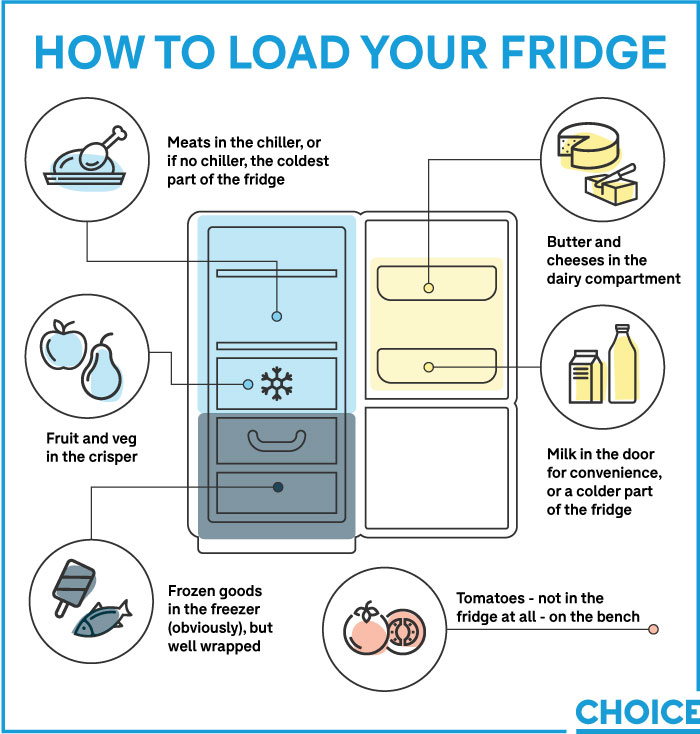
Meat and fish will keep for longer and stay in better condition if stored at around 0°C. That’s colder than your fridge’s main compartment, so store them in a chiller if you have one – it’s designed specifically for colder temperatures and isolates its contents, helping to prevent cross-contamination of bacteria and odours. Chillers also keep spills contained.
Don’t have a chiller? Then aim for the coldest part of your fridge. You can check where that is with a thermometer, but generally it’s the area at the back which is less susceptible to warm draughts when the door is opened. And consider freezing those steaks if you’re not barbecuing in the next few days.
Raw chicken
Chicken has a particularly high risk of causing food poisoning, so it’s important to store it properly.
Raw chicken and other poultry should only be kept in your fridge for a couple of days. Keep raw chicken tightly wrapped or in a sealed container in your chiller if you have one, or in the coldest part of your fridge if you don’t.
If your chicken has changed colour, gone slimy or smells sour or acidic, it’s probably not safe to eat
If you need to store raw chicken for more than a couple of days, you should freeze it. Chicken pieces can be frozen for up to nine months and a whole chicken can last up to a year. Either way, make sure the chicken is tightly wrapped to reduce the risk of freezer burn. Thaw it out slowly in the fridge so you don’t risk letting it get too warm on the bench.
Whether fresh or frozen, if your chicken has changed colour, gone slimy or smells sour or acidic, it’s probably not safe to eat.
Cooked chicken
Chicken leftovers can last three to four days in the fridge in an airtight container, or up to six months in the freezer. And yes, if it was frozen before you cooked it, you can freeze it again once it’s cooked.
Whether frozen or just refrigerated, make sure you heat leftover chicken (like a curry or stir-fry) to 70°C or higher to kill off any bacteria, and never reheat it more than once.
Ham
How long your ham will last in the fridge will vary. It depends on whether it’s cooked or uncooked, and sliced or whole.
Uncooked whole ham
You should use refrigerated uncooked whole ham within three days, or within five days if it’s in a sealed package. If it’s in the freezer, use it within six months.
Cooked whole ham
Cooked whole ham will last a little longer in the fridge – between one and two weeks, and up to three months in a sealed package (or until the use-by date, whichever comes first). A whole cooked ham can be stored in the freezer for up to three months.
You should consume ready-to-eat slices within five days, or within a month if they’re in a sealed package or kept in the freezer.
Whatever the type of ham, eat it as soon as possible after thawing.
Ham needs to be able to breathe when it’s refrigerated, but it’s important to keep it moist. Loosely wrap ham on the bone in a tea towel, pillowcase, piece of calico or a purpose-made ham bag, seasoned with diluted vinegar – this will keep it from drying out in the fridge, although you’ll need to re-season the cloth every few days.
If you’ve got more ham than you can get through in two weeks, carve some chunks off, wrap them tightly, and freeze them.
Sliced ham should be stored in an airtight container lined with paper towel. Replace the paper towel when it becomes damp.
Accessible text-only version of infographic
How to store food in your fridge:
Meats in the chiller or if no chiller, the coldest part of the fridge.
Butter and cheeses in the dairy compartment.
Fruit and veg in the crisper.
Milk in the door for convenience, or a colder part of the fridge.
Frozen goods in the freezer, obviously, but well wrapped.
Tomatoes – not in the fridge at all, but on the bench.
Condiments
When it comes to condiments, convenience is key, so keep them in the door or at the front of the top shelf. Condiments and sauces tend to be more robust than other foods, so a precise temperature isn’t as important.
Cooked rice
There are several sources that claim cooked rice can, if handled correctly, be stored in the fridge for up to five days. But the advice from government health sources is to use it within 24 hours.
Unlike most other leftovers, which are fine to refrigerate for up to four days, rice calls for special care. The reason is Bacillus cereus, a bacterium that’s commonly found in soil and plants that grow close to the ground. Bacillus cereus produces toxins that can make you sick, and it’s not killed off by the cooking process. Unfortunately, warm moist cooked rice is the ideal environment for it to grow in.
Bacillus cereus produces toxins that can make you sick, and it’s not killed off by the cooking process
Refrigeration won’t kill Bacillus cereus either, but it will slow it down. So if you’re not going to eat the rice straight away, you should refrigerate it as soon as it’s cool enough, preferably within an hour of cooking.
(We normally recommend leaving things to cool on the bench first, but this time it’s safest not to – you can put ice bricks on top of your warm rice containers in the fridge to minimise the temperature disruption).
The next step is to make sure it’s rapidly and thoroughly heated to at least 60°C or preferably hotter before serving. The goal is to minimise the time the rice spends in the bacteria danger zone of between 5°C and 60°C.
If you haven’t eaten it within a day or two, it’s safest to toss it, although you can also freeze rice immediately after cooking and it will last for up to two months. Beyond this, it may not taste very nice, although it will probably be safe to eat for a little while longer.
Breast milk
There are many reasons why you would express and store breast milk for later use. Because your baby’s safety is paramount, it’s important to know exactly how long you can safely store supplies of breast milk.
According to the National Health and Medical Research Council’s infant feeding guidelines, freshly expressed breast milk can be safely stored:
in a sealed container in the fridge for up to 72 hours
in the freezer for up to two weeks
in a standalone freezer with a separate door (where you’ll have better temperature stability) for up to three months.
Keep breast milk towards the back of the fridge where it’s coolest – not in the door where it can be exposed to large temperature fluctuations.
Frozen breast milk can be gently thawed in the fridge and will be safe to use for the following 24 hours. You can also thaw it on the bench at room temperature or in warm water if you’re planning to use it within four hours.
If you’re combining freshly expressed milk with chilled or frozen breast milk, you should cool the freshly expressed milk in the fridge first.
Previously frozen breast milk should never be refrozen – discard any that hasn’t been consumed within the recommended timeframe.
Specialist wine fridges are ideal for long-term storage but you shouldn’t use a domestic fridge for this purpose – the low temperatures will stop your wine aging properly, and the fridge’s cold dry air will dry out the corks, causing air to enter the bottles and your wine to evaporate.
Domestic fridges are also prone to vibrations from their powerful compressors, and large temperature fluctuations from regular door openings – neither of which are good for wine storage.
So if you don’t have a dedicated wine fridge, keep your wine lying down in a cool, damp, dark place with stable temperatures, such as under the house.
Once opened, wine has a very short life, but you can extend it a little by keeping it in the fridge. You can also freeze wine for use in cooking if you’re not going to drink it. First, pour the leftovers into an ice cube tray.
Then, once it’s frozen – be patient, it may take longer than you think because of the alcohol content – tip it into a ziplock bag. It will then be ready for your next culinary adventure, or even for chilling a glass of a similar varietal without diluting it.
Can you store red wine in the fridge?
As a rule, red wines are served at room temperature, so there’s no need for them to spend time in your fridge before opening. (That said, room temperature originally referred to the drawing room of a French château, not an Australian house in summer, so you may want to chill your Beaujolais a little before serving it.)
Room temperature originally referred to the drawing room of a French château, not an Australian house in summer
Once opened, wine starts to oxidise. Refrigeration can slow this process down a little, so tightly stopper the partially empty bottle and pop it in the fridge, ideally using a special stopper that lets you pump some air out first. Aim to finish the wine off within about three days – after this time it will still be safe to drink, but the taste will start to go downhill.
How long does white wine last in the fridge?
As with red wine, your fridge isn’t the best place to store your whites long term. But that’s not too much of an issue as most whites are meant to be drunk within two to three years of bottling. In fact, most are made to be consumed right away.
White and sparkling wines are typically drunk chilled. So although you shouldn’t store your wine in the fridge long term, you’ll probably want to pop it in the fridge the day before you plan to drink it.
And while it’s handy to have a bottle chilled for a spur-of-the-moment tipple, you should aim to get through it within about two months. If you’re not going to do that, take the bottle out of the fridge and put it somewhere more suitable.
The ideal serving temperature is slightly warmer than your fridge – the intense cold can mask the wine’s flavour, so you might want to take the bottle out of the fridge an hour or so before serving.
Once opened, white wine (like red) will start to oxidise. So you should definitely keep it in the fridge – tightly stoppered, of course – and aim to finish the bottle off within about three days or the taste will begin to spoil.
For more than 60 years, CHOICE has been fighting the good fight for Australian consumers.
In the past year alone we've uncovered systemic issues with sunscreens, investigated shonky supermarket pricing, fought for stronger scam protections and helped make complex energy pricing fairer and clearer.
CHOICE is here to provide unbiased advice and independent testing in our world-class labs. We buy the products we test, just like you do, and our expert reviews are influence free. We’re here to help you choose smarter. Hopefully you’ll also save some money along the way.
Thanks to CHOICE, you’ll never be alone when a business treats you unfairly. You can support our work by joining or donating to our cause.