Travel money cards are debit cards you can load with foreign currencies and use for purchases and cash withdrawals overseas
They’re offered by banks, airlines and financial services, but vary in terms of fees, available currencies and exchange rates
Most travel money cards have more fees and less competitive exchange rates than low-fee, travel-friendly bank debit cards, so consider if one of these could better suit you
Planning a trip overseas and wondering how you’ll pay for things when you get there?
Travel money cards have long been one of the most popular spending solutions for Australians heading to foreign shores.
Here, we explain what these cards are and how they work.
But first, it’s worth noting that travel money cards tend to have more fees and less competitive exchange rates than some low-fee debit cards offered by smaller Australian banks.
In other words, a regular bank card you’d use for everyday spending in Australia could be your best friend when it comes to transacting overseas.
That being said, travel money cards do still have their advantages.
So, if you’ve settled on getting one for your next trip, read on for our comparison of the most popular options to see how they stack up on fees, currencies and conditions.
What is a travel money card?
A travel money card is a card you can load with money which you can change into different currencies. You can then take it overseas and use it like a regular debit card to spend and withdraw money in those currencies.
These prepaid cards are offered by banks, airlines, foreign exchange retailers and other financial institutions.
All the common cards we’re comparing here operate on either the Mastercard or Visa networks, so you’ll be able to use them wherever most debit or credit cards are accepted.
You can load a travel money card with multiple currencies at the same time and manage it via a connected app or website, allowing you to top up your balance or convert it into different currencies on the go.
Thanks to their association with Mastercard or Visa, travel money cards can also be used to spend in currencies you haven’t preloaded.
But doing this means you’ll lose a chunk of your deposited funds to cover the transaction and won’t be able to see what exchange rate you’re being charged beforehand.
Things to watch out for
Of course, a travel money card isn’t going to be useful in places where businesses don’t let you pay with a card or where there aren’t any ATMs, so make sure cards are commonly accepted where you’re visiting before going through the process of getting some travel money plastic.
Getting a travel money card and loading up on a currency before you go overseas can mean you’ll prevent exchange rate volatility playing havoc with your holiday budget, but keep in mind that all travel money cards still come with fees.
They also limit which currencies you can pre-load, so make sure any travel money card you’re considering will let you stock up on the currencies you plan to use.
Each travel money provider also offers different rates for converting the money on your card into different currencies and these exchange rates can fluctuate and change day-to-day.
Finally, most card providers set a minimum amount you have to put onto your card when you first load it or when you’re topping it up.
With more banks offering everyday debit cards that run on globally-accepted networks like Visa and Mastercard and waiving international transaction fees, travel money cards face greater competition to be the first pick of Aussies wanting to spend overseas.
There are now a number of smaller Australian banks whose everyday spending accounts and linked cards, despite being marketed for use in Australia, can help your money go further overseas than a travel money card.
Here are the areas where we’re seeing travel money cards being outdone by these low-fee debit cards.
CHOICE tip: the best low-fee debit cards for spending overseas are offered by smaller banks. Although cards issued by the big four banks can also be used internationally, they charge hefty fees for the privilege, making them a poor option for spending overseas.
Exchange rates
Because they’re all run on either Visa or Mastercard, travel money cards and everyday debit cards let you transact in all the same currencies.
The advantage of a travel money card is you can exchange money and load these currencies onto your card in advance.
Meanwhile, because they’re largely designed for spending in Australia, most low-fee debit cards only carry Australian dollars and will convert to the required currency on the spot when you use them overseas.
The exchange rates offered by most travel money cards aren’t as good as those on everyday bank debit cards.
But CHOICE analysis shows the exchange rate used by low-fee debit cards (which is usually the original rate provided by Visa or Mastercard) is noticeably better (in general) than the rate you pay when loading a currency onto a travel money card.
This is hardly surprising, when several travel card providers admit that they add an extra charge on the rate they provide you.
It’s worth noting, however, that this is the state of play only when you haven’t opted in to dynamic currency conversion (DCC).
You’re at the whim of DCC whenever you agree to an overseas merchant’s offer to charge your card in Australian dollars.
We suggest you avoid this: it allows the merchant to set their own exchange rate, one which could deliver them a profit margin and therefore be less competitive than what your bank or travel money card issuer provides.
Fees
Most travel money cards also charge more fees than travel-friendly everyday debit cards.
Some travel money products charge you to load money onto the card, while others levy conversion fees when you exchange your balance into different currencies. Nearly all travel money cards also charge you a fee every time you withdraw money from an overseas ATM.
Users can also be hit with fees for transferring money off the card and with inactivity charges if they haven’t used the card for a period of time.
The best low-fee debit cards, meanwhile, will convert the Australian dollars on your card into whatever currency is required for a transaction without charging a fee.
They also won’t charge you for withdrawals at overseas ATMs, but you may still be stung by fees levied by the ATM operators or merchants taking your card.
Other requirements
Travel money cards can also be inflexible in that they often require you to transfer a minimum amount (sometimes as much as $100) when topping up your balance.
Additionally, only some are available as digital cards, so paying with them via your phone or wearable device may not be possible (although it’s worth noting that paying this way may not be as commonly accepted overseas as it is in Australia).
But as highlighted below, travel money cards still have some benefits, so they may still be the best option for your journey, especially if you can get one attached to your existing bank account or don’t want to open an account with a new bank in order to get a travel-friendly, low-fee debit card.
CHOICE tip: several newer products, including cards from Wise and Revolut, market themselves as travel money cards. These products come with similar sorts of fees as the travel money cards offered by banks, airlines and currency exchange providers, but tend to offer better exchange rates than their more traditional competitors.
Wise and Revolut’s rates are close to the Visa and Mastercard rates quoted for users of low-fee debit cards.
Avoid exchange rate fluctuations disrupting your budget during your trip by putting money aside in different currencies before you go.
Avoid the risk of using a card overseas that’s linked to your Australian bank account and containing savings or money you might rely on at home.
Avoid the likely multiple currency conversion fees you’ll have to pay if you take Australian Dollars (AUD) or an Australian card from one of the big four banks overseas.
Avoid carrying large amounts of cash.
Cons:
You might have to pay fees to open and close your account or to get the card.
You might have to be a customer of a particular bank or part of an airline’s loyalty program to be able to use the card easily and without high fees.
You’ll likely be charged for ATM withdrawals, topping up or exchanging money on your card.
You’ll likely be hit with more fees and a worse exchange rate than if you used a low-fee debit card.
You may not be able to pre-load the currency of the country you’re visiting.
A travel money card won’t be useful if you can’t pay with a card or access an ATM in your destination.
Read more:
How we compare travel money cards
We’re looking at the most popular travel money cards and showing which ones will charge you fees for:
opening an account
getting access to a card
loading money (Australian Dollars) onto your card
exchanging money on your card into a different currency
making ATM withdrawals
not using your card for a period of time
transferring money off your card (cashing out)
closing your card.
When a card charges you for any of these actions, we tell you how much it’ll set you back.
Then, we tell you the minimum amount you’ll have to load onto your card every time you want to put money on it.
After that, we look at how many currencies you can load each card with.
All the cards listed here support the currencies of popular destinations including New Zealand, the UK, the USA, Thailand, Europe and Japan, as well as AUD.
But some are unique in letting you load the legal tender of other popular travel spots, such as Indonesia and Fiji.
Finally, it’s worth noting that two of the newer products listed here (Wise and Revolut) can also be considered multi-currency accounts.
We’ve included them here because they market themselves as travel money cards and perform many of the same functions as the other products listed.
Neither of these cards come with any currency conversion fees, loading fees or other common charges.
They only charge for overseas ATM withdrawals, which will cost you a fee ranging from $1.95 and $2.00, respectively, depending on the currency.
However, you will need to be a Qantas Frequent Flyer member or a Westpac customer to get access to these companies’ respective cards without stumping up extra fees.
Frequent Flyer membership is free, but opening a Westpac account may come with fees.
The travel money card supporting the most currencies
Wise Personal Account
This card lets you hold, spend in and convert between 48 currencies.
Popular travel money cards compared
Any percentage charges outlined below are levied against the value of the transaction you’re performing. Any dollar value charges are in AUD.
Image: Australia Post.
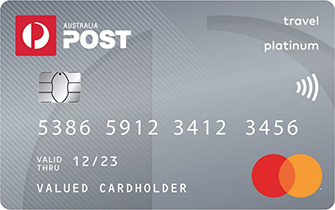
Australia Post Travel Platinum Mastercard
Fees
Loading: $5 if done using a debit card online, 1% if using BPAY, 1.1% if loading AUD instore. Free methods, including bank transfer, are available.
ATM withdrawals: 2.95% within Australia, $3.50 or local currency equivalent overseas. ATM operator fees may also apply.
Cashing out: $10
Closing the card: $10
Minimum load: $100
No. of currencies supported: 11
Image: Cash Passport.
Cash Passport Platinum Mastercard
Fees
Loading: 1.1% or $15 (whichever is greater) if done instore, 0.5% if using a debit card online. Free methods, including bank transfer and BPAY, are available.
ATM withdrawals: 2.95% within Australia, $3.50 or other similar amounts overseas, depending on the local currency. ATM operator fees may also apply.
Cashing out: $10 if done manually, free online.
Minimum load: $100
No. of currencies supported: 11
Image: Commonwealth Bank.
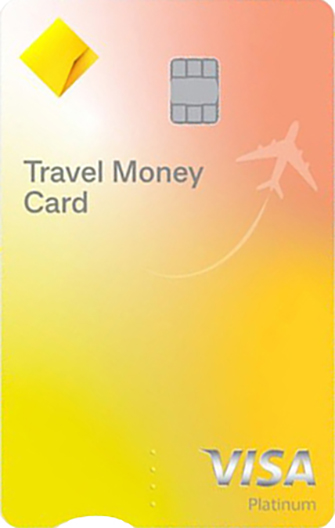
Commonwealth Bank Travel Money Card
Fees
ATM withdrawals: $3.50 in local currency equivalent overseas. ATM operator fees may also apply.
Minimum load: $50 when you first load the card, $1 for subsequent top-ups. Money must be loaded from an eligible Commonwealth Bank account.
No. of currencies supported: 16. This is the only card we looked at that lets you load the Fijian Dollar, and is one of only three letting you load the currencies of China, Vietnam, Indonesia and India.
Image: Qantas.
Qantas Pay
Fees
Account opening and card access: $99.50 if you’re not a Frequent Flyer member. Free for Frequent Flyer members.
ATM withdrawals: $1.95 or other similar amounts overseas, depending on the local currency. ATM operator fees may also apply.
Minimum load: $50
No. of currencies supported: 11
Note: Frequent Flyers members earn 1–2 Qantas points when they spend with this card in Australia or overseas, depending on the amount spent.
Image: Revolut.
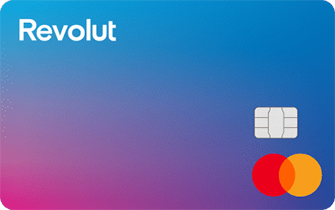
Revolut Standard Account
Fees
Physical card delivery: $4.99. A digital card is free.
Loading: 1% if using an Australian credit card, 2–2.25% if using a foreign credit or debit card. Free methods, including bank transfer and Australian debit card, are available.
Exchange: Free at certain times of day, 1% at other times. Up to 1.5% after $2000 has been exchanged in a month, depending on the time the exchange occurs.
ATM withdrawals: 2% or $1.50 (whichever is greater) after you’ve made five withdrawals worth a total $350 in a month. ATM operator fees may also apply.
Minimum load: N/A when first loading, $25 when reloading via debit or credit card.
No. of currencies supported: 39. This is one of only three cards we looked at that lets you load the currencies of Indonesia, China, India and Vietnam.
Note: Revolut and Wise tend to offer better exchange rates on popular currencies than most other travel money cards.
Image: Travel Money Oz.
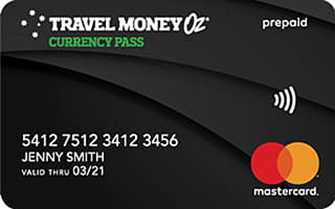
Travel Money Oz Currency Pass
Fees
Loading: Initial load online or instore is free. Up to 1.1% if reloading using Travel Money Oz app or website, 1% if using BPAY. Free reload methods, including bank transfer and instore, are available.
ATM withdrawals: 2.95% within Australia, $3.50 or other similar amounts overseas, depending on the local currency. ATM operator fees may also apply.
Cash out: $10
Minimum load: $20
No. of currencies supported: 10
Image: Travelex.
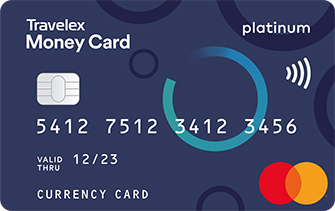
Travelex Money Card
Fees
Loading: 1.1% or $15 (whichever is greater) when loading AUD instore. 1% if using BPAY and not via the Travelex website or app. Free methods, including via the Travelex app or website, are available.
Inactivity: $4 per month if you haven’t used the card in 12 months.
Cashing out: $10
Closing the card: $10
Minimum load: $350 when first loading the card online or via the Travelex app ($100 if done instore) $50 for subsequent top-ups done online or via the app ($1 for subsequent top-ups done instore).
No. of currencies supported: 10
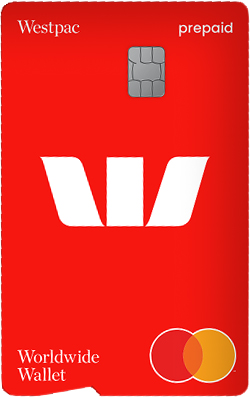
Westpac Worldwide Wallet
Fees
ATM withdrawals: Free overseas if performed at a Global ATM Alliance or Westpac machine, otherwise $2.00 or other similar amounts, depending on the local currency. ATM operator fees may also apply.
Minimum load: None, but money must be loaded from a Westpac Choice transaction account.
No. of currencies supported: 11
Image: Wise.
Wise Personal Account
Fees
Card access: $10 for a physical card. A digital card is free.
Loading: Various fees if done via card, depending on whether it’s debit or credit. CHOICE calculations have found these to be around 0.3% for debit cards and 1% for credit cards. Free methods, including bank transfer, are available.
Exchange: From 0.63%, depending on currency and amount being exchanged. A dynamic charge may also apply during times of exchange market volatility or if you’re converting a less-used currency.
ATM withdrawals: Various, depending on the amount of money and number of withdrawals you’ve performed in a month. 1.75% after you’ve withdrawn more than $350. $1.50 per withdrawal after you’ve performed two withdrawals. Both fees apply (1.75% + $1.50) for each withdrawal you perform after you’ve performed two withdrawals totaling $350. ATM operator fees may also apply.
Cashing out: A fee starting from 0.63% can apply for transferring money out of your account, even if you’re not exchanging between currencies.
Minimum load: None
No. of foreign currencies supported: 48. This is one of only three travel money cards we looked at that lets you load the currencies of Indonesia, China, Vietnam and India.
Note: Wise and Revolut tend to offer better exchange rates on popular currencies than most other travel money cards.
Make sure the places where you’re planning to use your card have card payment facilities or ATMs.
If you have an everyday debit card linked to your Australian bank account, check what fees it charges for overseas transactions. A card from a big four bank probably won’t be worth using overseas, but a low-fee debit card from a smaller bank may be better than a travel money card, as these have fewer fees and better exchange rates.
Compare the exchange rates offered by different travel money cards for the currencies you want to load.
Travel money cards are unique in letting you put aside money in different currencies. Make the most of this feature by organising your card balance on days when the exchange rates for the currencies you want to pre-load are good.
Make sure the card supports all the currencies you’ll need (also consider stopovers).
Get familiar with your travel money card’s linked website or app so you know how to reload your card overseas, in case you run out of funds while travelling.
It may be more convenient to choose a card that can be linked to, and reloaded via your bank account. CBA and Westpac’s cards operate this way.
Try to budget your reloads. Some cards require you to transfer $100 minimum each time you want to top-up your card.
Be aware of fees you may be charged for making ATM withdrawals.
Even if your card doesn’t charge fees for ATM withdrawals, ATM operators can still add their own charges at any time.
Avoid loading more money than you’ll need, as some cards charge you to cash out and transfer your balance off the card.
Consider if you’ll have to cancel your card once you’re finished your trip, as some cards charge inactivity fees.
Be mindful that you still may need a credit or bank debit card, as travel money cards may not be accepted as security for hotels and car rental agencies.
Going overseas? Get your free travel insurance guide now
Liam Kennedy is a Journalist with the Editorial and investigations team. He answers consumers' most burning questions, from which scams to be aware of and how to save money, to whether new services and products are worth using and how the latest developments in consumer news could affect them.
Prior to CHOICE, Liam worked in production in daily news radio and podcasting.
Liam has a Bachelor of Communication (Journalism) and a Bachelor of Arts in International Studies from the University of Technology Sydney. LinkedIn
Liam Kennedy is a Journalist with the Editorial and investigations team. He answers consumers' most burning questions, from which scams to be aware of and how to save money, to whether new services and products are worth using and how the latest developments in consumer news could affect them.
Prior to CHOICE, Liam worked in production in daily news radio and podcasting.
Liam has a Bachelor of Communication (Journalism) and a Bachelor of Arts in International Studies from the University of Technology Sydney. LinkedIn
For more than 60 years, CHOICE has been fighting the good fight for Australian consumers.
In the past year alone we've uncovered systemic issues with sunscreens, investigated shonky supermarket pricing, fought for stronger scam protections and helped make complex energy pricing fairer and clearer.
CHOICE is here to provide unbiased advice and independent testing in our world-class labs. We buy the products we test, just like you do, and our expert reviews are influence free. We’re here to help you choose smarter. Hopefully you’ll also save some money along the way.
Thanks to CHOICE, you’ll never be alone when a business treats you unfairly. You can support our work by joining or donating to our cause.