Unlike other product review websites, we don’t accept free test models. We buy the products we test, just like you do, so our expert reviews are always influence-free.
How we test TVs
We test more TVs than anyone else in Australia in our specialised labs. Here's how we do it.
Last updated: 1 Dec 2023

On this page:
We test around 60 TVs in the CHOICE test labs every year for:
- Picture quality (SD, HD, 4K and Filmmaker mode)
- Sound quality
- Energy use
We also assess them for ease of use – set up, interface and smart functions – and reliability so you’ll know if they’re fiddly or seamless to operate and will fit with your home setup.
Why you can trust our independent testing
How does CHOICE pick which TVs to test?
Types tested:
- OLED (individual pixels emitting their own light)
- QLED (LED with a wide colour gamut) Also known as QNED, ULED, QD-Mini LED
- Micro LED (Individual LEDs for each subpixel)
We aim to test the most popular brands and types on the market, and what you’re most likely to see in shops. To do this, we:
- Survey manufacturers to find out about their range of products.
- Check market sales information.
- Check member requests to test specific models.
We then buy each product, just as you would. We do this so we can be sure the products are the same as any consumer would find them, not ‘tweaked’ for better performance.
Loan models
We occasionally accept one-off loans of large TVs over 75 inches. This lets us extend our testing to cover high-end units, which can cost $40,000 or more for one TV. These TVs are returned to the manufacturer once testing has finished.
How we test TVs
Our tests take around 3 weeks and are designed to give each TV a fair go at providing a good picture. But our main focus is to get as close as we can to real-world experiences. We want to watch what you watch, not just what will make the television display look good instore.
We generally test six TVs in each batch and our most common display model selection is 65-inches (165cm), the current popular size among consumers. Past testing of different sizes in the same model and type has shown that we can confidently determine that a size larger and smaller than 65-inches will deliver identical video quality performance.
Video: How we test TVs
Picture quality
1 Expert viewing panel assessment
We place TVs side by side and connect them to an HDMI distribution system that provides them all with the same source material at the same time. This lets our panel of viewers move seamlessly from one TV to another.
Our expert panel views:
- Standard and HD footage from movies on discs and technical footage to look at noise levels, jaggies (diagonal lines that appear as jagged or broken)
- Standard and HD footage from a sports broadcast (including long shots of players on a field moving quickly)
- 4K UHD, which includes footage from a 4K movie with HDR enabled on the TV and the player (Xbox with support for 4K and HDR)
- HD and 4K UHD movie footage in Filmmaker Mode, or the TV’s Movie/Cinema mode if this feature isn’t available.
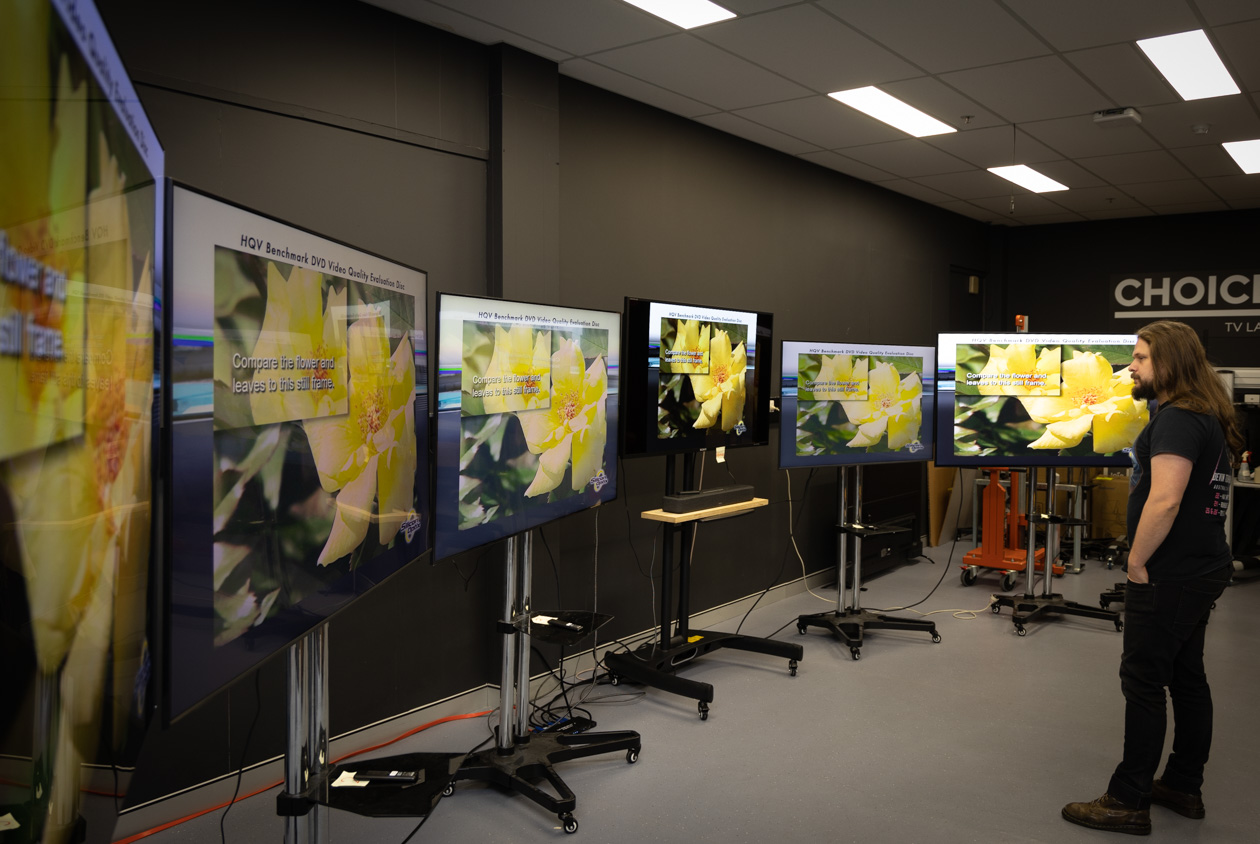
They look for colours that have good saturation and that don’t look false, and sharpness and noise in the picture. They score down TVs that show faults like plastic-looking skin tones, poor black levels, noise, backlight bleeding and pixelation.
2 Technical assessment
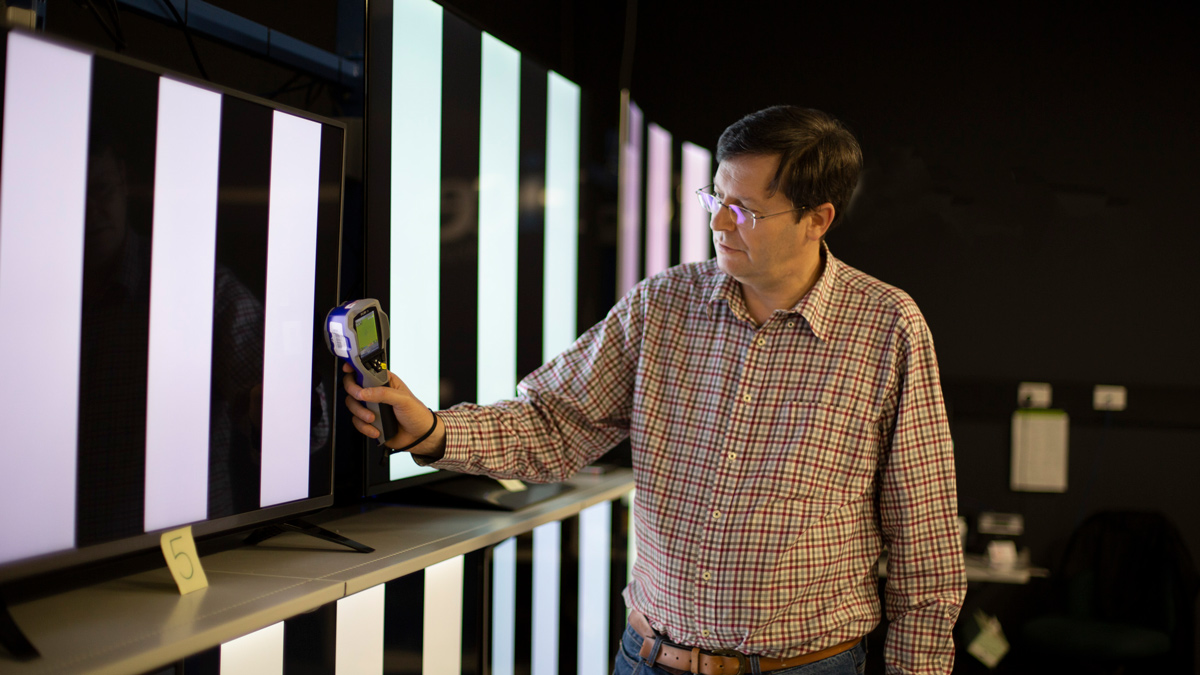
We assess technical footage, designed to test the TV’s ability to deal with noise in the signal at both high and standard definition.
These tests include:
- Test patterns and footage, which check each TV for overscan (how much picture is not being shown)
- Jaggies (the diagonal lines that appear as jagged or broken)
- Judder and blur at a number of different frame rates.
Sound quality
We play a number of high-quality voice and music recordings on a DVD player connected to the TV and compare it to a reference soundbar.
A panel of three experts then assess the TV at a volume loud enough for listening in a normal room, and at the TV’s maximum volume (assuming this is louder).
The panel listen for:
- Clear voices
- Enough high-, mid- and low-frequency responses to provide some drama and presence
- Rattles, humming or obvious distortion
Ease of use
We assess the real-world things that affect your experience of using the TV, so you’ll know what it’s like to operate and own.
Remote control
We check that:
- Buttons dials or touch pads are well-spaced, easy to reach, logically grouped and not too close together.
- Labels are big enough to read and have enough contrast to read in low light.
- Volume and channel up/down buttons are prominent.
- The remote includes numeric buttons 0 through 9, a favourite channels button, and a prominent home button
- That the overall size and shape fits well in the hand and is easy to use with one hand.
User interface
We check that the on-screen user interface has:
- A simple and well organised means of selecting the main functions or options
- Easy to read characters
- Intuitive descriptions or symbols
- Stays on the screen long enough
- A guide to which keys to use
- An easy way to organise frequently viewed channels – either the favourites function or channel skip/erase.
- That closed captions, once activated, stay active after changing channels.
Smart TV functionality
We assess this on:
- Ease of Home screen interface navigation and clarity
- Availability of apps (YouTube, Netflix, TV catch-up apps) and if they’re prominently displayed or have to be searched for
- Screen layout of apps and content rows, including how logical and accessible they are
- How long it takes for Netflix, YouTube and ABC iView to start up, and how easy it is to use them via voice commands
- Embedded Chromecast and AirPlay capability
- Amount of home screen space taken up by advertising and whether pre-installed apps (bloatware) can be deleted
- Whether automatic content recognition can be turned off in the settings
Who does the testing?
Our technical staff includes some of the most experienced TV testers in the country, with 30 years’ experience testing televisions between them. They’ve seen the progression from bulky cathode ray tube TVs through to plasma sets, LCD and now OLEDs and QLEDs.
They’ve also sat on Australian Standards Committees and have had a major influence on getting MEPS (mandatory energy performance standards) implemented, which is why the TVs you can buy today use significantly less energy than the sets of old.