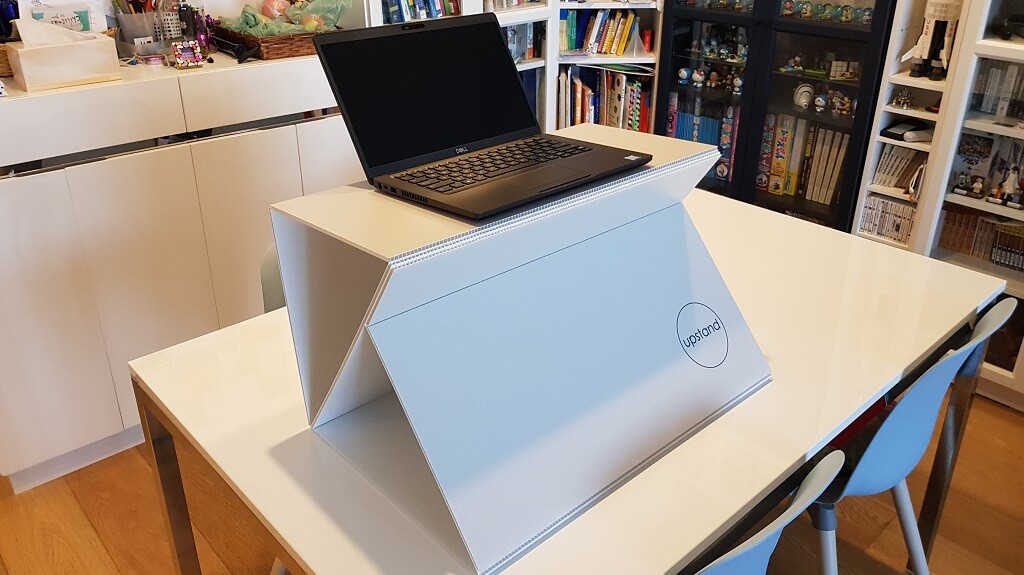
The Upstand desk may be stylish, but we’re moving back to the good old-fashioned cardboard box. After a week, we found that the configurability and expense of cardboard boxes suits both of us (tall and short). Meanwhile, the Upstand’s fixed height made it much less comfortable for the shorter member of our family. However, we’ll miss the stylish design of the Upstand – the most we can do with the cardboard box style-wise is cover it with a flashy bit of material. We also liked the Upstand’s carry handle, which made it easy to move around. But we don’t depart much from our desks anyway.
Whether through choice or circumstance, a mixture of sitting and standing at your desk while working on a computer is best, according to current work health and safety standards.
The Upstand was designed to meet demand for a stylish standing desk that people could use anywhere they have a work desk or table. But is it any good? And how does it compare with a good old cardboard box?
Setting up the Upstand
Lacking written instructions of any sort, we still found the Upstand very easy to put together. It comes in one flat piece and can be set up without any need for Allen keys.
Following the pictures on the Upstand website, we put the slots in the right place and were up and running within minutes. It has a handle on the top that makes it easy to carry around if you want to move to a different work space. And because it just sits loosely on top of the surface, you can adjust it easily.
The Upstand desk can’t be adjusted much, which can make it uncomfortable to use.
Using the Upstand
We had two people test the Upstand on two different desk heights. It may be easy to set up, but one downside of the Upstand is that it’s a static product that isn’t really height adjustable, unlike some other standing desks. This means you might have to raise or lower it – according to your height – by placing it on something else.
It may be easy to set up, but the Upstand is a static product that isn’t really height adjustable
We ended up with a situation whereby the taller person (172cm) felt comfortable using it on the two different desk heights. But the shorter person (150cm) felt uncomfortable using it on either desk height – primarily because they either had to raise their arms to shoulder height, or raise their forearms to elbow height. Needless to say, neither is great option long term.
Setting up your laptop or tablet
The Upstand is designed for a tablet or laptop, and not much else. If you work with a large laptop, you won’t have a lot of space for a mouse, so you might want to adjust your mouse sensitivity to high so you can move it less. Otherwise, it’s going to topple off the side. You might also be able to use the trackpad or pointer built into some laptops.
For those of us who are used to working with a larger monitor with our laptops, you won’t have space for a monitor to sit on the Upstand. If you tend to use a larger monitor to extend your laptop’s desktop, you might need to look elsewhere, or shop around for a laptop stand to complement the Upstand – but this will increase the overall cost of your setup.
Is the Upstand stable?
Made of recyclable plastic (polypropylene), there’s a little bit of flex in the Upstand, so when you put a laptop on it, it dips a little. That won’t matter if you’re a delicate typist, but if you bash your way through work, you’re going to get some bouncing.
Is the Upstand right for you?
The Upstand is a decent short-term standing desk – and it’s hard to argue with the low price tag. But there are a lot of compromises to make and the limited adjustability means very few people are likely to find it truly comfortable.
Portability may be the hook here, but how often do people move their standing desks when they’re home-working? If you only work from home occasionally and don’t need a dedicated workspace, then this could be a good solution to pop on the dining room table for a day.
But if you work from home more regularly, or even all the time, you may want to consider something a bit more adjustable and robust.
Matthew Steen is the Director of Reviews and Testing, which conducts all the testing for CHOICE. He has had a long and storied history in the consumer movement.
Matthew is driven to work at CHOICE for its constitutional mission and its dedication to making Australia more fair, safe and just.
Matthew represents CHOICE as a council member on the Standards Australia Council. He is also responsible for CHOICE lowering its environmental footprint.
Find Matthew on LinkedIn.
Matthew Steen is the Director of Reviews and Testing, which conducts all the testing for CHOICE. He has had a long and storied history in the consumer movement.
Matthew is driven to work at CHOICE for its constitutional mission and its dedication to making Australia more fair, safe and just.
Matthew represents CHOICE as a council member on the Standards Australia Council. He is also responsible for CHOICE lowering its environmental footprint.
Find Matthew on LinkedIn.
For more than 60 years, CHOICE has been fighting the good fight for Australian consumers.
In the past year alone we've uncovered systemic issues with sunscreens, investigated shonky supermarket pricing, fought for stronger scam protections and helped make complex energy pricing fairer and clearer.
CHOICE is here to provide unbiased advice and independent testing in our world-class labs. We buy the products we test, just like you do, and our expert reviews are influence free. We’re here to help you choose smarter. Hopefully you’ll also save some money along the way.
Thanks to CHOICE, you’ll never be alone when a business treats you unfairly. You can support our work by joining or donating to our cause.