A quality home entertainment system is no longer solely for the ultra-rich. There are plenty of entry-level, mid-range and high-end TVs out there that can turn a quiet weekend at home into a multiplex movie marathon.
But how do you tell the A-list models from the B-grade pretenders? After all, retailers tinker with the settings and pick particular content to make TVs look as eye-catching as possible on the show floor. The things you see in store barely match the look of movies and shows at home – unless you’re really into stock footage of nature.
A movie lover’s guide to buying a TV – what to look for
A good TV is all about immersion. You want a screen that evenly delivers visual impact (aka pop) and accurate, balanced colour. A super-saturated or high-contrast screen may catch your eye at first but it doesn’t suit cinematic movies and shows, and that can break the immersion.
Deep, rich blacks are also a big tick, rather than soft, murky greys. These can really suck the life out of darker scenes, particularly night time sequences.
You want a screen that evenly delivers visual impact (aka pop) and accurate, balanced colour
Also look for a TV that doesn’t aggressively remove film grain. While newer movies shot digitally can look squeaky clean, older ones that used film will have some grain (aka noise).
TVs can remove it to varying degrees, but the picture can look soft, smeared and lacking in detail if the noise reduction goes too far. We look for a clean image that still retains detail and doesn’t apply aggressive noise-reduction during our tests.
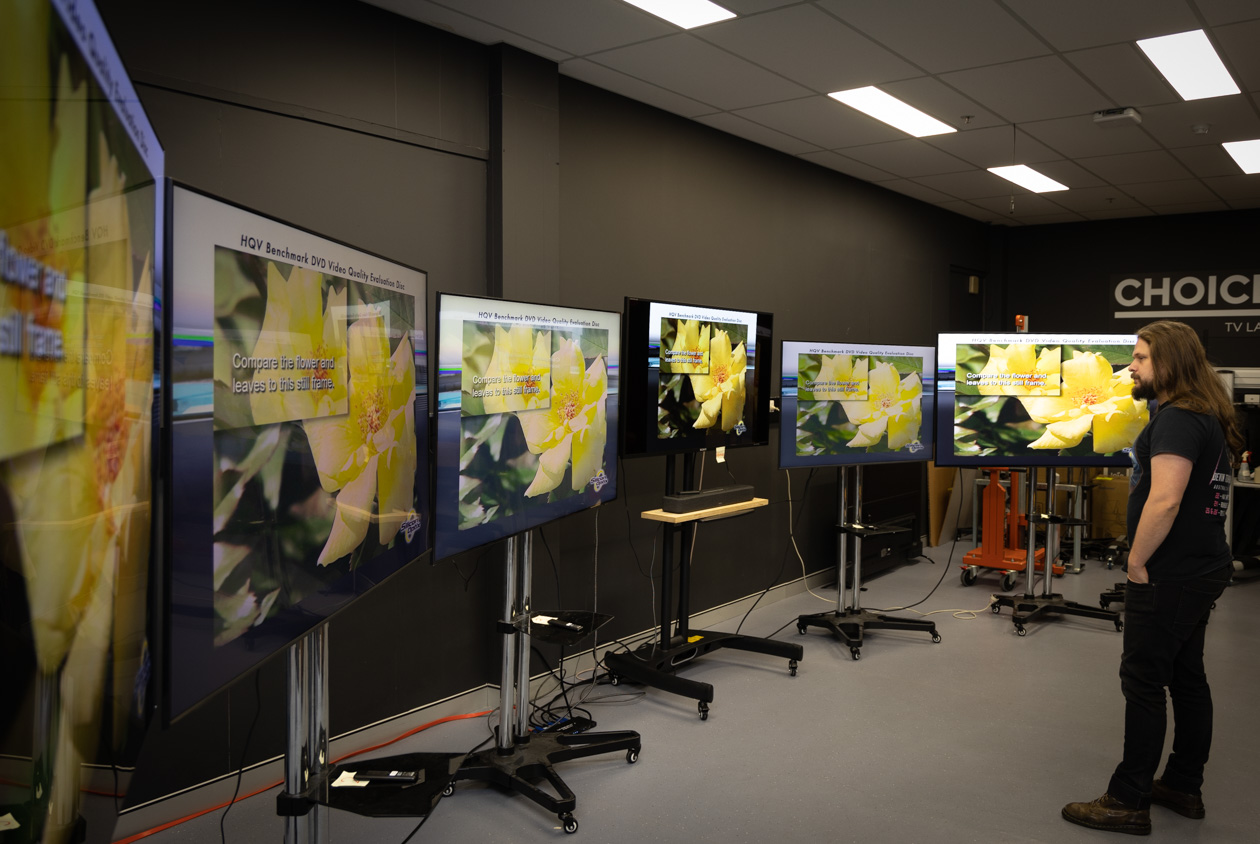
We take ‘screen time’ to a whole new level during our TV lab tests.
Image processing and Filmmaker mode
TVs will, by default, process video to try to make it look as good as possible for different viewing situations – this is what the different picture settings like vivid, sports and movie mode are. But they don’t always hit the mark, which is why most TVs include an industry standard setting called Filmmaker mode.
It turns off all the image processing to get the picture quality as close to the cinematic intentions of the people behind the lens. We included it in our 4K UHD test to determine whether performance improves with image processing turned off. The difference is stark in some cases.
Almost all modern TVs use a 4K screen, but the majority of movies and shows are only available in SD (standard definition) and HD (high definition). This is where upscaling comes into play.
Instead of just stretching lower resolution content to fit a high-res display (which looks awful), upscaling essentially generates extra pixels on the fly. This helps fill the gaps between SD, HD and 4K, so that SD and HD look as good as possible on an ultra-high definition screen.
With so many movies and shows yet to make the jump to 4K, it’s important to find a TV with good upscaling software. This is included in our SD and HD movie scores.
Issues to look out for
TVs with cheaper components can’t process video very well, which can snap you out of a particularly engaging movie moment. It’s a classic case of ‘you had one job’. Look for TVs with these issues and avoid them like a late-career Michael Bay movie.
Artifacting (aka fragmenting): the image temporarily breaks up and looks blocky in certain fast-moving portions of the scene.
Banding: the TV struggles to blend colour shades as parts of the screen get brighter or darker, leaving distinct lines, shades and blocks that look like bands.
Light bleed: The TV’s backlight excessively illuminates areas around the edge of the screen, which causes blooming effects (inconsistent blotches of white light).
Narrow viewing angle: The picture quality starts to degrade as you sit further to the left or right of the screen. Not the best experience when your mates come over for movie night.
According to our experts, an OLED (organic light emitting diode) display is definitely the showstopper here, but LCD (liquid-crystal display) has its advantages.
LCD TVs (which cover a bunch of sub categories such as QLED and mini-LED) require a light source behind their screen panel, meaning they can go very dark grey but never fully black. By comparison, OLED (organic light emitting diode) screens have lights integrated within each diode and they can simply turn off when required, giving you true blacks.
OLED display is definitely the showstopper here, but LCD has its advantages
OLED TVs tend to deliver more accurate, vivid and richer colours but they can’t get quite as bright. LCD, meanwhile, is usually brighter than OLED, so it could be a preferred option if you watch TV a lot during the day or in a well-lit room.
Price is also a factor. OLED TVs are almost always more expensive than their LCD counterparts, though they can be heavily discounted during sales periods – by as much as 40% on occasion.
Huge TVs aren’t exactly necessary, but the bigger the screen, the closer you’ll get to bringing the cinema experience home. Aim for a 55-inch model at the very least but ideally, look for a 65- or 75/77-inch display.
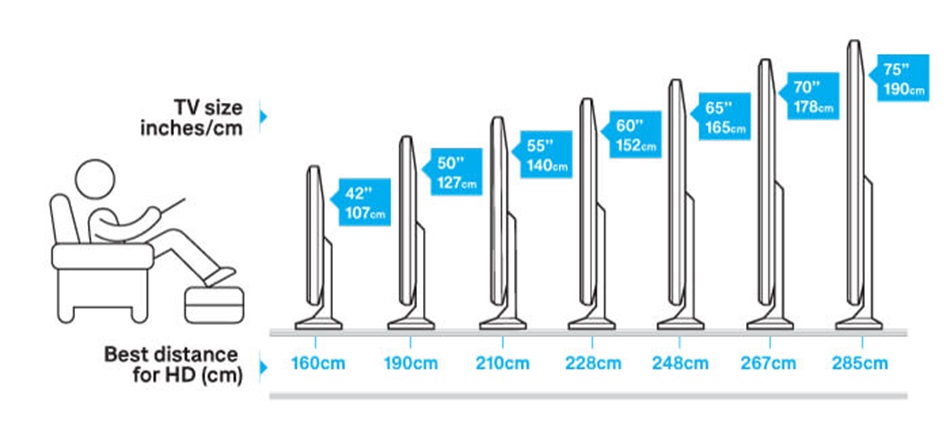
The right TV size does depend on the size of the room. There are optimal viewing distances for HD and 4K content and you’re not going to get the best experience if you sit too close or too far from TVs of a certain size.
Using a 65-inch TV as an example, the best distance for HD content is 240cm, while for 4K it’s 125–215cm. Yes, you read that correctly, it’s best to sit a bit closer to see all the detail in 4K.
Field of view (FOV) is important as well. It’s best to position the TV, or your couch, at a point where your FOV sits at the edges of the screen, which is about 30 degrees.
This is suitable for all types of content – movies, shows, sport etc – but hardcore film buffs can sit a little closer in the 40-degree range. This position feels more like a cinema, but may not work for shows, sports and gaming.
Short answer, yes. Audio is a vital part of the cinema experience and even the best TV speakers are usually pretty average. They certainly can’t fill a room with the kind of sound that really gets the blood pumping during exciting or emotional movie moments.
As a starting point, look for a soundbar that can simulate basic surround sound, which is usually referred to as 5.1. Then you can investigate higher end options that will enhance the experience.
As a starting point, look for a soundbar that can simulate basic surround sound
Some let you connect additional speakers to place at the back of the room to deliver genuine surround sound. Others can simulate a feature called object-based audio, aka Dolby Atmos and DTS-X. This adds height channels (speakers) to the mix so you can hear sounds above your ears as well as around them.
Some TV and soundbar manufacturers offer bonus features if you buy certain models within the same brand, such as a Samsung soundbar and TV. We’ve written a guide to this you may find useful.
It’s showtime! The best TVs for movies and series revealed
To test TVs, our expert panellists watch a range of movie scenes in standard definition (DVD), high definition (Blu-ray) and ultra-high definition (4K).
The same scenes are viewed on every TV so they can directly compare picture quality and performance using films you’re likely to watch at home. All tested models are 65 inches unless otherwise stated.
Usually our scores for movies feed into our overall CHOICE Expert Rating for each TV, but we’ve pulled them out individually below so you can see how each model performs specifically for this metric.
Only CHOICE members can access our detailed testing data. If you’re not yet a member, join CHOICE to get instant access to all our expert, independent reviews, from coffee machines and grinders, to kettles and cots, toasters and TVs, and more.
If you’re a Disney+ die-hard or you love chilling with Netflix, read on to discover our top tested picks for flicks and streaming shows.
Peter Zaluzny is a Content producer in the Digital home team. He covers everything from home entertainment and personal safety devices to tech for your car and mattresses.
Peter enjoys cutting through the nonsense to help people understand the products they’re considering to buy. He helps consumers make educated, informed decisions.
Peter has a Bachelor's degree in Journalism and a Bachelor of Arts from the University of Wollongong.
Peter Zaluzny is a Content producer in the Digital home team. He covers everything from home entertainment and personal safety devices to tech for your car and mattresses.
Peter enjoys cutting through the nonsense to help people understand the products they’re considering to buy. He helps consumers make educated, informed decisions.
Peter has a Bachelor's degree in Journalism and a Bachelor of Arts from the University of Wollongong.
For more than 60 years, CHOICE has been fighting the good fight for Australian consumers.
In the past year alone we've uncovered systemic issues with sunscreens, investigated shonky supermarket pricing, fought for stronger scam protections and helped make complex energy pricing fairer and clearer.
CHOICE is here to provide unbiased advice and independent testing in our world-class labs. We buy the products we test, just like you do, and our expert reviews are influence free. We’re here to help you choose smarter. Hopefully you’ll also save some money along the way.
Thanks to CHOICE, you’ll never be alone when a business treats you unfairly. You can support our work by joining or donating to our cause.