
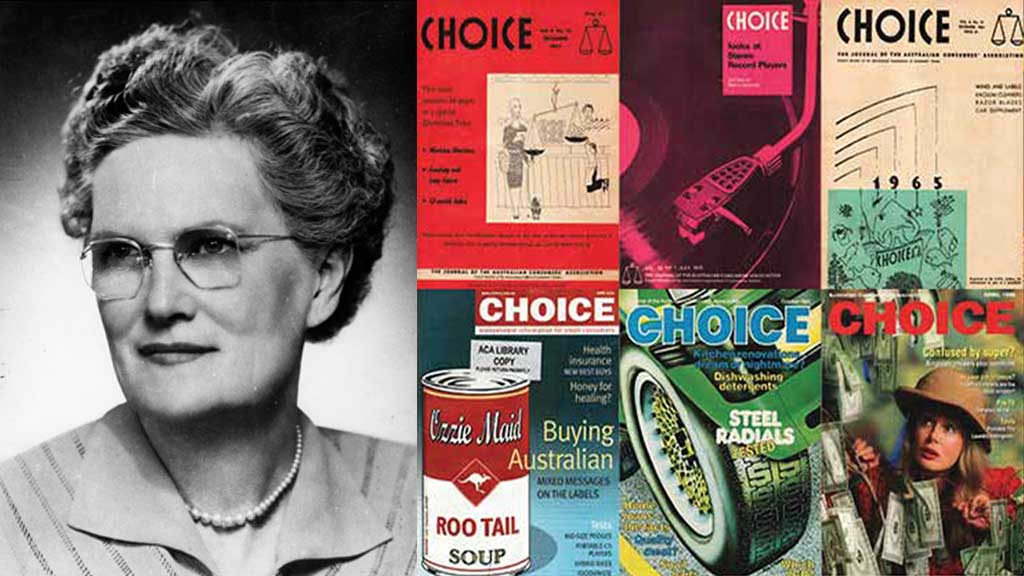
CHOICE TV celebrates 50 years of CHOICE with this five-part series, kicking off with the sixties, where it all began.

1960
About 20,000 copies of CHOICE magazine were printed, four issues in the first year. In the launch issue, a woman photographed peering into a freezer (below) complained she hadn’t given permission to appear. We appeased her with a free year’s subscription (then a hefty £1).
We tested “slimming cures” (Turkish baths and corsets got the thumbs down) and aspirin in Roland Thorp’s lab. However, ACA was running lean – we had £50 in the kitty. A universal theme emerged – comparison of groceries with unit pricing (50 years on, this is legislated, partly thanks to us). Membership stood at 7500.
1961 
In our “biggest project yet”, we tested cigarettes for nicotine and tar levels on our special “smoking machine”, which puffed away for months. We cautiously concluded “studies tended to emphasise a connection between excessive smoking and arteriosclerosis and pulmonary emphysema”. On the subject of lung cancer? We said: “Time alone will show whether there really is a risk between the two occurrences.” But we did reassure ACA’s more macho members that smoking seemed to have little effect on virility.
We got in a lather over detergents. “A bewildering array of value-for-money options (‘save 2/11’, ‘great free gift’) confronts the housewife whenever she shops.” We concluded that “it‘s pointless to evaluate which detergent gives best value for money, since prices are arbitrary and change from week to week”.
Transistor radios were tested – but which from the mind-boggling array of 80 models available? Similarly, ballpoint pens were brand new and we scribbled away, putting them through their paces.
Membership passed 20,000. “Official bodies and manufacturers are taking notice of our tests and even consulting us from time to time,” CHOICE enthused.
1962
“Look how fit he is; he’s as brown as a berry” – ACA debunked the link between a good tan and good health as we slip-slapped suntan lotions: “None make you tan; they only slow down burning, so you can tan less painfully.” However, we did suggest “too much exposure to UV rays can have harmful effects and produce conditions that may lead to skin cancer”.
ACA received many enquiries about goods with tricky guarantees, particularly electrical appliances. Our advice? “Your primary contract is with the shopkeeper and your legal rights are with him… you will be best advised to make your purchases from stores of good repute.”
We made submissions to the Packaged Goods Inquiry. Packages are “the silent salesman”, we declared, “but too many are deceptive and misleading, and do not give us the information we want”.
On a membership roll, we proclaimed we wanted a market where “Best Buys replace best-sellers”. Six issues a year of CHOICE now.
1963
We continued our campaign against dodgy packaging, with a celebrity on our side: “Mr. Kennedy, president of the USA, believes consumer protection is a first order of national community business. So does ACA, and we have urged for the setting up of the Australian Packaging Board.”
Our lifejacket test left us with a sinking feeling – we could only recommend one out of 36. We also tested rifle cartridges, “because .22 calibre rifle ammunition is very popular for light sporting use”. We measured for accuracy, velocity and the amount of powder each contained.
Australians embraced technology – at a cost. A TV was the equivalent of $160 – 10 weeks’ salary for a secretary.
CHOICE promoted family planning: “The pill, one of the most effective means of birth control, is now available on the prescription of a doctor.”
But Women’s Lib was but a dream, as our washing machine test revealed. “A fully automatic washing machine represents the most advanced device available to the housewife to lessen her daily labours.” In 1960, 31,000 machines were sold; in 1962, sales rocketed to 65,000. We tested stockings, “a maiden’s dream”, rating them on cost per hour – expensive lasted about 80 hours, cheapies 45.
“The mail pours in,” said our May cover. “1000 new subscribers join ACA every week.”
1964 
CHOICE is read by 500,000, but popularity had a downside. We hit out at manufacturers using ‘CHOICE’, ‘consumer’ or ‘Best Buy’ recommendations to tout their products.
Mushrooms on the menu took on a new meaning when we assessed fallout from atomic testing at Maralinga. ACA measured Caesium 137 and Strontium 90 in food and milk. “Australians are relatively well-off as regards radioactivity in the diet,” we said and advised against altering eating patterns – missing out on vital nutrients could be more harmful than any fallout.
We served up hock, chablis, burgundy, riesling and claret to a tasting panel, concluding the ‘variety’ gave no indication of what the bottle contains!
1965
Student slide rules slid back and forth 10,000 times in a special machine for our slide rule test. And we didn’t miss a chance to make a point: “In this day and age, the housewife needs a slide rule to calculate whether 3/4oz at 1/6d is a better buy than 9oz at 2/11.”
We lashed out at misleading ads. Ford claimed its Falcon “completes 70,000 miles in 8 3/4 days. No car has ever travelled so far, so fast, as the stock-model Falcons.” In fact, five Falcons covered 14,000 miles each, “just running-in distance,” we said.
“Cinderella-like lotions to erase lines are of great interest to most women,” CHOICE wrote. Magic Secret wrinkle lotion was matched against an egg white. “Both may smooth out wrinkles, but the effect is likely to be slight and unlikely to last long.”
In a food mixer test, we proclaimed: “For thousands of years, housewives have been preparing delectable dishes to tempt their husbands, all without machines. But this is the machine age, and the kitchen has not escaped mechanisation.
“The food mixer is a machine that 10 years ago was a rarity but today is regarded as one of the first buys for newlyweds.”
1966
For the nation’s many home dressmakers, we put pins through their paces: “Such a little thing,” we said. “But then, how useful – and not so very cheap when the prices are examined.”
A member raised this problem: “It’s unfair for a housewife to engage in a battle of wits with a salesman, as the latter has the training to ensure a sale.” His suggestion? A form saying purchases are made by family discussion. “As soon as the housewife sees the caller is a salesman, she hands him a Notice to Hawkers.” At the bottom, it says, in plain Australian, “be on your way, sport.”
“Nothing will grow on you but the flavour,” stated Slenderella, a low-calorie soft drink. “What a temptation for dieters,” we commented. Such a large range of low-calorie soft drinks ...
We called for standardised food purity laws. NSW required 3.2% buttermilk in milk, while Victoria required 3.5%, a difference of nearly 10%. “After all the excitement of the parting of the streamers on the docks, you are on you way …”
So began CHOICE’s pre-jet age report on visiting Britain, where “even the ‘best’ restaurants can serve a completely tasteless meal for a high price”.
1967
A whole issue was devoted to the great Holden vs Ford debate. Our sister association, British Consumers’ Association, put each through their paces. “If you do a lot of long distance driving, the Falcon was the better bet – its comfort and handling were better than those of the Holden.” The story brought us thousands of new members, but existing members were furious because they had heard about the test in the media before they read about it in their own magazine.
We fought our own war over the Agent Zero M Sonic Blaster toy, which resembled a bazooka. Our lab tests showed it emitted 140 decibels. “Repeated firing would be very likely to cause damage to the child’s ear.”
Our 11-page report, “Flammable Night Wear for Children,” lobbied to force manufacturers to label clothing, especially children’s night wear.
1968 
Tanning got another whipping: “A good suntan is the done thing,” we said. “Skin cancer is an occupational hazard for the sailor, rural worker and others who must expose themselves to the sun all day, year in, year out.”
We changed our minds on the electric toothbrush. “It is not as foolish a gadget as it might first seem to be,” we said, arguing it was handy for “invalids” and children, encouraging them to clean their teeth.
ACA called for a vaccination program to stamp out measles, a disease striking 100,000 children every year. “The money must be found,” we said.
And toddlers were contracting lead poisoning from eating flakes of paint. CHOICE called for legislation to restrict lead in paint to less than one per cent.
The conference of the International Organization of Consumers Unions took place in the US. Privileged ACA delegates visited the White House as the guests of Mrs. Lyndon Johnson.
1969
Compulsory breath testing was introduced. We concluded the DIY Breathmeter was fiddly to use and expensive, so we advised readers against buying one.
Wear-once paper panties were put through their paces (“fashion’s folly?” we asked). Suitable for travellers, but pricewise no substitute for “prettily trimmed” nylon or cotton equivalent was the verdict.
Consumer credit became available and in demand. “It’s shrouded in mystery, with the cost of credit expressed in bewildering terms.”
ACA turned 10, but forwent the champers. “Many think it’s something to celebrate, but we wish we didn’t need to be here at all,” we said soberly.