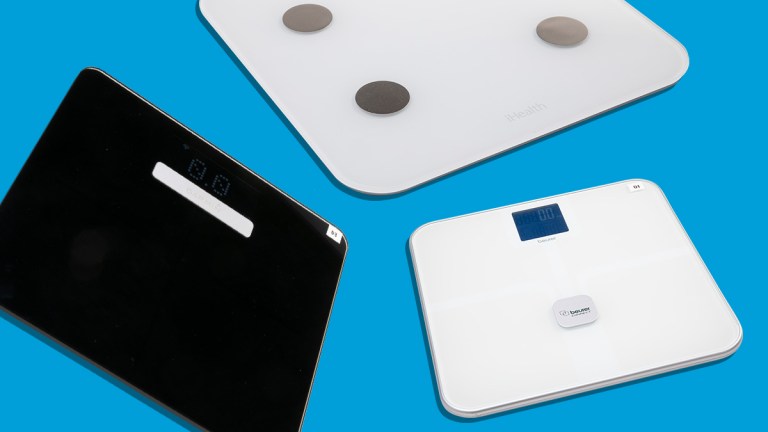
Table notes
Overall score This is made up of:
- Body fat: 40%
- Ease of use: 30%
- Weight accuracy: 20%
- Weight sensitivity: 10%
Price Recommended retail, as of August 2009.
(A) In ALDI stores again April 2010; similar model in store January 2010.
(B) Discontinued. Replaced by model UM-051.
How we test
Body fat Our test is carried out at the University of Sydney’s Exercise and Sport Science laboratory. Eight CHOICE volunteers (five males and three females) are weighed using underwater weighing (UWW), regarded as one of the best methods for determining a person’s body fat. It measures the weight of water displaced when someone is submerged, and uses this value (together with dry weight, height and residual lung volume) to calculate body density, from which body fat percentage can be derived.
The person is weighed first on a normal calibrated scale, then again in a special underwater scale. Because bone and muscle are denser than water, someone with more bone and muscle mass will weigh more in water than on land and so will have a higher body density and lower percentage of body fat. Conversely, fat is less dense, so someone with more fat will be lighter in water.
In the same session, the volunteers are weighed on each of the scales. The average difference in percentage body fat between UWW and that measured by the scales is calculated and scored. A score of 70% indicates the scales were within 3-5 percentage points of the UWW measurement (e.g. for a person with body fat percentage of 30%, the scales gave an average reading between 25% and 27%); a score of 50% indicates they were within 7-9 percentage points.
Ease of use Our CHOICE tester, Norbert Suto, assesses the ease of reading the display, programming user data into the scales, subsequent use (measuring body fat and weight) and foot placement/stability.
Weight accuracy He records how accurately the scales measure weight, using calibrated 60kg and 100kg weights. These measurements are combined with the weight measurements from the laboratory test to determine overall weight accuracy.
Weight sensitivity Starting from a weight of 20kg, he measures how sensitive the scales are to incremental changes of 100g.