How to buy the best blood pressure monitor
Choose the right device to use in the comfort of your home.
Last updated: 10 Jan 2022
One in three Australian adults have high blood pressure (hypertension) and many more have low blood pressure (hypotension). If you’re one of them, then you may find a home blood pressure monitor is an essential tool for measuring your blood pressure daily, which can help you keep track of any unexpected changes in your health and tell you if you need to visit your GP.
On this page:
Why you should monitor your blood pressure at home
If you have hypertension, monitoring your blood pressure at home can help you keep it under control. Home monitoring can also help you identify hypertension in the first place, and it might be worth investing in a home blood pressure monitor if you think you’re at risk, particularly if you have a family history of heart disease, or if you have other contributing factors.
A home blood pressure monitor can allow you to build a timeline so you can share results with your health professional. It can also help you fine-tune new treatments by seeing how they’re working for you and what impact they’re having on your body.
Another good reason for monitoring your blood pressure at home is that sometimes going to the doctor to get your blood pressure checked can be stressful enough to cause it to spike. This is called “white-coat hypertension”, and it can be avoided by checking your blood pressure at home in comfortable surroundings.
The opposite is also a possibility, known as “masked hypertension” – some people give normal readings at the GP’s office but actually have high blood pressure at other times which would otherwise go undetected – home monitoring can also pick this up.
Monitoring at home is also useful if you’re experiencing pre-eclampsia, or pregnancy-induced hypertension.
What’s the difference between automatic and manual blood pressure monitors?
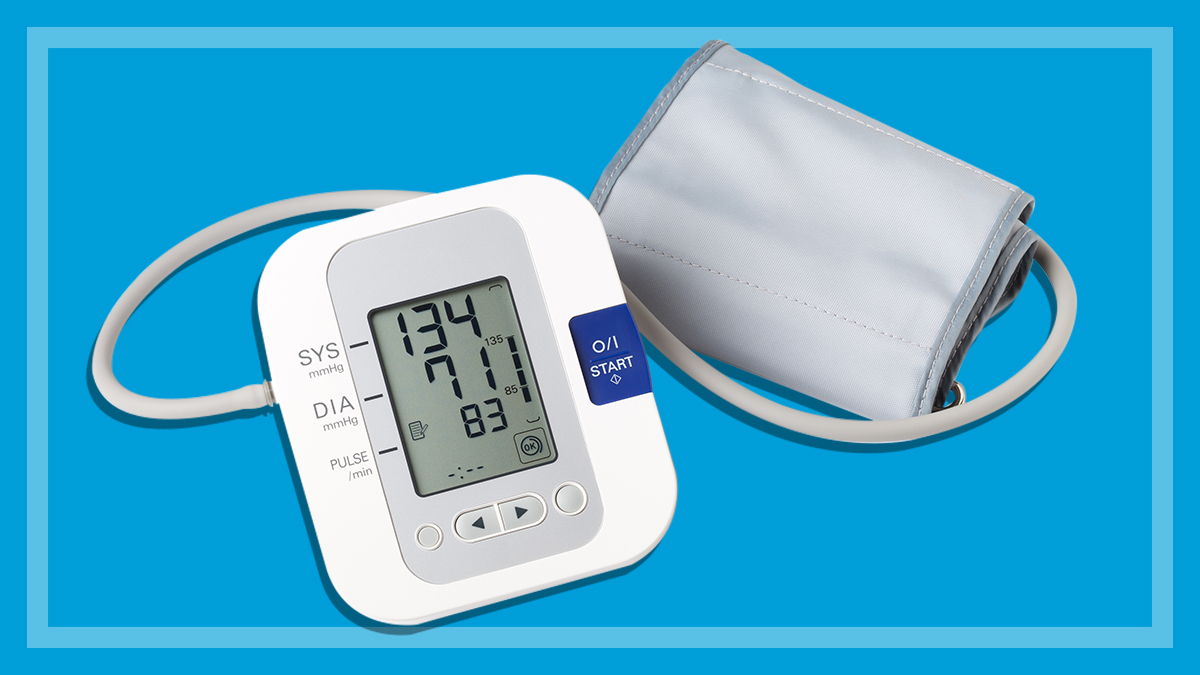
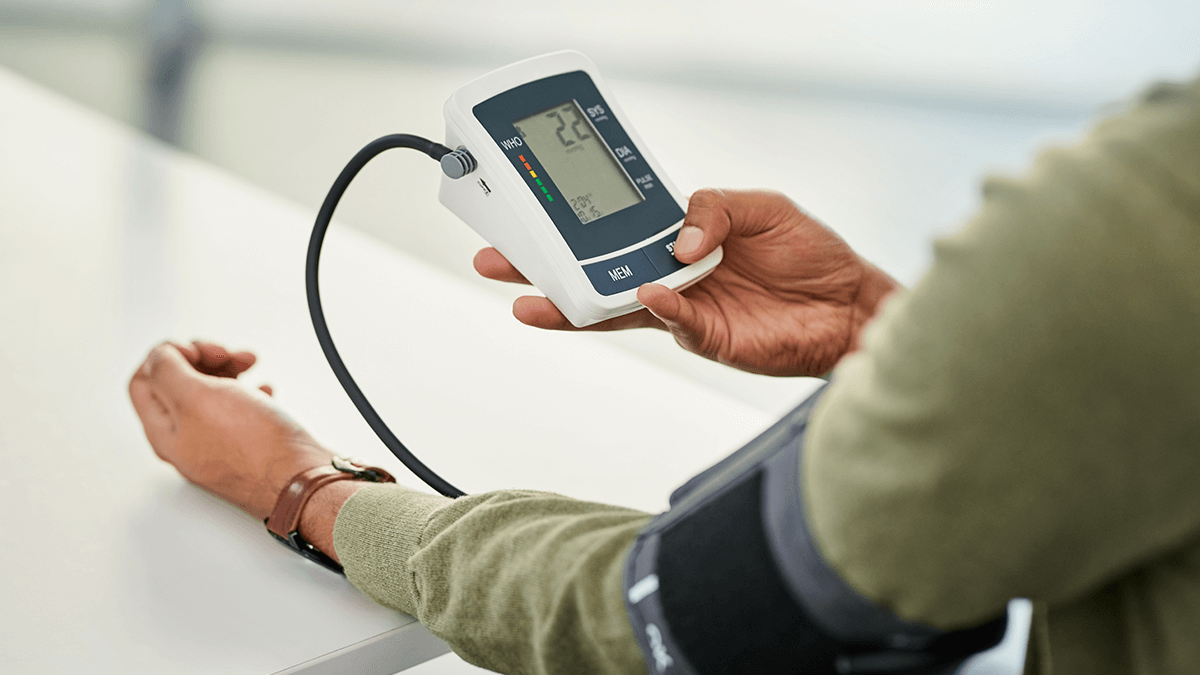
- Automatic models inflate, measure and deflate the cuff automatically. They work at the push of a button, and tend to perform better than manual monitors, but there are some exceptions. As they’re easier to use and more ‘foolproof’, an automatic model is better suited to use by people at home.
- Manual models require you to inflate the cuff yourself by pumping a bulb. Unfortunately, this doesn’t count as exercise, no matter how vigorously you do it.
Do you need an upper arm cuff or wrist mount blood pressure monitor?
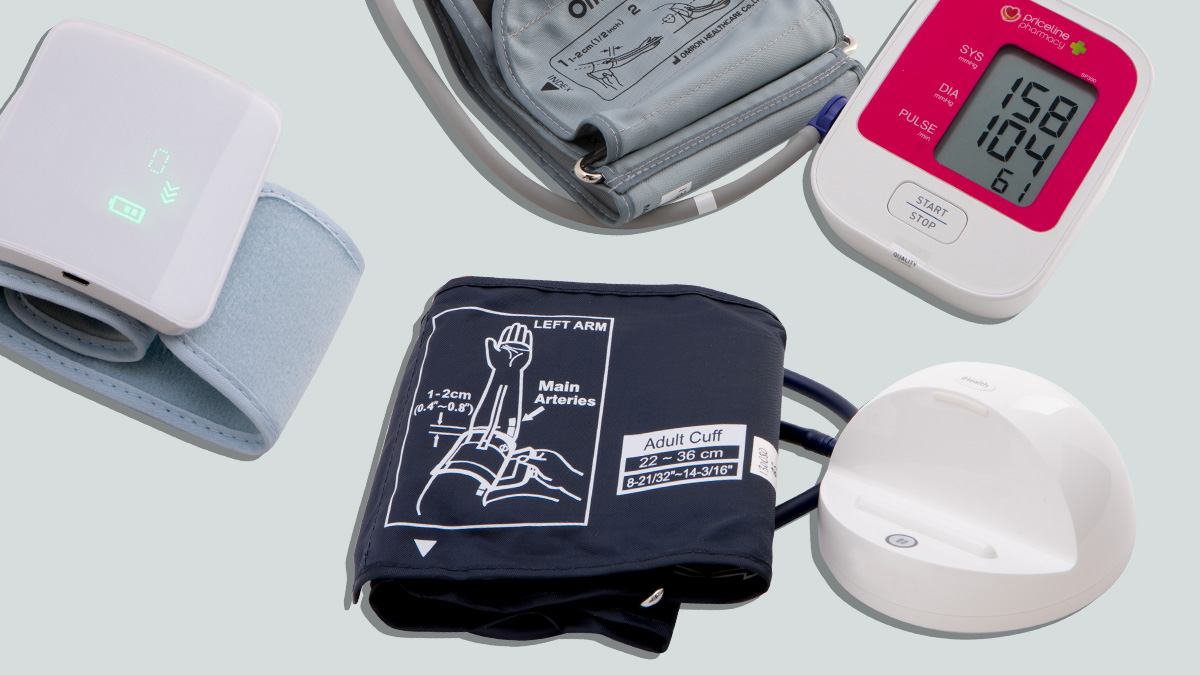
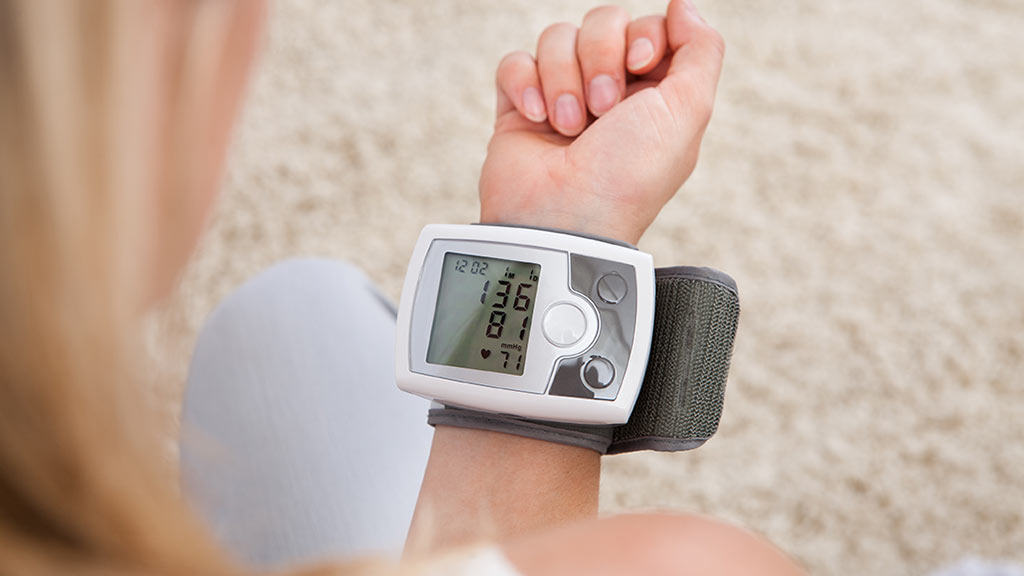
The majority of blood pressure monitors are the upper-arm cuff type, but we’re seeing an increase in wrist cuff models, which look a little bit like an overly chunky wrist watch. Despite not finding much difference in accuracy between upper arm and wrist cuff models when used exactly as directed, the medical community considers the wrist cuff models much less accurate so we don’t recommend them.
Arm cuff models typically also have a larger, easier to read display, though if you’re using an app-based monitor then it’s the same no matter what style you choose.
Why are wrist blood pressure monitors less accurate?
Wrist cuff models may be easier to put on (like a watch) but it’s harder to keep them at the required height for an accurate reading. Wrist blood pressure monitors are extremely sensitive to body position – your arm and wrist must be at heart level for an accurate measurement – that’s easy with an arm cuff as it’s the natural position of your bicep, but much harder to manage for your wrist.
Even with your wrist at the exact right elevation, measurements taken at your wrist are usually less accurate than those at your upper arm because arteries in your wrist are shallower and narrower, so you’re likely to measure a higher pressure.
Accuracy concerns aside, a wrist mount blood pressure monitor might be a better option for you if your arm is too big for a cuff or if you find blood pressure measurement at the upper arm uncomfortable.
Are blood pressure monitors covered by Medicare or private health insurance?
Unfortunately, the purchase of home blood pressure monitors does not qualify for a Medicare rebate. Some private health insurers will cover them under an extras policy, but it varies from provider to provider. You should check your policy documents to see what, if anything, you can claim.
How much does a blood pressure monitor cost?
Home blood pressure monitors cost somewhere between $29 and $370. While there are plenty of more expensive monitors available, there’s no real reason to pay more for home use and more expensive monitors may start to be targeted towards professional use.
While this sounds good, in practice they may actually be harder to use, as their cuffs may not be designed to be put on by yourself. The important thing is to find one which is accurate, and which you’re comfortable using. See our blood pressure monitor reviews for more information.
Features to look for in a blood pressure monitor
Cuff size
Upper arm style monitors generally come with a medium sized cuff as standard. While this will be suitable for the majority of users, if you’ve got exceptionally large or small arms then look for one which has different sized cuffs available. To find the right size cuff for you, measure your arm’s circumference halfway between your shoulder and elbow while standing with your arm hanging at your side. A circumference of 18–22cm requires a small cuff, 22–32cm requires a medium cuff, and above 32cm you’ll need a large cuff – but check the measurements against the manufacturer’s instructions on the product you intend to buy.
Wrist cuff monitors are usually one size fits all.
Display
Make sure the monitor’s buttons and display are easy for you to read and use. Upper arm cuff style monitors will generally have larger, easier to read displays than their wrist cuff counterparts. If your vision isn’t the best then you may even want to consider the Pharmacy Care monitor which speaks your results out loud, but it does become tiresome after a few uses.
Adjustable inflation level
The cuff has to be inflated to a level above the systolic blood pressure, but the automatic inflation setting might be a lot higher and it could be uncomfortable. Some models have an adjustable inflation level so you can program the pressure.
Memory with date and time stamps
Some monitors can store several recent date and time stamped blood pressure measurements, which may be useful for you and your doctor for identifying trends and patterns. Some blood pressure monitors also have separate memory storage for two users. It’s also worth noting that many app-based monitors will give you even better memory storage options, and may even integrate with other health-related apps (like Apple Health).
Blood pressure data averaging
Your true blood pressure is clinically defined as “the average level over prolonged periods of time”, so a monitor that can take a number of readings and average the results will give you a more accurate figure than just taking a single point, as blood pressure can vary up and down for any number of reasons, including the act of putting on the blood pressure cuff itself.
Mains power adapter
Some battery-run monitors can also operate from the mains power, but check that an adapter is supplied.
Irregular heart rate display
An on-screen alert if the monitor detects a disturbance in your heart rate.
Hypertension indicator
A hypertension warning on the screen is a good prompt to visit your GP.
Connected, Bluetooth and app-based monitors
App-based blood pressure monitors generally give you more and better data logging capabilities than the traditional standalone models, including a longer history, data manipulation and graphing, and often the ability to communicate with other health-based apps for more holistic monitoring of your vital signs.
App-based monitors generally don’t have their own displays, so you need to connect your phone via Bluetooth or Wi-Fi before you can take a quick measurement (which can be a hassle if your phone’s in the other room).
While there are many benefits to an app-based approach, having to pair your phone with your monitor adds a level of complexity to the process. If you and technology don’t exactly see eye to eye then you may be better off with a conventional standalone monitor.
Which blood pressure monitors work with Apple Health?
Apple Health is one of most popular apps in the iOS ecosystem, and if you’ve got an iPhone then there’s a good chance you’re already using it, as it’s installed by default on every iPhone. Apple Health tracks all of your health information, such as vital signs, medications, and health conditions, and it can also interface with compatible devices to track your blood pressure.
Combining this information with other health and biometric data makes the app a very useful tool for monitoring your overall wellbeing, so if you use Apple products and are considering a heart rate monitor, look for one that’s compatible with this powerful app. Don’t just assume that all connected/Bluetooth heart rate monitors will be though – many will be locked to their own proprietary systems, so it’s important to check the literature first.
Can blood pressure monitors be wrong, or give false readings?
Yes, and we’ve seen a wide variance of accuracy in testing home blood pressure monitors when measured against our hospital-grade reference monitor. But it’s not exclusively the fault of the monitor itself – there are a number of factors that can lead to incorrect readings, like recent physical activity, time of day, arm position or user error can all skew your results.
That means that home monitoring is more useful for identifying changes over time than measuring an absolute value, and you should aim to always measure your blood pressure at the same time of day, and under the same conditions to get the most accurate result.
How do you calibrate a blood pressure monitor?
When you first get your blood pressure monitor, take it to your GP to get it checked against a sphygmomanometer or your GP’s monitor so you know if it’s accurate. If not, then you may need to consult your manual for how to adjust its readings for error. Also, ask your doctor to check your technique to make sure you’re measuring your blood pressure correctly. Check out our 8-step guide to measuring your blood pressure.
Validation of blood pressure monitors to international standards
Because of the proliferation of blood pressure monitors, there has been an effort by some organisations to develop a validation criterion that amalgamates the British Hypertension criteria with others around the world into a single source. When shopping for a blood pressure monitor, you should check to see if the model has passed these international standard clinical tests.
We’ve started to list these in our test criteria and don’t recommend any blood pressure monitors that have not been validated, though we may still test some that aren’t. Regardless of whether your new blood pressure monitor is validated, we recommend you get it checked by your GP prior to use.
Do blood pressure monitors wear out?
After two or three years your blood pressure monitor might not be as accurate as it once was, so if yours is getting on a bit then it might be worth taking it with you on your next visit to the GP to see how it’s performing. You may need to recalibrate your monitor, or failing that it might be due for retirement. Over time, the air tubes and cuffs can also deteriorate and perish, but these are usually cheap and easy to replace.
Are blood pressure monitors allowed on planes?
You’ll have no problem taking your blood pressure monitor in your checked luggage. It’s worth checking with your airline whether you can take your blood pressure monitor as carry-on, but while low cabin pressure at altitude can affect blood pressure there’s really no reason why you would need to check your blood pressure mid-flight (unless you’ve been advised to do so by your doctor).
Also remember airlines have strict rules about the use of electronics on aircraft, so remember to switch your monitor to flight mode (if it has one) before boarding, and bear in mind you likely won’t be able to use any of the connected (Bluetooth or Wi-Fi) features.
Ashley worked at CHOICE from 2017–2024. He was Head of the whitegoods team.
You can find Ashley on LinkedIn.
Ashley worked at CHOICE from 2017–2024. He was Head of the whitegoods team.
You can find Ashley on LinkedIn.